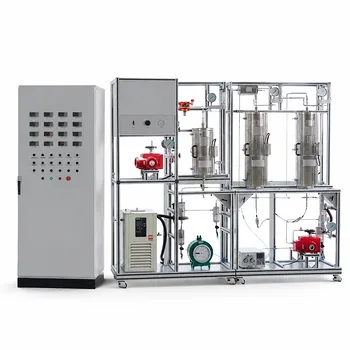
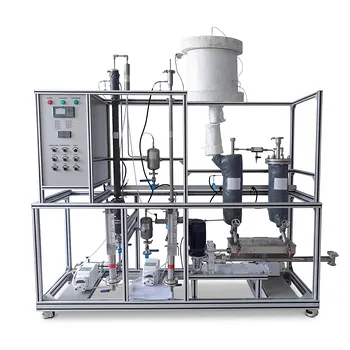
If your biodiesel transesterification yields are plummeting and you’re fighting stubborn soapy emulsions, your feedstock impurities are the invisible saboteurs. Water and free fatty acids (FFAs) are the two most devastating contaminants in alkaline-catalyzed biodiesel production. Once water exceeds just 0.2% by weight, it triggers triglyceride hydrolysis that generates additional FFAs. Those FFAs, already a problem above 0.5% by weight, immediately react with your alkaline catalyst to form soap—deactivating the catalyst, choking phase separation, and dragging glycerin into your ester layer. Pilot plants mitigate this by integrating pretreatment modules where you can test degumming, vacuum drying, and acid-catalyzed pre-esterification under real-world conditions, giving you hands-on data to design a resilient process.
Even trace levels of water and FFAs don’t just reduce yield—they initiate a self-amplifying chain of soap production that can turn an entire batch into an unbreakable emulsion. The only reliable defense is systematic feedstock conditioning, and pilot plants are the ideal proving ground for that conditioning strategy.
The Chemistry of Contamination: How Water and FFAs Sabotage Your Reaction
The Two-Threshold Problem
Alkaline transesterification has razor-thin tolerance limits. FFA levels must stay below 0.5 wt% because every fatty acid molecule consumes one base catalyst—typically sodium or potassium methoxide—in a saponification side reaction. This soaps up your catalyst, dramatically reducing the active species available to attack the triglyceride backbone.
Water, meanwhile, must be kept under 0.2 wt%. Even moderate moisture hydrolyzes triglycerides into diglycerides and new FFAs. Those freshly minted FFAs then compound the catalyst destruction. You end up with a vicious cycle: more soap, less catalyst, and a reaction mass that resists clean separation.
Why Soap Is More Than a Messy Byproduct
Soap doesn’t simply deplete your catalyst. It acts as a surfactant, stabilizing stubborn emulsions between the glycerin phase and the ester phase. This leads to longer settling times, higher methanol consumption, and severe product quality issues—high glycerin content, poor cold-flow properties, and out-of-specification biodiesel that fails the EN 14214 or ASTM D6751 standards.
The economic toll is immediate: lost yields, wasted chemicals, and intensive downstream washing that generates large volumes of wastewater.
From Lab to Pilot Scale: Why Pretreatment Is Non-Negotiable
Moving Beyond Beaker-Scale Testing
In a laboratory flask, you can stir in some acid or dry a sample in an oven. But biodiesel is a scale-sensitive process. Heat transfer, mass transfer, and separation dynamics change dramatically when you move from glassware to a pilot plant. Pilot units let you observe how pretreatment steps behave in a continuous or semi-continuous flow, revealing bottlenecks that bench experiments miss.
The Three Core Pretreatment Modules
Educational and research pilot plants address feedstock impurity challenges through modular pretreatment. Three complementary operations form the backbone of effective conditioning:
-
Degumming: Removes phospholipids that can also emulsify and foul downstream equipment. Phospholipids are especially problematic when working with crude oils. On a pilot scale, you can test acid or water degumming protocols and measure how residual phosphorus impacts catalyst efficiency.
-
Vacuum drying: Provides precise moisture control. A pilot plant’s heated vessel under vacuum strips water without exposing the oil to high temperatures that could cause oxidation. You can map exactly how drying time and temperature affect final moisture content and determine the minimum energy input required to stay below the 0.2 wt% threshold.
-
Acid-catalyzed pre-esterification: Converts FFAs into methyl esters before the main transesterification step. A strong acid catalyst (usually sulfuric acid) esterifies FFAs with excess methanol, effectively lowering the acid value of the oil. Running this in a pilot reactor lets you optimize parameters—acid loading, methanol-to-FFA ratio, residence time—and measure how consistently you can drive FFA below 0.5 wt% across multiple batches or during continuous operation.
Gaining Process Control Through Feedstock Variation
A pilot plant isn’t just for treating one neat oil. You can deliberately spike feedstocks with known amounts of water or FFAs to stress-test your pretreatment protocol. This reveals the failure limits of your process and builds a robust operating window. It also generates invaluable data for scaling up: you’ll know exactly how much catalyst to spike, what mixing intensity prevents soap gel formation, and how to adjust your post-reaction wash sequence.
Understanding the Trade-offs of Feedstock Conditioning
Every mitigation step carries a cost, and blindly adding all three modules can be counterproductive.
Acid-catalyzed pre-esterification demands excess methanol, which must be recovered or recycled, and introduces an additional separation step to remove the acid catalyst and water generated during the esterification. If not properly dried afterward, you can re-introduce moisture that cancels your gains.
Vacuum drying, while effective, adds capital expenditure and energy consumption. Over-drying certain oils can increase free radical oxidation, leading to polymers that form unwanted deposits in your reactor.
Degumming generates a phospholipid sludge that must be disposed of, and water-degumming can inadvertently leave behind trace moisture if the drying step isn’t sized correctly.
The art of feedstock conditioning is balancing these costs against the yield and quality benefits. A pilot plant is the only place where you can economically test trade-offs—for example, determining whether an aggressive pre-esterification step eliminates the need for a secondary vacuum drying, or whether a milder acid treatment combined with tight moisture control yields a better overall mass balance.
How to Apply This to Your Pilot Plant Strategy
The key is to design your pilot campaign around answering specific, risk-prioritized questions. Your feedstock impurity strategy shouldn’t be a one-size-fits-all checklist; it should be a response to the real variability in your supply chain.
-
If your primary focus is processing high-FFA waste oils (brown grease, trap grease, used cooking oil): Prioritize the acid-catalyzed pre-esterification module and run a series of experiments varying acid concentration and temperature until you consistently achieve an FFA content below 0.5 wt% while monitoring soap formation in the downstream transesterification step.
-
If your primary focus is establishing a repeatable process for refined, low-FFA oils that occasionally show batch-to-batch moisture spikes: Make vacuum drying your central investigation, mapping moisture reduction curves at different jacket temperatures and vacuum levels to define the most energy-efficient drying cycle that guarantees <0.2 wt% water.
-
If your primary focus is understanding the combined effect of phospholipids and impurities in crude degummed soybean or rapeseed oil: Start with a degumming step and follow it with both drying and pre-esterification, then systematically remove one module at a time to see where the most critical failure point lies. This reveals what you can simplify when scaling up.
Data from these targeted pilot runs turns feedstock variability from a liability into a manageable process variable, empowering you to write standard operating procedures that operators can follow with confidence.
Mastering the interplay of water and FFAs is what separates a temperamental lab curiosity from a robust, revenue-generating biodiesel plant—and your pilot facility is the classroom where that mastery begins.
Summary Table:
| Pretreatment Module | Target Impurity | Key Mechanism | Pilot Scale Benefit |
|---|---|---|---|
| Degumming | Phospholipids | Acid or water washing to remove gums | Evaluates phosphorus removal & prevents downstream fouling |
| Vacuum Drying | Moisture (Water < 0.2 wt%) | Thermal evaporation under vacuum | Optimizes energy use and prevents catalyst-deactivating hydrolysis |
| Acid-Catalyzed Pre-Esterification | Free Fatty Acids (FFAs > 0.5 wt%) | Conversion of FFAs to methyl esters using acid catalysts | Minimizes soap formation and defines optimal acid-to-methanol ratios |
Scale Up Your Biodiesel Process with LABPARK
Don't let feedstock impurities compromise your yields and process efficiency. LABPARK designs and provides high-quality Educational and Vocational Unit Operations Pilot Plants in chemical engineering, bioprocess & biotech, and environmental & water treatment. We empower universities, research institutes, and enterprises to master chemical synthesis, optimize feedstock pretreatment, and transition seamlessly from lab to industrial scale.
Ready to elevate your research or production capabilities? Contact our engineering experts today to find the perfect pilot plant solution for your organization!
Related Products
- Bio-fermentation Ethanol Production Practical Training Unit Operations Pilot Plant
- Continuous Batch Extractive Distillation Educational Pilot Plant
- Multi-Functional Special Distillation Educational Pilot Plant
- Natural Product Extraction Unit Operations Training Pilot Plant
- Green Anhydrous Ethanol Refining Practical Training Pilot Plant
People Also Ask
- Why Use PTFE & Hastelloy in Chemical Pilot Plants? Prevent Corrosion & Ensure Safety
- Why Compare Predicted and Experimental Excess Enthalpy? Key to Accurate Pilot Plant Scale-up
- Why is the chemical plant startup schedule crucial? De-risk scale-up with pilot plants.
- When to transition from PID to adaptive control in pilot plants? Key process indicators.
- Why must batch and fed-batch fermentation pilot plants be designed to accommodate changing rheological conditions?