Boiling heat transfer is a delicate balance of thermodynamics and surface physics. In pilot-scale evaporators and reboilers, increasing the operating pressure directly amplifies the boiling heat transfer coefficient by raising the liquid’s saturation temperature and thereby lowering its surface tension and viscosity. This physical change makes it easier for bubbles to nucleate, grow, and detach from the heating surface. At the same time, a rougher heating surface provides a higher density of active nucleation sites, which further intensifies boiling. However, these gains can be completely undermined if the surface becomes fouled, as even a thin deposit adds significant thermal resistance.
The boiling heat transfer coefficient in a pilot plant is not a fixed property—it is a dynamic outcome shaped by pressure-dependent fluid properties and surface micro-geometry. Mastering both factors enables you to deliberately enhance performance, but only if you also manage the inevitable counter-effect of fouling and the system-level constraints that come with higher pressures.
The Physics of Boiling Heat Transfer in Pilot Plants
How Pressure Elevates the Boiling Coefficient
When you increase the operating pressure in a boiling unit, the saturation temperature of the liquid rises. That rise changes two critical fluid properties: surface tension and viscosity both decrease. Lower surface tension reduces the energy barrier for bubble formation, while lower viscosity allows bubbles to grow and break away from the wall more rapidly.
The result is a denser population of active nucleation sites and more vigorous bubble agitation, both of which disrupt the thermal boundary layer. This translates directly into a higher boiling heat transfer coefficient—you transfer more thermal energy per unit area per degree of temperature difference. In a pilot-plant environment, this means you can achieve the same boiling duty with a smaller heat transfer area, and you can observe the effect in real time by manipulating the system back-pressure.
Why Surface Roughness Matters: Nucleation Sites
On a microscopic level, a heating surface is never perfectly smooth. Every scratch, pit, or grain boundary can trap a tiny pocket of vapor or gas, which acts as a pre-formed nucleus for bubble growth. A deliberately roughened surface provides orders of magnitude more of these potential nucleation sites than a polished one.
That higher site density enables nucleate boiling to initiate at a lower wall superheat and to sustain itself across a wider range of heat fluxes. For the researcher or pilot-plant operator, this means that surface finish is a design lever—choosing a surface with optimal roughness can shift the boiling curve into a more efficient regime. It is critical, however, to recognize that roughness characteristics can degrade over time due to oxidation, scaling, or deposition.
The Hidden Enemy: Fouling and Thermal Resistance
Fouling is the quiet performance killer in any pilot plant. Even if you optimise pressure and surface roughness, a fouling layer on the heat transfer side inserts an additional resistance in series with the boiling film coefficient. This extra resistance can rapidly dominate the overall heat transfer equation:
$$\frac{1}{U_o} = \frac{1}{h_o} + \frac{1}{h_{od}} + \frac{d_o \ln(d_o/d_i)}{2 k_w} + \frac{d_o}{d_i}\frac{1}{h_{id}} + \frac{d_o}{d_i}\frac{1}{h_i}$$
Here, the fouling resistances ($h_{od}$, $h_{id}$) sit directly alongside the convective film coefficients. A thin fouling deposit can easily reduce the overall coefficient by 30–50%, negating all the improvements gained from higher pressure or surface roughness. In educational pilot plants, monitoring $U$ over time is a classic method to observe fouling kinetics and to teach the importance of clean surface maintenance.
Understanding the Trade-offs
When Higher Pressure Becomes a Burden
Elevating pressure does not come for free. A higher operating pressure demands a stronger pressure vessel, thicker walls, and potentially higher-grade materials, which raises capital cost. On the process side, a higher pressure also means you are working at a higher saturation temperature; this can exceed the thermal stability limit of heat-sensitive products or organic solvents commonly handled in pilot plants.
Additionally, the energy to pump a pressurised system increases. While the boiling coefficient itself benefits from the lower surface tension, the total plant pressure drop on the steam or utility side must still be overcome. If the pressure drop constraint is exceeded, the desired flow rate—and therefore the heat duty—cannot be maintained. So the optimum pressure is a balance between enhanced boiling dynamics and mechanical-practical limits.
Balancing Roughness with Cleanability
A rough surface is a nucleation paradise, but it is also a fouling trap. The same cavities that promote bubble formation can shelter scale-forming solids, polymerised residues, or biological films. Once fouling begins, the roughness cavities become clogged, and the active nucleation site density plummets.
In a pilot plant that frequently switches chemical systems, excessive surface roughness may force you into a much more aggressive cleaning regime or a shorter runtime between cleanings. The practical compromise is to select a surface finish that gives a meaningful nucleation benefit without creating crevices so deep that they cannot be effectively cleaned via CIP (clean-in-place) protocols. This trade-off is a central discussion every time a new heat exchanger is designed for a multipurpose pilot skid.
Experimental Significance in Pilot Plant Education
Isolating the Boiling Contribution from Overall U
In laboratory and pilot-scale experiments, the boiling film coefficient is rarely measured directly. Instead, students measure the overall heat transfer coefficient ($U$) from (Q = U A \Delta T_m) and then use correlations or multi-step experiments to back-calculate the boiling-side coefficient.
For example, by varying the flow velocity on the non-boiling side and constructing a Wilson plot, one can extrapolate to the condition where that side’s resistance is negligible. The intercept then reveals the sum of the boiling-side film coefficient and the wall resistance. Such methods teach the fundamentals of thermal resistance networks and demonstrate exactly how a change in pressure or surface condition shifts the boiling contribution within the total $U$.
Connecting Roughness and Pressure to Dimensionless Analysis
The boiling coefficient can be correlated through dimensionless groups like the Nusselt, Reynolds, and a boiling-specific bubble departure Reynolds number. While these correlations are often empirical, they capture the key dependencies: the Nusselt number increases with lower fluid surface tension (a pressure effect) and with higher nucleation site density (a surface roughness effect).
In a jacketed stirred tank reactor operating with boiling on the jacket side, the same principles apply. The fluid dynamics within the jacket—influenced by geometry, baffles, and flow distribution—couples with the surface condition to determine the overall heat transfer rate. Pilot plants allow these variables to be changed systematically, turning abstract equations into observable phenomena.
Making the Right Choice for Your Pilot Plant Goal
The ultimate decision on pressure level and surface finish depends on what you are trying to achieve in your pilot unit.
- If your primary focus is maximizing heat flux for a given area: Operate at the highest allowable pressure that respects your material and product temperature limits, and specify a heating surface with a controlled, enhanced roughness to maximise active nucleation sites.
- If your primary focus is long, uninterrupted runs with minimal cleaning: Moderate the pressure increase and select a surface finish that is cleanable—smooth enough to resist fouling but with enough micro-texture to still promote nucleate boiling.
- If your primary focus is generating accurate scale-up data: Run experiments at multiple controlled pressures and with well-characterised surface finishes, and measure the boiling coefficient independently so you can decouple its behavior from other resistances when translating to production scale.
A pilot plant is not just a small production unit—it is a magnifying glass for physical phenomena. Used intentionally, the interplay between pressure and surface roughness becomes a teachable, tunable system that bridges directly from laboratory theory to industrial reality.
Summary Table:
| Factor | Impact on Boiling Heat Transfer | Key Trade-offs & Limitations |
|---|---|---|
| Operating Pressure | Increases coefficient by lowering surface tension and viscosity. | Higher structural costs; risk of degrading heat-sensitive fluids. |
| Surface Roughness | Enhances nucleate boiling by providing more nucleation sites. | Increases fouling susceptibility; harder to clean (CIP). |
| Fouling | Significantly reduces overall heat transfer coefficient ($U$). | Adds thermal resistance; requires regular maintenance & monitoring. |
Optimize Your Heat Transfer Research with LABPARK
Ready to bridge the gap between heat transfer theory and industrial reality? LABPARK provides state-of-the-art Educational and Vocational Unit Operations Pilot Plants in chemical engineering, bioprocess & biotech, and environmental & water treatment. Designed specifically for universities, research institutes, and enterprises, our systems allow you to precisely study and control complex thermal dynamics.
Contact LABPARK today to find the perfect pilot plant for your lab!
Related Products
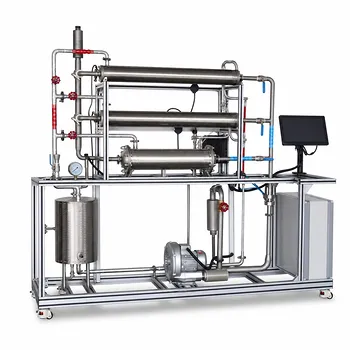
- Comprehensive Heat Transfer Coefficient Determination Educational Unit Operations Pilot Plant
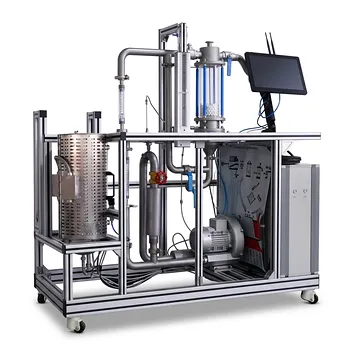
- Solid Spherical Heat Transfer Coefficient Determination Educational Chemical Engineering Pilot Plant
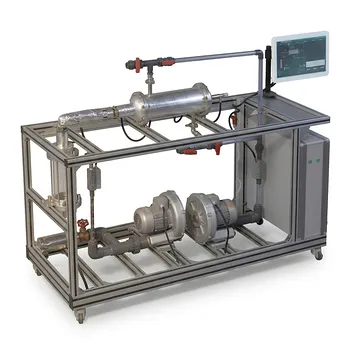
- Shell and Tube Heat Exchanger Heat Transfer Coefficient Determination Educational Pilot Plant
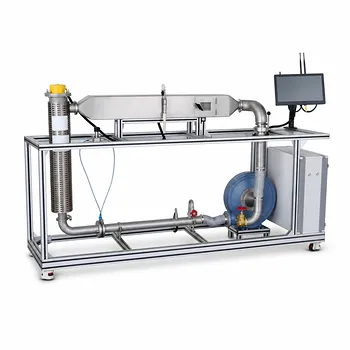
- Circulating Wind Tunnel Drying and Convective Heat Transfer Coefficient Determination Educational Pilot Plant
- Liquid-Liquid Mass Transfer Coefficient Determination Educational Pilot Plant
People Also Ask
- When is ε-NTU preferred over LMTD in pilot plants? Predict heat exchanger performance without iteration.
- How do unit conversions affect pilot plant calibration? Avoid errors in heat transfer data analysis
- Why is the prevention of scale formation on heat exchanger surfaces a critical learning objective? Key Lessons
- How does thermal conductivity affect pilot plant performance? Optimize heat transfer & accuracy
- What engineering trade-offs must students analyze in a heat transfer pilot plant? Balance performance & cost.