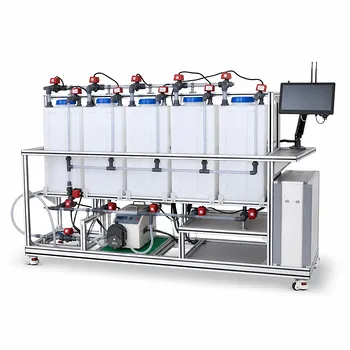
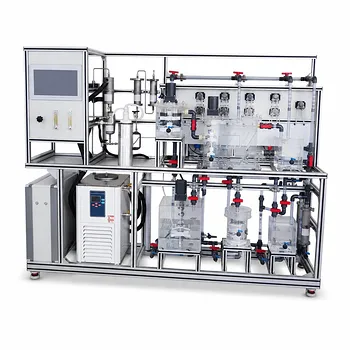
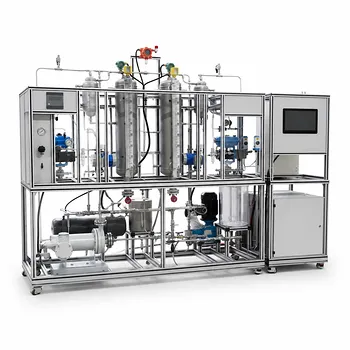
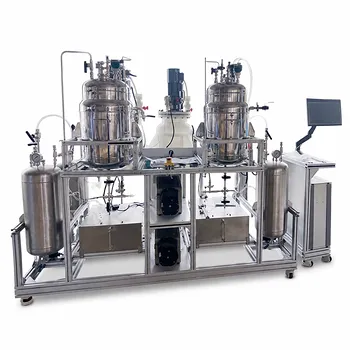
Pilot plants are the critical bridge between laboratory chemistry and full-scale industrial action. Environmental unit operations pilot plants facilitate the study of heavy metal and toxic compound removal by allowing researchers to configure and test actual separation technologies—like precipitation, ion exchange, adsorption, and membrane filtration—at a reduced but realistic scale. Within these systems, teams can precisely manipulate flow rates, pH, chemical dosing, and other variables to determine the exact operating recipe needed to meet discharge standards, something a beaker simply cannot provide.
The core value of a pilot plant lies in its ability to expose the chaotic, real-world variables that textbook equations ignore. It transforms removal from a theoretical possibility into a controlled, repeatable, and scalable engineering process by revealing the practical interplay of reaction kinetics, mass transfer, and equipment performance under continuous flow.
Bridging the Gap Between Theory and Industrial Reality
A laboratory test can prove that a chemical reaction removes copper from water. A pilot plant proves you can do it for 10,000 liters an hour without breaking the system.
From Solubility Product to Settling Tank
Textbook chemistry tells you that adding sulfide to copper-laden water will form highly insoluble copper sulfide (CuS, with a Ksp of $6.3 \times 10^{-36}$), causing it to fall out of solution. In a pilot plant, you learn that while the thermodynamics are correct, the speed and completeness of that precipitation depend heavily on mixing intensity, residence time, and the precise point where the precipitant is added. A poorly mixed tank leaves a portion of the copper untouched.
Simulating the Unseen: Coordination Chemistry in Action
Removal isn't always about simple precipitation. Heavy metals can form soluble complexes, like the deep blue tetraamminecopper(II) ion, ([Cu(NH_3)_4]^{2+}), when ammonia is present. In a pilot plant, you can deliberately adjust pH and ligand concentration to shift the coordination equilibrium, learning firsthand how complexation can mask a metal and sabotage a simple precipitation step, or conversely, how it can be exploited for selective separation.
Mastering the Key Unit Operations
Pilot plants are modular playgrounds for process engineers. They allow the assembly and testing of different treatment sequences to find the most effective combination for a specific wastewater.
Chemical Precipitation: Selective Removal by Design
This workhorse operation is brought to life in a pilot plant. By leveraging solubility differences, as demonstrated with manganese sulfide ((MnS)), you can achieve remarkable selectivity. Because (MnS) is more soluble than the sulfides of copper, lead, or cadmium, adding solid (MnS) to a mixed-metal stream triggers a precipitate conversion: the toxic heavy metals displace the manganese, forming solid (CuS), (PbS), and (CdS) while harmless (Mn^{2+}) ions go into solution. The pilot plant lets you operate the solid-liquid separation equipment—like filter presses or clarifiers—to physically isolate the hazardous solids from the cleaned water.
Ion Exchange and Adsorption: Polishing and Purity
For achieving ultralow concentrations, ion exchange columns and activated carbon adsorption units are unmatched. In a pilot plant, you don't just know they work; you generate breakthrough curves—live plots of outlet concentration versus time. These curves are the blueprint for designing a full-scale system, telling you exactly when a resin bed will be exhausted and how much regenerating chemical you will need.
Membrane Filtration: A Barrier Against the Microscopic
Membrane systems offer a physical barrier to contaminants, but they are famously sensitive to the water’s matrix. A pilot plant exposes the reality of membrane fouling, where colloids, organic matter, or precipitates coat the membrane surface, choking its performance under constant operating pressure. This is how you test pretreatment steps, cleaning protocols, and the true long-term cost of a membrane solution.
Controlling Critical Process Parameters
The insight a pilot plant provides is locked inside its operational data. Its value is the ability to manipulate and measure the variables that govern removal.
pH and Chemical Dosing as Precise Control Knobs
The pilot plant’s reaction vessels are wired for control. When neutralizing acidic wastewater with lime ((CaO)) or sodium hydroxide, real-time pH sensors and automated dosing pumps maintain a stable, compliant effluent pH. You can study the precipitation kinetics firsthand, watching how the rate of base addition affects the size and filterability of the resulting gypsum ((CaSO_4)) particles. This also opens the door to analyzing economic feasibility, such as generating a marketable byproduct like ammonium sulfate fertilizer when ammonia is used as the neutralizing agent.
Flow Dynamics and Residence Time
Removing a toxic compound is never instantaneous. The pilot plant forces you to reckon with residence time—how long the water must be inside a reactor or column for the reaction or mass transfer to complete. By varying the flow rate, you see the direct trade-off: run too fast and the reaction is incomplete, run too slow and your plant capacity is uneconomical.
Understanding the Trade-offs
No pilot plant study is complete without a clear-eyed assessment of what goes wrong. These systems are not magic; they reveal the inherent compromises in every treatment strategy.
The Scalability Trap
A perfect result in a 10-liter reactor is not a guarantee for a 10,000-liter tank. Mixing gradients, temperature differentials, and wall effects that are negligible at pilot scale can dominate at full scale. The pilot plant helps identify these scale-sensitive parameters so an engineer can design a larger system that accounts for them, rather than blindly multiplying the reactor volume.
Sludge and Brine Management
Most treatments that remove a toxic compound from the water simply concentrate it into another phase—like a metal-laden sludge from precipitation or a concentrated brine from ion exchange regeneration. A pilot plant quantifies this secondary pollution, forcing you to solve not just the removal problem, but the disposal problem, which often drives the total process cost.
Complex Waste Matrices
An industrial wastewater is never pure. Gas cleanup liquors, for example, can contain a cocktail of tarry organics, phenols, dissolved hydrogen sulfide, ammonia, and carbon. A single operation like an ion exchange column would be instantly fouled by the organics. Pilot plants show the necessity of pre-treatment steps—like gravity separation of light and heavy oils, or filtration of sub-micron solid particulates—before the heavy metal removal unit can even be attempted.
Making the Right Choice for Your Study
A pilot plant is an instrument of inquiry. What you configure it to study depends entirely on your primary goal.
- If your primary focus is selective heavy metal removal: Design your study around precipitation kinetics and sulfide reagent selection, using solubility product differences to achieve high-purity separations.
- If your primary focus is treating complex, mixed organic/inorganic waste: Start by testing physical separation and filtration steps, then stage multiple unit operations in series (e.g., sedimentation followed by adsorption) to build a resilient process flow.
- If your primary focus is meeting the strictest discharge limits: Concentrate your pilot work on ion exchange and membrane filtration, generating breakthrough curves and fouling data that define the operational and economic boundaries of the technology.
- If your primary focus is operational and economic feasibility: Use the pilot plant to quantify chemical consumption, sludge generation, energy use, and resin regeneration cost, translating "it works" into "it is affordable."
A textbook provides the map, but the environmental unit operations pilot plant gives you the scars, scars that prove you know how to navigate the terrain.
Summary Table:
| Unit Operation | Main Mechanism / Focus | Key Parameter Measured | Scale-up Challenge |
|---|---|---|---|
| Chemical Precipitation | Solubility product manipulation | pH & chemical dosing | Mixing gradients & sludge disposal |
| Ion Exchange & Adsorption | Polishing & high-purity removal | Breakthrough curves | Resin saturation & regeneration cost |
| Membrane Filtration | Physical barrier to microscopic toxins | Transmembrane pressure | Membrane fouling & pretreatment needs |
Bring Industrial-Scale Realism to Your Lab
Accelerate your research, teaching, and process development with LABPARK. We provide state-of-the-art Educational and Vocational Unit Operations Pilot Plants in chemical engineering, bioprocess & biotech, and environmental & water treatment.
Designed specifically for universities, research institutes, and enterprises, our systems allow you to accurately simulate scale-up effects, master complex waste matrices, and optimize treatment workflows.
Ready to transform theoretical chemistry into scalable engineering solutions? Contact LABPARK today to find the perfect pilot plant for your laboratory!
Related Products
- Solid Waste Pyrolysis and Refining Educational Pilot Plant for Unit Operations
- Dual-Mode Rectification Pilot Plant for Practical Training Unit Operations
- Electrochemical Water Treatment Educational Unit Operations Pilot Plant
- Thermal Desorption Exhaust Gas and Tail Water Treatment Educational Pilot Plant
- Continuous Batch Extractive Distillation Educational Pilot Plant
People Also Ask
- How do educational unit operations pilot plants bridge theory and design? Bridge the Engineering Gap
- How do educational unit operations pilot plants address safety and waste management when scaling up?
- When to transition from PID to adaptive control in pilot plants? Key process indicators.
- Why is the chemical plant startup schedule crucial? De-risk scale-up with pilot plants.
- Why Compare Predicted and Experimental Excess Enthalpy? Key to Accurate Pilot Plant Scale-up