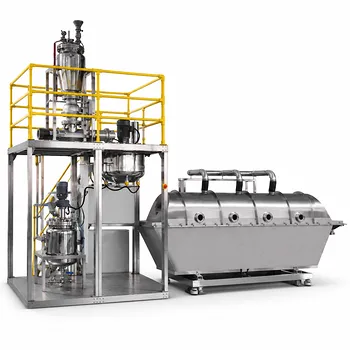
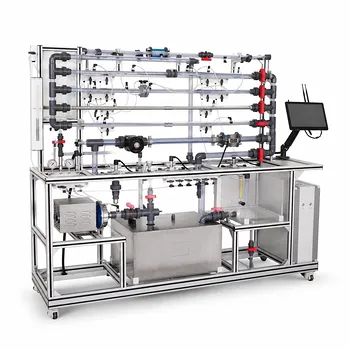
Direct observational capability combined with adaptable process control makes educational pilot plants irreplaceable for studying particle mechanics. In sedimentation, cyclone separation, and fluidized beds, these scaled-down systems transform theoretical equations into tangible, visual experiments. Students can directly manipulate flow rates, particle sizes, and geometries, then measure resulting particle trajectories, settling rates, separation efficiencies, bed expansion, and pressure drops—linking abstract force balances to concrete engineering design.
Educational unit operations pilot plants provide the missing link between mathematical models and industrial reality. By operating a controlled physical system, students observe two-phase solid-fluid dynamics firsthand, apply principles like Stokes’ law and fluidization mechanics, and gain the parameter-optimization skills essential for designing real separators and reactors.
Observing Dilute Systems: Sedimentation and Cyclone Separation
Dilute particle-laden flows reveal fundamental particle-fluid interactions without the complexity of particle-particle collisions. Pilot plants make these dilute systems transparent, measurable, and repeatable.
Applying Stokes’ Law in Sedimentation Tanks
A transparent sedimentation tank pilot plant lets students watch particles settle under the influence of gravity. By timing the descent of individual particles, they directly measure settling velocity.
Students then calculate the theoretical settling rate using Stokes’ law (for laminar flow) and force balances. Comparing measured and calculated values immediately reveals the impact of particle diameter, fluid viscosity, and density difference—no simulation can replicate the tactile proof of seeing a 50-micron particle behave exactly as the drag equation predicts.
Small discrepancies drive deeper inquiry. Students investigate the limits of Stokes’ law when particles are non‑spherical or when wall effects influence motion, building an engineer’s instinct for model applicability.
Analyzing Particle Trajectories in Cyclone Separators
A transparent cyclone pilot unit visualizes how centrifugal force separates particles from a gas stream. Students inject a particle-laden feed and observe the spiral motion that forces solids toward the wall while clean gas exits the center.
By varying inlet flow rate, they measure separation efficiency—the weight fraction of particles recovered. Plotting efficiency versus particle size produces a grade‑efficiency curve, directly connecting aerodynamic cut‑point theory to operational reality.
These pilot cyclones often include pressure taps. Students measure the pressure drop across the unit and discover the trade‑off between high separation efficiency and energy cost. This hands‑on optimization teaches that industrial cyclone design always balances capture performance against fan power.
Understanding Dense Systems: Fluidized Beds
When fluid drag suspends an entire bed of particles, the system transitions from dilute to dense. Pilot-scale fluidized beds make this transition observable, measurable, and controllable.
Visualizing Fluidization and Bed Expansion
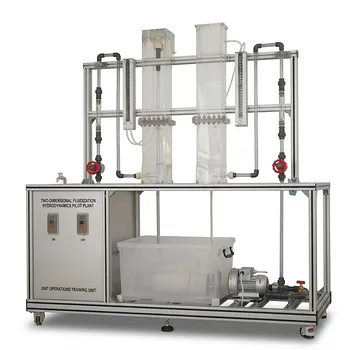
A glass‑walled fluidized bed column provides a direct view of the minimum fluidization velocity. As gas flow increases, students watch the fixed bed suddenly unlock—particles begin to move, and the bed height rises.
Measuring bed height versus superficial gas velocity allows them to calculate bed expansion and void fraction. They see firsthand how narrow particle size distributions fluidize more uniformly, while wide distributions lead to segregation and channeling. These visual insights cement the complex theory of fluid‑particle interactions.
Pressure Drop and Particle‑Particle Interactions
Manometers or pressure transducers connected along the column height reveal the characteristic pressure‑drop‑versus‑velocity curve. Students confirm that pressure drop rises linearly until minimum fluidization, then remains nearly constant—a clear demonstration of the fluid dynamic force balancing the bed’s weight.
In the dense phase, particle‑particle collisions dominate. Students observe bubble formation, coalescence, and particle mixing patterns, linking them to pressure fluctuations. These observations help explain why real fluidized beds deviate from ideal two‑phase theory, especially at high gas throughputs.
Residence Time Distribution and Reactor Design
A fluidized bed pilot plant can be configured as a reactor simulator. By injecting a tracer (e.g., a colored particle or a salt pulse) and measuring its concentration over time, students construct a residence time distribution (RTD) curve.
Comparing the measured RTD with ideal reactor models (plug flow, perfectly mixed) indicates the degree of backmixing or bypassing. This practical exercise directly supports industrial reactor design, where RTD determines conversion and selectivity, and teaches students that scaling up a fluidized bed requires preserving the right mixing pattern.
Bridging Theory and Industrial Reality
Beyond isolated particle mechanics, pilot plants teach engineers how to translate laboratory observations into actionable process knowledge.
Validating CFD Simulations with Physical Data
Computational fluid dynamics (CFD) models are only as good as their validation. Fluidized bed and cyclone pilot plants offer the physical data—pressure drops, phase distributions, and exit concentrations—needed to anchor simulations.
Students learn to compare CFD‑predicted velocity fields against visual observations and quantitative measurements. When simulation and experiment disagree, they must critically assess boundary conditions and turbulence models. This iterative loop between pilot‑plant reality and digital models is the core methodology of modern process design.
Identifying Critical Process Parameters (CPPs) for Optimization
By deliberately disturbing one variable at a time—gas flow rate, solids feed rate, or particle size—students identify which factors most strongly affect separation efficiency or bed stability. These are the Critical Process Parameters that must be tightly controlled in full‑scale plants.
Applying a simple Failure Mode and Effects Analysis (FMEA) on the pilot unit fosters a risk‑based mindset. Students learn to ask: What happens if the feed concentration suddenly drops? How would that affect cyclone grade‑efficiency or fluidized bed collapse? This proactive thinking bridges unit‑operations theory with industrial reliability engineering.
Understanding the Trade‑offs and Limitations
No pilot plant perfectly replicates its industrial counterpart. Acknowledging these limitations builds credibility and teaches crucial scale‑up lessons.
Scale‑Down Effects and Reynolds Number Mismatch
Pilot units operate at smaller diameters and lower flow rates, often yielding lower Reynolds numbers than full‑scale equipment. The resulting flow regimes—especially the vortex behavior in a cyclone or the bubble size in a fluidized bed—may not be fully representative.
Students must learn that directly scaling up a cyclone’s grade‑efficiency curve without accounting for these hydrodynamic differences can lead to over‑optimistic performance predictions.
Idealized Particle Assumptions vs. Real‑World Complexity
Educational pilots often use glass beads or uniform sand to provide clear, repeatable results. Industrial streams, however, contain cohesive powders, sticky agglomerates, or wide size distributions that behave very differently.
Students must recognize that the clean Stokes’ law settling they observed may not apply directly to flocculating biological slurries, and that fluidized beds processing Geldart C powders face channelling and plugging unseen with Geldart B glass beads.
Operator‑Induced Variability and Measurement Challenges
Hands‑on operation introduces variability. Slight differences in how a student times particle descent or adjusts a valve can blur the data. Additionally, simple visual measurements may not capture the full turbulent kinetic energy distribution.
While these challenges mirror real plant operation, they require careful experimental design and statistical thinking to extract meaningful conclusions.
Making the Right Choice for Your Educational Goal
How you use a pilot plant to study particle motion depends entirely on the learning objective. The same unit can serve very different purposes if the focus is adjusted accordingly.
- If your primary focus is fundamental understanding of particle-fluid forces: Maximize visual access and manual control. Choose simple, transparent sedimentation columns and cyclones where students can directly time settling rates and trace particle spirals, then quantitatively verify Stokes’ law and centrifugal force balances.
- If your primary focus is process design and scale‑up: Prioritize pilot units with comprehensive instrumentation—pressure transducers, flow meters, and online particle sizing. Use these to generate grade‑efficiency curves, pressure‑drop profiles, and RTD data that can be fed into scale‑up models, always highlighting the gap between pilot‑scale Reynolds numbers and industrial conditions.
- If your primary focus is developing computational validation skills: Operate the pilot plant as a physical twin of a CFD model. Deliberately change boundary conditions (e.g., inlet velocity profile) and compare predicted vs. measured separation efficiencies and flow patterns. Emphasize the iterative process of model refinement rather than perfect agreement.
- If your primary focus is operational reliability and risk assessment: Introduce controlled upsets—a sudden surge in solids loading or a partial blockage—and task students with performing an FMEA on the observed failure modes. Frame the experiment around identifying critical process parameters and defining safe operating windows.
Ultimately, educational unit operations pilot plants do more than demonstrate particle motion; they cultivate an engineer’s ability to question models, interpret real‑world data, and make confident design decisions.
Summary Table:
| Operation | Core Principles | Key Student Observations & Measurements |
|---|---|---|
| Sedimentation | Stokes' Law, Gravity Settling | Settling velocity, wall effects, particle trajectories |
| Cyclone Separation | Centrifugal Force, Drag | Separation efficiency, grade-efficiency curves, pressure drop |
| Fluidized Beds | Fluid-Particle Drag, Bed Expansion | Minimum fluidization velocity, void fraction, RTD, mixing patterns |
Bring Industrial Reality to Your Classroom with LABPARK
Are you looking to bridge the gap between complex engineering theories and hands-on practice? LABPARK provides state-of-the-art Educational and Vocational Unit Operations Pilot Plants in chemical engineering, bioprocess & biotech, and environmental & water treatment.
Designed specifically for universities, research institutes, and enterprises, our systems enable students to:
- Validate Mathematical Models: Move from equations (such as Stokes' law and fluidization mechanics) to direct physical observation.
- Master Process Optimization: Gain hands-on experience analyzing critical parameters like pressure drops, grade-efficiency, and residence time distribution (RTD).
- Connect Theory to Simulation: Generate real physical data to validate CFD models and analyze scale-up effects.
Elevate your educational and research capabilities today—contact our experts now to find the perfect pilot plant solution for your lab!
Related Products
- General Purpose Cosmetics Production Unit Operations Training Pilot Plant
- Multi Pump Fluid Transport Process Piping Unit Operations Training Pilot Plant
- Multi-Functional Drying Educational Unit Operations Pilot Plant
- Fixed-Bed Chemical Reaction and Gas Dust Tar Removal Unit Operations Pilot Plant
- 100L Continuous Loop Hydrogenation Educational Unit Operations Pilot Plant
People Also Ask
- How do deviations in estimating latent heat impact pilot plant thermal systems? Avoid hardware mis-sizing.
- Why is the chemical plant startup schedule crucial? De-risk scale-up with pilot plants.
- When to transition from PID to adaptive control in pilot plants? Key process indicators.
- Why Compare Predicted and Experimental Excess Enthalpy? Key to Accurate Pilot Plant Scale-up
- Why Use PTFE & Hastelloy in Chemical Pilot Plants? Prevent Corrosion & Ensure Safety