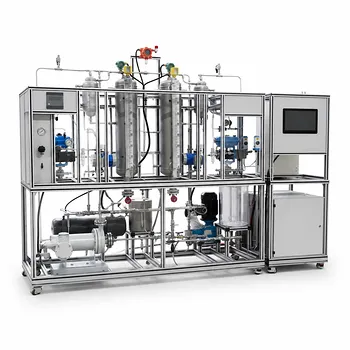
Dissolved salts are non-volatile solutes that dramatically reshape vapor-liquid equilibrium. They directly depress the vapor pressure of the solvents in a mixture, altering relative volatilities and, in many cases, breaking or shifting azeotropic boundaries. For pilot-plant catalyst recovery, this means that any distillation step designed without accounting for the salt effect can suffer from incorrect stage counts, off-spec purities, and wasted energy—precisely the kind of risk that pilot plants are meant to eliminate before scale-up.
Salt-induced vapor pressure depression turns a standard VLE problem into an electrolyte thermodynamics challenge. Catalyst recovery processes must therefore combine rigorous electrolyte models with hands-on pilot validation to avoid costly over- or under-design and to ensure robust, efficient separation.
The Science Behind Salt-Induced VLE Shifts
How Dissolved Salts Depress Solvent Vapor Pressure
When an electrolyte dissolves, its ions become strongly solvated by surrounding solvent molecules. This solvation reduces the number of solvent molecules that can escape to the vapor phase, lowering the partial pressure of each volatile component in proportion to the salt concentration. The effect is a direct manifestation of vapor pressure depression—the same principle that raises the boiling point of salted water—applied to every solvent in a catalytic reaction mixture.
Salting Out and the Shift in Relative Volatility
A dissolved salt often makes organic solutes less soluble in the liquid phase, a phenomenon known as “salting out.” This pushes the solute into the vapor phase and increases its relative volatility compared to a salt-free system. In catalyst recovery, that extra volatility can be an advantage: it can break a troublesome azeotrope between the product and the solvent, or sharply reduce the number of theoretical stages needed to reach a target purity.
The Electrolyte Effect on Azeotropes
Because a salt alters the fugacity of each component in the liquid phase, the composition at which an azeotrope forms can shift or disappear entirely. This is a critical alteration. A standard distillation designed on salt-free VLE data may fail to separate a product-solvent azeotrope, while a salt-filled system might achieve a clean split. For catalyst recovery, where the catalyst itself often supplies the salt, understanding this shift is what turns an impossible separation into a practical one.
Why This Matters for Catalyst Recovery in Pilot Plants
The Real Consequences of Ignoring Salt Effects
Chemical engineering pilot plants are expressly built to de-risk scale-up by confronting thermodynamic models with reality. If a process uses a homogeneous catalyst that is itself a dissolved salt (e.g., sodium hydroxide, sulfuric acid, a phase-transfer catalyst), the entire distillation train—from the reboiler to the condenser—must be sized and operated based on VLE data that includes that salt. Without it, design errors cascade: stages are under-counted, reflux ratios are miscalculated, and column diameter is mismatched to the actual vapor/liquid load.
Over-Design Versus Under-Performance
Historically, imprecise thermodynamics forced practitioners to over-design columns (extra trays, oversized heat exchangers, higher reflux) to compensate for uncertainty. In a catalyst recovery pilot plant, over-design wastes utilities and capital, but under-design is worse: a column that cannot achieve the required product purity because salt shifted the equilibrium will invalidate the entire pilot campaign. Salt effects make the safe middle ground narrower, demanding accurate predictions from the start.
Validating Electrolyte Models Under Real-Process Conditions
Computer simulations using electrolyte-capable thermodynamic packages (e.g., eNRTL or Pitzer-based models) can approximate salt effects, but these models are sensitive to parameter fitting and often struggle at high salt concentrations or with mixed solvents. Only a pilot plant run with the actual catalyst-laden process stream can confirm that bubble points, dew points, and flash splits match the model’s predictions. This validation closes the loop between theory and reliable commercial design.
The Duty of a Pilot Plant: Turning Theory into Safe Design
The Three Equilibrium Conditions in a Salt-Containing Stage
To achieve true vapor-liquid equilibrium on any tray or packing section, three conditions must hold simultaneously: thermal equilibrium ($T^L = T^V$), mechanical equilibrium ($p^L = p^V$), and chemical equilibrium ($\hat{f}_i^V = \hat{f}_i^L$ for each component). The presence of dissolved salt does not alter the thermal or mechanical equalities, but it profoundly changes the fugacity of every volatile component in the liquid phase. A VLE calculation that ignores this non-ideality will produce a fictional equilibrium state, leading to faulty tray efficiency estimates and incorrect reflux policies.
Mapping the Ternary Operating Window
In more extreme recovery schemes—such as high-temperature or supercritical solvent systems—the salt can shift the entire immiscibility boundary by more than 50 °C. For a pilot plant handling a H₂O‑CO₂‑NaCl-type stream (catalyst + solvent + product), failing to map these ternary boundaries can cause unintended phase splitting, precipitation, or equipment plugging. Pilot-scale mapping defines the safe, homogeneous operating window and averts catastrophic failures during later scale-up.
Common Pitfalls and Important Trade-offs
Model Breakdown at High Salt Loadings
Electrolyte models often lose accuracy once the salt molality becomes large, or when multiple salts are present. The errors can be on the same scale as the -47% to 96% variance in predicted condensed liquid seen in cryogenic systems when wrong K-value correlations are used. Relying on an unvalidated electrolyte model for a salt-heavy catalyst recovery can lead to a column that is either completely undersized or dangerously over-capacitated.
Corrosion and Solids Formation
Beyond thermodynamics, dissolved salts frequently cause corrosion or fouling when solvent compositions change across the column—conditions that pure VLE simulations never predict. Pilot-plant operation uncovers these practical hazards early, allowing material upgrades or washing protocols to be incorporated before the plant is built at production scale.
The Separation‑Energy Trade-off
Exploiting a salting‑out effect to break an azeotrope can dramatically improve product purity, but it often requires keeping the salt concentration high. This, in turn, may increase the still-bottom temperature, raise corrosion potential, and demand more heating duty. The pilot plant clarifies whether the improved recovery yield justifies the extra energy and metallurgy costs—a classic engineering trade-off that no simulation alone can resolve.
Making the Right Choice for Your Catalyst Recovery Pilot Plant
The path to a reliable, scalable design depends on your immediate goal. Use these guideposts to align your pilot-plant strategy with the reality of salt‑altered VLE.
- If your primary focus is accurate column design: Build your process simulation with a validated electrolyte thermodynamic package, then run at least one pilot distillation charged with the exact catalyst salt at target concentration to confirm key separation points.
- If your primary focus is troubleshooting an existing separation: Suspect salt effects whenever a column fails to meet purity targets despite operating at design conditions—measure actual tray compositions to see if relative volatility has shifted, and consider adjusting salt loading or introducing a solvent to reset the VLE.
- If your primary focus is preparing for scale-up: Never rely on salt-free VLE screening runs. Perform the pilot campaign using the real, recycled catalyst stream so that salt-induced azeotrope shifts, foaming, and fouling are all captured—and can be engineered out—before locking in the commercial design.
Salt-induced VLE changes are not a nuisance but a powerful lever; pilot plants that frankly address them produce catalyst recovery processes that are both thermodynamically honest and industrially robust.
Summary Table:
| Salt Effect on VLE | Impact on Catalyst Recovery | Pilot Plant Design Action |
|---|---|---|
| Vapor Pressure Depression | Depresses solvent vapor pressure; alters boiling points. | Implement electrolyte thermodynamic models (eNRTL/Pitzer). |
| Salting Out Effect | Increases relative volatility of organic solutes. | Optimize column stage counts and reflux ratios. |
| Azeotropic Shifting | Shifts or breaks standard product-solvent azeotropes. | Run pilot trials with real process fluids to validate VLE. |
| Phase Boundary Shifts | Can cause unintended phase splitting or precipitation. | Map ternary operating windows to avoid fouling and clogging. |
De-Risk Your Separation & Catalyst Recovery Scale-Up with LABPARK
Translating complex electrolyte VLE models into reliable industrial processes requires hands-on validation. LABPARK designs and manufactures premium Educational and Vocational Unit Operations Pilot Plants in chemical engineering, bioprocess & biotech, and environmental & water treatment.
Specially tailored for universities, research institutes, and enterprises, our pilot systems enable you to accurately map chemical equilibria, test actual catalyst-laden process streams, and eliminate costly scale-up design errors.
Ready to elevate your research and process engineering? Contact our technical experts today to find the perfect pilot plant solution for your laboratory or facility.
Related Products
- Potassium Salt Thermal Dissolution and Crystallization Separation Educational Unit Operations Pilot Plant
- Binary System Vapor Liquid Equilibrium Data Determination Educational Unit Operations Pilot Plant
- Liquid-Liquid Mass Transfer Coefficient Determination Educational Pilot Plant
- Two Phase Flow Pattern Velocity Resistance Measurement Educational Pilot Plant
- Ternary Liquid-Liquid Equilibrium Educational Pilot Plant
People Also Ask
- What are the benefits of integrating online PAT tools like ATR-FTIR into crystallization unit operations pilot plants?
- How do crystallization pilot plants improve student learning? Shift from manual observation to process control.
- Why is precise temperature control critical in crystallization pilot plants? Key to Scale-Up Success
- Control Crystallization Pilot Plant Secondary Nucleation: 4 Key Adjustments
- What key factors should be considered when configuring a crystallization unit operations pilot plant?