Temperature control is a battlefield, and your reactor’s internal geometry decides who wins. In a fixed bed, catalyst handling is a careful, batch-like affair with minimal particle wear, but heat builds up in dangerous pockets. A fluidized bed solves that heat problem by violently churning the catalyst, achieving near-perfect temperature uniformity at the cost of constant particle attrition and more complex solid recovery systems.
The core difference is a direct trade-off between thermal uniformity and catalyst longevity. Fixed-bed reactors keep the catalyst stable and relatively intact but struggle with heat removal, leading to hot spots. Fluidized-bed reactors continuously wear down their catalyst but deliver exceptional heat transfer and isothermal conditions, making them ideal for highly exothermic reactions where temperature control is critical.
How Catalyst Handling Diverges
The Life of a Particle: Attrition vs. Stability
In a fixed bed, catalyst pellets sit stationary, typically as larger particles (1–5 mm). This near-zero abrasion environment means catalyst wear is negligible; the bed stays intact for long runs. The trade-off is that when the catalyst eventually deactivates, replacement is labor-intensive—you must shut down, unload the packing, and reload fresh material.
Fluidized beds operate like a boiling liquid. Fine catalyst powder (often under 300 μm) is suspended by the gas stream, causing constant particle-to-particle and particle-to-wall impacts. This catalyst attrition is unavoidable, generating fines that can escape the reactor. To manage this, systems require high-strength catalysts and downstream separation units like cyclones or filters to capture and return elutriated solids.
Loading, Unloading, and Regeneration
Fixed-bed reactors demand manual, precise packing to avoid channeling and ensure uniform flow. Catalyst regeneration or replacement interrupts production entirely. In contrast, fluidized-bed designs allow continuous catalyst handling: fresh catalyst can be metered in during operation, and deactivated catalyst withdrawn, just like circulating a fluid. The ability to easily transfer particles between reaction and regeneration zones is a signature advantage, especially in processes where coke rapidly deactivates the catalyst.
Heat Transfer: The Defining Performance Variable
Why Fixed Beds Breed Hot Spots
Fixed-bed reactors suffer from inherently poor heat transfer. The relatively large catalyst particles have a low surface-to-volume ratio, and the catalyst itself often acts as a thermal insulator. In an exothermic reaction, heat generated at the active sites cannot escape quickly, creating localized hot spots—axially and radially—where temperatures can spike and permanently damage the catalyst or cause runaway reactions.
Mitigating this requires serious engineering: multi-tubular designs with heat exchange fluid surrounding narrow tubes, multiple adiabatic stages with inter-stage cooling, or quench systems that inject cold feed to suppress temperature rise. These solutions work, but they multiply the heat exchange surface area—often up to 10 times that of an equivalent fluidized bed.
The Fluidized Bed’s Thermal Uniformity
Fluidized beds are self-regulating thermal marvels. Violent particle motion constantly redistributes heat, resulting in a virtually uniform bed temperature. Any hot particle instantly shares its excess energy with the entire inventory. This gives heat transfer coefficients an order of magnitude higher than those in fixed beds, commonly reaching around 200 W/(m²·°C) in pilot-scale units. The result: no hot spots, even for strongly exothermic reactions like benzene or acrylonitrile synthesis.
This thermal advantage directly simplifies temperature control. Instead of complex multi-stage cooling, a fluidized bed often needs only internal heat exchange surfaces or moderate external cooling loops, because the bed itself acts as a superb heat transfer medium.
Pilot-Scale Reality Checks
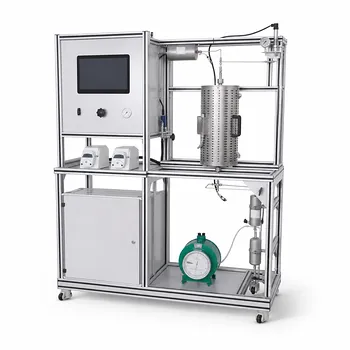
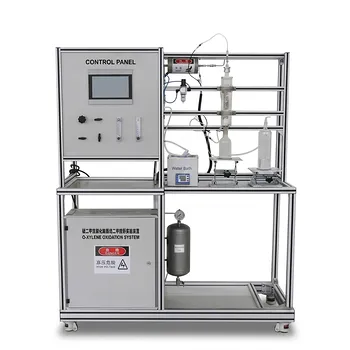
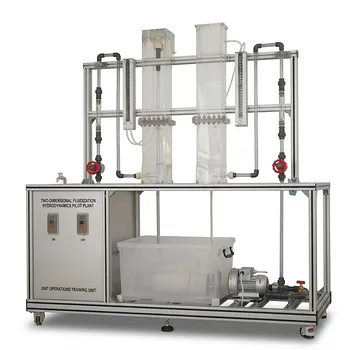
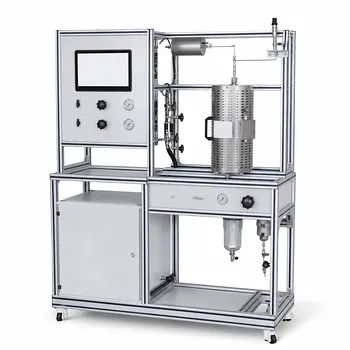
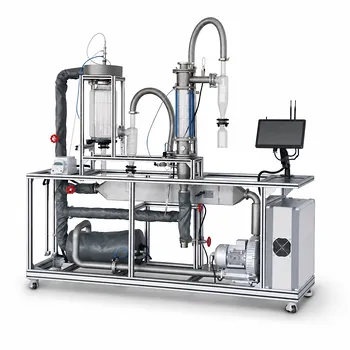
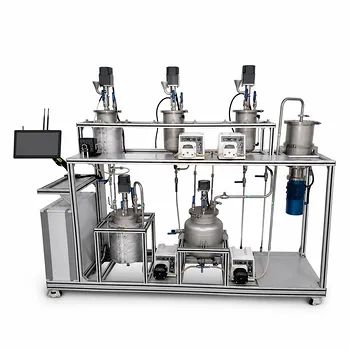
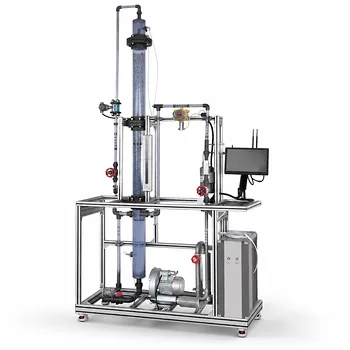
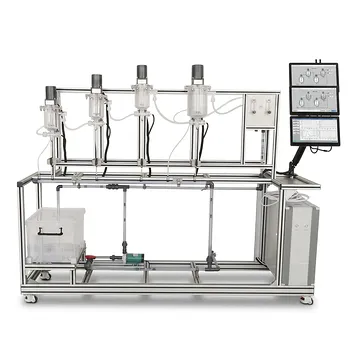
In educational or research pilot plants, these behaviors are immediately visible. A fixed-bed unit operated with a highly exothermic reaction quickly develops measurable axial temperature gradients, demonstrating the hot-spot challenge. Students can map these profiles across multiple insulated stages with intermediate utility streams. In a fluidized-bed pilot plant, the thermocouple readings stay remarkably flat, vividly illustrating the isothermal advantage. However, students also witness the attrition: fine powder accumulating in filter bags and the need for cyclone maintenance, driving home the operational cost.
Understanding the Trade-offs
When Uniformity Costs You Complexity
Fluidized beds might solve heat transfer, but they introduce backmixing. The intense solid circulation mixes reaction intermediates back into fresh feed, which can lower the selectivity of complex reaction networks. Fixed beds, by operating close to plug flow, push every packet of reactants through the same history, maximizing conversion per pass. Flow dynamics in fluidized beds are also notoriously complex to model and scale up—a challenge rich for study but a headache for production.
Catalyst Lifespan vs. Smooth Operation
Ease of catalyst exchange comes at a price. The constant attrition in fluidized beds forces you to spec harder, more expensive catalyst particles that resist fracture, and to continuously filter and recycle fines. Fixed beds let you use cheaper, mechanically fragile shapes, but they punish you with a slow, offline regeneration process. There is no free lunch.
Making the Right Choice for Your Unit Operation
Your specific reaction and what you’re trying to demonstrate will point directly to the right configuration.
- If your primary focus is tight temperature control for a highly exothermic reaction: Choose a fluidized-bed reactor. Its isothermal operation eliminates hot spots and protects sensitive catalysts, even though you’ll need to manage catalyst attrition and add solid recovery systems.
- If your primary focus is maximizing conversion and selectivity with a relatively mild thermal load: A fixed-bed reactor is your workhorse. Its plug flow behaviour and lack of backmixing give high per-pass yields, and minimal catalyst wear keeps operational costs low.
- If your primary focus is educational demonstration of transport phenomena: Use both. A fluidized-bed pilot plant vividly shows the benefits of intense mixing on heat transfer, while a staged fixed-bed unit teaches students how industrial engineers battle thermal gradients with inter-stage heating/cooling and multi-tubular designs.
There is no superior reactor, only the configuration that best matches the thermal demands, catalyst economics, and operational realities of your process.
Summary Table:
| Parameter | Fixed Bed Reactor | Fluidized Bed Reactor |
|---|---|---|
| Catalyst Wear | Negligible (Stationary pellets) | High attrition (Constant particle movement) |
| Heat Transfer | Poor (Prone to localized hot spots) | Excellent (Near-perfect thermal uniformity) |
| Catalyst Handling | Batch-like (Requires manual loading/unloading) | Continuous (Easy to feed and regenerate online) |
| Flow Behavior | Near-plug flow (Maximizes conversion) | Backmixing (Can affect reaction selectivity) |
Optimize Your Chemical Engineering Lab with LABPARK
Are you looking to bring these critical reactor transport phenomena to life for your students or research team? LABPARK designs and manufactures high-performance Educational and Vocational Unit Operations Pilot Plants in chemical engineering, bioprocess & biotech, and environmental & water treatment.
We help universities, research institutes, and enterprises bridge the gap between theory and industrial reality with safe, robust, and highly instrumented pilot systems.
Ready to upgrade your lab or training facility? Contact our engineering experts today to discuss your specific curriculum or research requirements!
Related Products
- Multi-Reactor Educational Pilot Plant for Reaction Engineering Unit Operations
- Multi Functional Catalytic Reaction and Reactor Evaluation Educational Unit Operations Pilot Plant
- Fluidized Bed Gas Solid Catalytic Reaction Educational Pilot Plant
- Fixed Bed Gas Solid Catalytic Reaction Educational Pilot Plant
- Fixed-Bed Chemical Reaction and Gas Dust Tar Removal Unit Operations Pilot Plant
People Also Ask
- How do educational unit operations pilot plants address safety and waste management when scaling up?
- How do educational unit operations pilot plants bridge theory and design? Bridge the Engineering Gap
- Why Compare Predicted and Experimental Excess Enthalpy? Key to Accurate Pilot Plant Scale-up
- How to study gasification in pilot plants? Compare exit gas composition & efficiency
- Why Use PTFE & Hastelloy in Chemical Pilot Plants? Prevent Corrosion & Ensure Safety