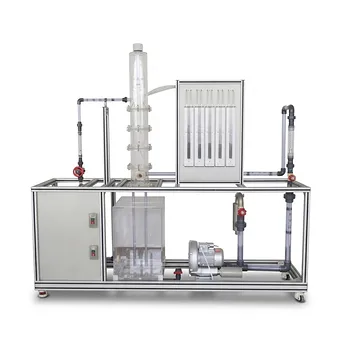
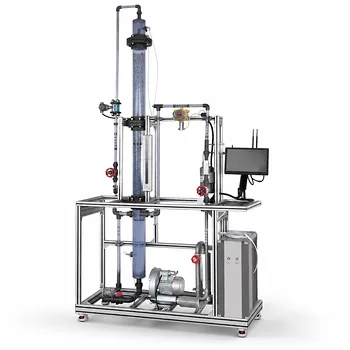
In agitated extraction columns, the core design choices—stator geometry, impeller type, and internals—determine how effectively a unit disperses droplets, suppresses backmixing, and handles changing conditions. The Scheibel column packs alternating turbine impellers and wire mesh to dramatically boost local mass transfer, but its packing can restrict flow and cause coalescence headaches. The Oldshue‑Rushton uses compartmentalized baffles and radial turbines to slash axial mixing, yet its performance becomes temperamental at larger scales. In contrast, the Rotating Disc Contactor (RDC) relies on simple flat discs for shear, delivering remarkably stable operation, high throughput, and forgiving control—making it an ideal workhorse for teaching basic extraction principles in pilot plants.
While all three columns use mechanical agitation to enhance mass transfer, the Rotating Disc Contactor (RDC) stands out for pilot‑plant teaching thanks to its simple, robust design and insensitivity to speed changes; the Scheibel excels at demonstrating intensified mass transfer with its integral packing; and the Oldshue‑Rushton offers a clear window into compartmental hydrodynamics and the delicate balance of backmixing suppression—at the expense of challenging scale‑up behavior.
How Each Design Works
Scheibel Column: Packed Turbine Agitation
The Scheibel column combines two distinct internal sections. Stages of turbine impellers actively disperse one liquid into the other, while intervening layers of wire mesh packing provide additional surface area and promote coalescence‑redispersion cycles.
This alternating arrangement intensifies local mass transfer compared to open agitated zones. However, the mesh packing is a double‑edged sword—it can restrict overall fluid flow and, paradoxically, cause poor droplet coalescence that narrows the stable operating window.
Oldshue‑Rushton: Compartmentalized Backmixing Control
The Oldshue‑Rushton column is built around vertical stator rings that divide the shell into discrete compartments. Inside each compartment, a Rushton‑type flat‑blade turbine imparts strong shear, while horizontal baffle plates between compartments suppress fluid back‑flow along the column axis.
This compartmentalized design is engineered explicitly to limit axial mixing—the primary enemy of counter‑current efficiency. Every detail, from stator‑ring clearance to baffle geometry, aims to force the phases to move stage‑wise, making the column a precision instrument for studying hydrodynamic segregation.
Rotating Disc Contactor (RDC): Simple Disc Shear
The RDC strips the internals down to bare essentials. A central rotating shaft carries a series of flat, unshrouded discs. As these discs spin, they generate a shear field that tears the dispersed phase into fine droplets, with no packing, no baffle plates, and no discrete compartments.
This mechanical minimalism yields a large free cross‑sectional area for phase flow and makes the resulting drop‑size distribution remarkably insensitive to minor changes in rotor speed. The column runs stably across a wide range of conditions with very high throughput.
Key Performance Differences
Mass Transfer and Droplet Dispersion
The Scheibel column generates intense local mixing thanks to its alternating impeller‑packing stages. The mesh promotes repeated droplet break‑up and surface renewal, often yielding high mass transfer coefficients in short column heights.
The Oldshue‑Rushton achieves strong dispersion through its compartment turbines, but the ultimate mass transfer efficiency is dominated by its ability to virtually eliminate axial mixing. The RDC produces a softer, more uniform shear field. While its peak local transfer rates may be lower, its stable drop‑size distribution sustains efficient counter‑current contact over long lengths.
Axial Mixing and Flow Control
Axial mixing is the parameter where these designs diverge most sharply. The Oldshue‑Rushton actively fights it with sealed compartments and horizontal baffles, delivering the closest approach to true plug flow. The RDC, with its open architecture, tolerates a degree of backmixing, but its gentle, even agitation keeps it within acceptable bounds. The Scheibel sits between the two: the mesh packing sections interrupt backmixing somewhat, but they cannot match the compartmental isolation of the Oldshue‑Rushton.
Sensitivity to Operating Conditions and Scale
Scale‑up sensitivity is a critical differentiator for pilot plants. The Oldshue‑Rushton is highly sensitive to agitation speed changes at larger column diameters; a small RPM variation in a tall column can drastically alter compartment hydrodynamics and separation efficiency. The RDC is far more forgiving—its dispersion effect shows low sensitivity to rotor speed variations, so performance remains stable even as flows or RPMs wander. The Scheibel is moderately sensitive, but the hydraulic restriction from the mesh creates additional nuisance at high throughputs.
Throughput and Operational Stability
The RDC offers the highest throughput of the three and the steadiest operation over prolonged runs. Its open disc design handles a broad range of phase ratios without flooding. The Scheibel column can suffer from flow restrictions and intermittent coalescence problems at higher loadings, limiting its turndown ratio. The Oldshue‑Rushton, while precise, demands careful tuning of agitation speed and phase rates to maintain clear compartment interfaces, which can complicate long‑term pilot campaigns.
Suitability for Chemical Engineering Pilot Plants
Teaching Fundamental Extraction Principles
For a student lab where the goal is to demonstrate how agitation creates contact, the RDC is the standout choice. Its simple design makes cause‑and‑effect relationships transparent—increase rotor speed and see smaller droplets, with virtually no risk of an unstable, flooding column. Students can focus on concepts like mass transfer driving force and flooding velocity without fighting a finicky machine.
Research in Mass Transfer Kinetics
If the research objective is to decouple mass transfer coefficients from axial mixing effects, the Oldshue‑Rushton provides the most precise tool. Its near‑ideal stage‑wise flow allows accurate determination of intrinsic transfer rates. The Scheibel column is valuable for investigating the impact of packing‑promoted coalescence‑redispersion on overall efficiency, a topic highly relevant to reactive extraction.
Demonstrating Scale‑up Challenges
Pilot plants often serve to preview industrial‑scale pitfalls. The Oldshue‑Rushton becomes a powerful teaching case for scale‑up sensitivity—showing how a design that works beautifully in a 50‑mm glass column can behave erratically when the diameter triples. The RDC, by contrast, teaches the value of robust, low‑sensitivity equipment in process development.
Understanding the Trade‑offs
The Cost of High Local Mass Transfer in the Scheibel
The wire mesh that boosts the Scheibel’s local mass transfer also introduces hydraulic restriction and coalescence challenges. In a pilot plant running real process streams, even sparse surface fouling on the packing can rapidly degrade performance. This makes the Scheibel better suited for short‑term demonstration runs with clean model systems than for extended, hands‑off operation.
The Scale‑Up Pitfall of the Oldshue‑Rushton
The very compartments that kill backmixing create severe scale‑up non‑linearities. Clearance ratios, baffle thickness, and turbine power input that work perfectly at laboratory scale may generate dead zones or excessive shear at pilot scale. Without meticulous geometric similarity and extended tuning, a pilot‑scale Oldshue‑Rushton can severely underperform.
When Simplicity Can’t Fully Replace Intensification
The RDC’s forgiving nature comes at a trade‑off in local mass transfer intensity. For extremely low interfacial tension systems or when a reaction must happen on a short contact time, the gentler shear of a disc may not provide sufficient surface area. In such cases, a more aggressive internal—like packing or a compartment turbine—might still be required.
Making the Right Choice for Your Pilot Plant
Your decision should be driven by the primary learning or research goal the pilot plant must serve.
- If your primary focus is teaching extraction fundamentals with robust, low‑maintenance operation: Choose the Rotating Disc Contactor. Its simplicity and stability let users observe cause‑and‑effect without being sidetracked by equipment troubles.
- If your primary focus is studying packing‑enhanced mass transfer and coalescence‑redispersion cycles: Select the Scheibel column. It offers the most dramatic demonstration of how internals can intensify local performance.
- If your primary focus is investigating compartmental hydrodynamics and precisely controlling axial mixing: Opt for the Oldshue‑Rushton. It is the definitive design for isolating backmixing effects, provided you are prepared for careful scale‑up tuning.
Ultimately, matching the column’s design trade‑offs to your pilot‑plant’s educational or research mission transforms a simple extraction rig into a vivid teaching platform and a sharp research instrument.
Summary Table:
| Column Design | Key Internals | Mass Transfer | Stability & Throughput | Primary Pilot Plant Use |
|---|---|---|---|---|
| Scheibel | Turbine impellers + wire mesh | Very High | Moderate (flow restriction) | Studying coalescence cycles |
| Oldshue-Rushton | Stator rings + flat turbines | High (low axial mixing) | Low (highly speed-sensitive) | Researching compartmental flow |
| RDC | Simple flat rotating discs | Moderate | High (forgiving & stable) | Teaching extraction fundamentals |
Optimize Your Unit Operations Lab with LABPARK
Equip your students and researchers with industry-grade experimental setups. LABPARK provides premium Educational and Vocational Unit Operations Pilot Plants in chemical engineering, bioprocess & biotech, and environmental & water treatment.
Whether you are a university upgrading your teaching lab, a research institute studying mass transfer kinetics, or an enterprise scaling up chemical processes, we deliver robust, high-performance systems tailored to your curriculum and research goals.
Contact LABPARK today to discuss your pilot plant requirements and get a professional consultation!
Related Products
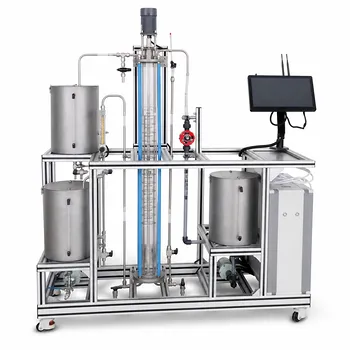
- Educational Rotary Disc Liquid-Liquid Extraction Pilot Plant
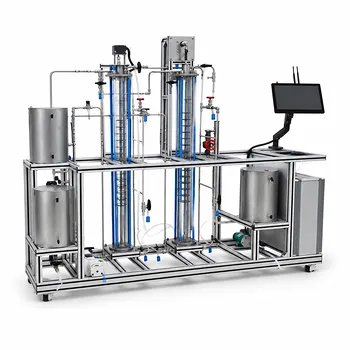
- Comprehensive Liquid-Liquid Extraction Pilot Plant for Engineering Education
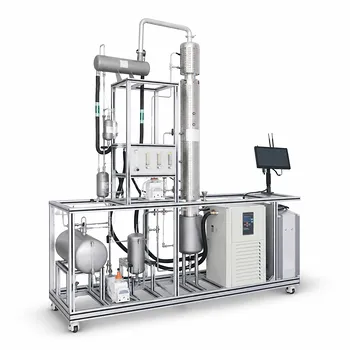
- Continuous Batch Extractive Distillation Educational Pilot Plant
- Multi-Functional Special Distillation Educational Pilot Plant
- Continuous Sieve-Plate Distillation Pilot Plant for Unit Operations Laboratory Education
People Also Ask
- In a liquid-liquid extraction pilot plant, how is a ternary-phase diagram utilized to determine solvent feed requirements?
- How are ternary phase diagrams and LLE data applied in extraction experiments? Optimize Pilot Plant Scale-up
- How Do Selectivity & Distribution Coefficients Influence LLE Pilot Plant Solvent Choice?
- How to Validate BIPs for LLE Pilot Plants? Steps to Align Simulations with Reality
- How do students utilize triangular phase diagrams in liquid-liquid extraction pilot plants? Master Ternary Analysis