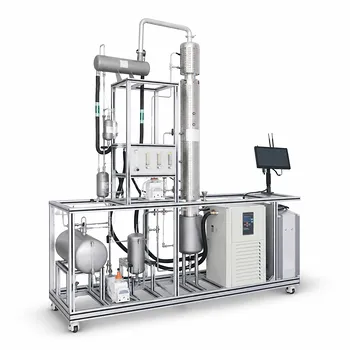
Bridging the gap between a laboratory bench and a full-scale factory isn't just about size—it's about confronting physics. Chromatography unit operations pilot plants are the critical educational tool that makes this tangible. They provide hands-on experience with the physical principles that are invisible in small glass columns, demonstrating how column packing, flow distribution, and pressure dynamics dictate purification success at scale.
While lab experiments prove a separation is possible, a chromatography pilot plant reveals how to make it reliable and profitable. The core lesson is that scale-up is not a simple multiplication; it’s a fight to maintain uniform fluid dynamics as the complexity of column hardware, fluid management, and process economics increases exponentially.
The Foundational Principle of Chromatography Scale-Up
The first conceptual leap a student makes in a pilot plant is that scale-up is geometric, not linear. The goal is to increase volumetric throughput while preserving separation quality.
Constant Bed Height, Expanding Diameter
In theory, chromatographic scale-up maintains a constant bed height and linear flow rate. The primary reference confirms this: increasing capacity involves widening the column diameter and proportionally increasing the bed volume. A pilot plant makes this theory concrete, showing students why a 20cm diameter column presents challenges a 1cm lab column never does.
The Illusion of Similarity
Without pilot plant experience, an engineer might assume a larger column behaves just like a small one. The pilot plant shatters this illusion. It demonstrates that the physics of fluid flow change dramatically at scale, turning abstract equations into risky realities.
Confronting the Three Hidden Challenges of Scale
The deep educational value of a chromatography pilot plant comes from the physical problems it forces users to solve—problems that are non-existent in the lab.
The Struggle for a Perfect Packed Bed
The primary reference highlights that column packing complexity increases at larger scales. In a lab, packing a small column is straightforward. In a pilot plant, achieving a uniform packing density is a skilled operation. Students learn firsthand that poor packing leads to channeling, where mobile phase finds a path of least resistance, bypassing the stationary phase and destroying resolution.
The Hidden Role of Column Hardware
A lab column is a simple glass tube. A pilot column is a precision piece of engineering. Students discover that flow distribution systems, screens, and headplates are critical. They see how poorly designed inlet headers can create jets of fluid that disturb the top of the bed, causing immediate separation failure. The hardware becomes as important as the resin itself.
The Onset of Pressure Drop Problems
Modern rigid resins, with protein loading exceeding 30 g/L and high operating pressure tolerance, are essential for commercial efficiency. A pilot plant lets students push these resins to their limits, managing the increased pressure drop across a tall, wide bed. They learn to balance high throughput against the structural integrity of the column and the compressibility of the resin, a critical economic calculation.
From Univariate Purity to Multivariate Process Signatures
A lab scientist focuses on a single endpoint: purity. A process engineer, trained on a pilot plant, looks at a multidimensional space.
Replicating a Process Path, Not Just an Outcome
The supplementary reference introduces a sophisticated concept: students learn that scale-up requires mapping product quality in a multivariate space. It’s about replicating the entire process signature—tracking mass and energy balances, temperature profiles, and pressure changes over time. This shifts the mindset from static quality to dynamic process control.
Validating Models with Real-World Data
Pilot plants, equipped with sensors and data systems, become testbeds for mathematical models. Students learn to use historical data and latent variable methods to predict how parameters must change in a site transfer. They discover that flow rate and gradient slope on a skid must be adjusted to compensate for differences in system dwell volume, a variable that doesn't exist in lab science.
Detecting Long-Term Deactivation
A lab experiment runs for hours. A commercial column runs for weeks. A pilot plant bridges this temporal gap by enabling continuous, closed-loop operations. Students observe phenomena like catalyst coking or the accumulation of recalcitrant impurities in recycle streams—chronic showstoppers that an acute lab experiment would never reveal.
Understanding the Trade-offs
Scale-up is an exercise in compromise. Pilot plant experience teaches that you can’t optimize everything at once.
Throughput vs. Resolution
The economics of production reward speed. A pilot plant makes the trade-off between high volumetric throughput and baseline separation perfectly clear. Students learn to find the exact point where faster flow rates in an overloaded column begin to sacrifice yield and purity, directly hitting the bottom line.
Theoretical Stages vs. Wall Effects
In a narrow lab column, wall effects can actually stabilize packing. In a wide pilot column, they are an insignificant portion of the bed. Students learn that the number of theoretical stages is not perfectly scalable; the ratio of column diameter to particle diameter matters, and poor packing in a large column creates a heterogeneous flow profile that no theoretical model can fully salvage.
Cost vs. Control
Adding precise feed-back controls and automated fraction collection, as mentioned for transitioning TLC to preparative column chromatography, increases a pilot plant’s cost. Students must justify this investment, learning that the value of detailed residence time distribution data and precise gradient control is a direct insurance policy against failed commercial batches.
Making the Right Choice for Your Learning Goal
How you approach a pilot plant study depends entirely on the core objective, whether it's demonstrating a production model or researching a novel process.
- If your primary focus is proving a manufacturing process: Obsess over reproducibility. Focus your pilot plant work on developing a standardized column packing protocol (e.g., flow pack, dynamic axial compression) and robust quality control metrics for the packed bed, then verifying consistent elution profiles over multiple cycles.
- If your primary focus is investigating a complex, multi-step purification: Use the pilot plant to map the process signature. Focus less on absolute purity in one run and more on understanding how the impurity profile shifts in the multivariate space over time, especially when recycling fractions or solvents.
- If your primary focus is transferring a legacy process to a new site or scale: Concentrate on the system's extra-column volume and its effect on the gradient. The key pilot plant task is to decouple the inherent separation power of the resin from the physical delay and dispersion of the fluid path on the skid itself.
Mastering scale-up is ultimately about mastering control over invisible forces, and the pilot plant is the only place where that critical skill can be safely—and affordably—developed.
Summary Table:
| Parameter | Lab Scale | Pilot/Commercial Scale | Key Challenge |
|---|---|---|---|
| Column Packing | Simple, manual packing | Highly complex, automated protocols | Achieving uniform packing density; avoiding channeling |
| Column Hardware | Simple glass tubing | Precision engineered headplates/screens | Ensuring even flow distribution across wide beds |
| Pressure Dynamics | Minimal pressure drops | High pressure drops, resin compression | Balancing throughput with resin/system structural limits |
| Process Focus | Univariate purity | Multivariate process signatures | Replicating dynamic mass, energy, and temperature profiles |
Bridge the Gap from Lab to Industrial Scale with LABPARK
Ready to equip your students and engineers with the practical skills needed for real-world chemical and bioprocess scaling? LABPARK provides state-of-the-art Educational and Vocational Unit Operations Pilot Plants tailored for universities, research institutes, and enterprises.
Our advanced pilot plants in chemical engineering, bioprocess & biotech, and environmental & water treatment simulate true industrial conditions, allowing users to master flow distribution, pressure dynamics, and complex process control.
Transform your training and research capabilities today. Contact us now to discuss your pilot plant needs!
Related Products
- Continuous Sieve-Plate Distillation Pilot Plant for Unit Operations Laboratory Education
- Multimodal Absorption and Desorption Pilot Plant for Unit Operations Training
- Multi Functional Membrane Crystallization Educational Unit Operations Pilot Plant
- Dual Mode Heat Transfer Pilot Plant for Unit Operations Training
- Multi-Reactor Educational Pilot Plant for Reaction Engineering Unit Operations
People Also Ask
- How to select the right activity coefficient model (Wilson, NRTL, UNIQUAC) for distillation pilot plants?
- Why is vacuum operation capability an essential feature for a distillation unit operations pilot plant? Unlock Efficiency
- What are the primary reflux ratio control strategies? Master Distillation Unit Operations
- How can real-time carbon number prediction improve distillation pilot plants? Optimize control.
- How does catalyst water concentration affect distillation pilot plant design? Key separation train choices.