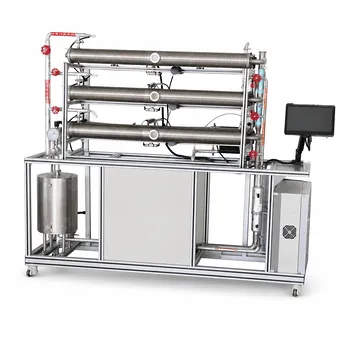
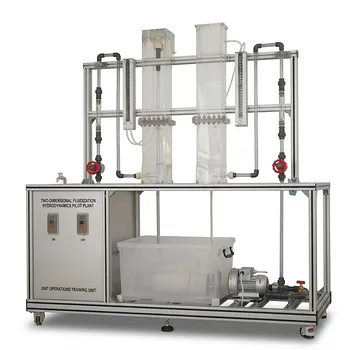
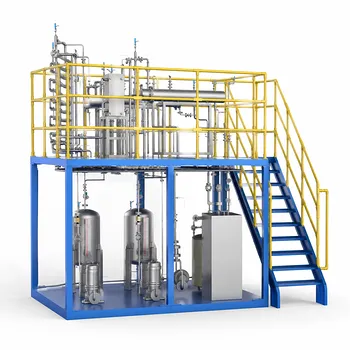
Hands-on pilot plants transform abstract pressure optimization into a concrete engineering puzzle. Unit operations training systems allow students to physically compare single-pressure and dual-pressure process configurations—most famously in nitric acid production. By running experiments that mimic industrial flow schemes, students directly measure conversion efficiency, product acid concentration, compressor power draw, and equipment footprint. These tangible data points turn the thermodynamic and economic trade-offs from textbook abstractions into an experiential, decision-based learning moment.
Single-pressure processes simplify equipment but sacrifice reaction efficiency or product quality; dual-pressure schemes optimize each step but add compressor cost and complexity. Unit operations pilot plants let students quantify these trade-offs—seeing how thermodynamics drive the choice and economics shape the final design—turning a theoretical abstraction into a hands-on optimization challenge.
Bridging the Gap: Why Pilot Plants Are Essential
The Theory–Practice Disconnect
In traditional curricula, thermodynamics and kinetics are taught through abstract formulas. Economics often arrives as a separate discipline. Students rarely see how these forces collide until they face a real process.
Unit operations pilot plants bridge this gap. They provide a scaled-down industrial environment where manipulating temperature, pressure, and flow yields measurable outcomes. This experiential approach forces students to integrate energy balances, reaction yields, and cost considerations in real time.
The Pressure Dilemma as a Perfect Teaching Vehicle
Few problems illustrate the theory–practice collision better than the nitric acid pressure dilemma. Ammonia oxidation is more efficient at lower pressures. Yet NO₂ absorption into water to form acid is highly favored at high pressure. A single-pressure plant forces a compromise; a dual-pressure plant tailors conditions to each step.
This binary choice—single vs. dual pressure—contains all the essential engineering tensions: thermodynamic equilibrium, kinetic rates, capital cost, and operating expense. Training systems that replicate these schemes let students explore the trade-offs directly.
The Single-Pressure vs. Dual-Pressure Experiment
Configuring the Pilot Plant
A typical training system can simulate or physically replicate both process modes. In the single-pressure configuration, the entire loop—reactor and absorber—operates at a uniformly high pressure. In the dual-pressure configuration, a low- or medium-pressure reactor is followed by a compressor, which then feeds a high-pressure absorption column.
Students work with the same chemistry and throughput. The only variables are the pressure staging and the presence of the inter-stage compressor. This isolates the effect of pressure strategy.
Gathering Thermodynamic Data
Conversion efficiency drops as reactor pressure rises—students measure this directly by analyzing reactor off-gas composition at different setpoints. At the same time, they can quantify the acid concentration leaving the absorber. At higher absorption pressure, the product acid is stronger and requires less downstream concentration effort.
These measurements vividly demonstrate Le Chatelier’s principle. The oxidation reaction’s volume change makes it thermodynamically unfavored at high pressure, while the absorption step’s equilibrium shifts favorably. Students see the theoretical curves manifest as real numbers on a control panel.
Measuring Economic Indicators
The dual-pressure setup introduces a compressor between stages. Students log the compressor’s power consumption under varying pressure ratios. They can then calculate the energy cost per ton of acid produced and compare it to the single-pressure case, where no inter-stage compression is needed.
They also assess equipment footprint. The dual-pressure train typically includes an extra compressor, separate vessels, and more piping—visible, countable items on the pilot skid. This allows a rough capital cost comparison. The trade-off crystallizes: energy and capital versus yield and product quality.
Beyond Nitric Acid: A Universal Teaching Framework
The Catalytic Reforming Analogy
The same pilot-plant logic applies to other pressure-sensitive processes. In catalytic reforming, higher hydrogen partial pressure suppresses coke formation on the catalyst but thermodynamically limits the conversion of naphthenes to valuable aromatics. Using a reforming pilot plant, students can adjust reactor pressure and the hydrogen-to-feed ratio.
They observe exactly how pressure shifts the balance between catalyst stability and aromatics yield—another real-world trade-off that textbooks present as static equilibrium curves. Running the experiments transforms these curves into decision tools.
This demonstrates that the pedagogical value of unit operations training systems is not confined to a single chemical. It’s a platform for teaching the universal skill of navigating conflicting thermodynamic and economic forces.
Understanding the Trade-offs in Pilot-Scale Learning
The Limitations of Scale-Down
Pilot plants are not miniature replicas of full-scale units. Heat losses are proportionally larger, compressor efficiencies may differ, and fluid dynamics can scale non-linearly. Students must learn to distinguish between intrinsic chemical effects and scale-induced artifacts. Otherwise, they risk over-extrapolating their data.
The Danger of Single-System Thinking
A pilot plant that focuses only on nitric acid can inadvertently teach that the single/dual-pressure trade-off is unique to this chemistry. Effective curricula use multiple systems (like the reforming example) to show that the underlying principle—thermodynamic conditions that favor one step may harm another—is universal. This broadens the engineering mindset.
Safety and Operational Constraints
Training systems operate within safe pressure bands, limiting how far students can push toward the extremes found in industry. The trends they see are correct, but the absolute values are compressed. Instructors must highlight how real industrial designs negotiate these extremes with different materials and safety margins.
Making the Right Choice for Your Learning Goals
How you spend your time on the pilot plant should align with what you want to master.
- If your primary focus is thermodynamics: Use the pilot plant to map conversion versus pressure curves for each reaction step. Verify how equilibrium constraints manifest and validate Le Chatelier’s principle with hard data.
- If your primary focus is energy economics: Concentrate on compressor power measurements. Calculate the energy cost per kilogram of product and compare how pressure staging shifts that number.
- If your primary focus is capital investment: Inventory the equipment pieces in each configuration. Discuss how the added compressor and absorber sizing affect plant cost and plot space, then weigh those against yield gains.
By turning abstract optimization into a tangible experiment, unit operations training systems equip future engineers with the intuition to navigate the intricate balance between thermodynamics and economics—an invaluable skill for any process designer.
Summary Table:
| Feature | Single-Pressure Configuration | Dual-Pressure Configuration |
|---|---|---|
| Equipment Complexity | Lower (no inter-stage compressor) | Higher (includes compressor & extra piping) |
| Reaction & Yield Efficiency | Sub-optimal (forced compromise) | Optimized (customized pressure per step) |
| Energy & Operating Cost | Lower power consumption | Higher due to compressor operation |
| Product Concentration | Lower output concentration | Higher, high-quality concentration |
| Capital Footprint | Smaller, compact skid | Larger footprint, extra vessels |
Empower the Next Generation of Chemical Engineers with LABPARK
Bridge the gap between abstract thermodynamic theory and industrial reality. LABPARK designs and manufactures premium Educational and Vocational Unit Operations Pilot Plants in chemical engineering, bioprocess & biotech, and environmental & water treatment.
We help universities, research institutes, and enterprises deliver hands-on, decision-based learning that prepares students for real-world engineering challenges.
Ready to elevate your laboratory’s training capabilities? Contact LABPARK today to discuss your custom pilot plant requirements!
Related Products
- General Purpose Cosmetics Production Unit Operations Training Pilot Plant
- Multi Pump Fluid Transport Process Piping Unit Operations Training Pilot Plant
- Multi-Functional Drying Educational Unit Operations Pilot Plant
- Fixed-Bed Chemical Reaction and Gas Dust Tar Removal Unit Operations Pilot Plant
- 100L Continuous Loop Hydrogenation Educational Unit Operations Pilot Plant
People Also Ask
- Why is the chemical plant startup schedule crucial? De-risk scale-up with pilot plants.
- How do deviations in estimating latent heat impact pilot plant thermal systems? Avoid hardware mis-sizing.
- When to transition from PID to adaptive control in pilot plants? Key process indicators.
- Why Compare Predicted and Experimental Excess Enthalpy? Key to Accurate Pilot Plant Scale-up
- Why Use PTFE & Hastelloy in Chemical Pilot Plants? Prevent Corrosion & Ensure Safety