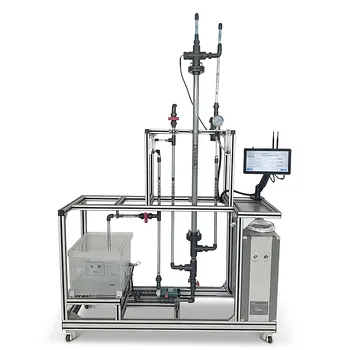
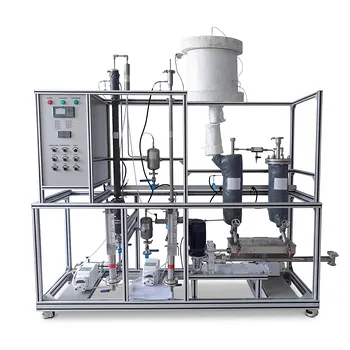
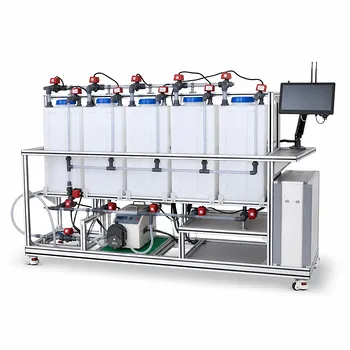
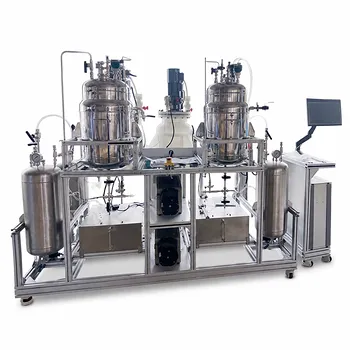
The secret to safe pilot-scale chlor-alkali production lies in a meticulously controlled physical separation. Chemical engineering educational pilot plants prevent the dangerous mixing of chlorine gas and sodium hydroxide by replicating an industrial diaphragm cell. A porous physical barrier, combined with a steady hydraulic flow of brine, continuously sweeps the caustic cathode product away from the chlorine-generating anode. This ensures that the two highly reactive streams are collected through entirely separate paths before they can recombine.
The defining challenge of the chlor-alkali process is that its two valuable products—chlorine and caustic soda—instantly destroy each other. Educational pilot plants solve this by using a diaphragm and gravity-driven flow to create a selective, one-way ion migration, physically pushing the hydroxide away from the chlorine. The result is a safe, continuous, and observable simulation of an industrial mainstay.
The Two-Product Problem: Why Mixing Must Be Prevented
The Reactions at Each Electrode
In the electrolysis of aqueous sodium chloride (brine), two distinct and valuable products form at opposite electrodes. At the anode, chloride ions (Cl⁻) are oxidized into gaseous chlorine (Cl₂). Simultaneously, at the cathode, water is reduced to produce hydrogen gas (H₂) and hydroxide ions (OH⁻)—the base that forms sodium hydroxide (NaOH) with the remaining sodium ions.
Immediate Recombination Risks
If the chlorine and hydroxide ions were to meet, they would react spontaneously and dangerously. This back-reaction generates a cascade of unwanted by-products, including sodium hypochlorite (ClO⁻, bleach) and sodium chlorate (ClO₃⁻). The reaction not only consumes electrical current with zero net product formation but also creates a significant safety and purity hazard. In a pilot plant, this would instantly ruin the students’ material balance and produce a hot, corrosive mixture.
The Industrial Mimic: Diaphragm Cell Principles for Education
A Physical Barrier as a Selective Gate
The core solution, replicated from historical Nelson cell designs, is a permeable diaphragm. This is typically an asbestos-like or modern polymeric porous material, or an insulating layer placed against a perforated cathode. The barrier sits between the two electrodes, allowing electrical current to pass via ion movement but physically restricting the bulk mixing of the liquid electrolytes.
Controlled Flow: The Hydraulic Sweep
The pilot plant does not rely on the barrier alone. Gravity-driven flow continuously feeds fresh, saturated brine into the anode compartment. The hydraulic head is precisely set so that the liquid seeps slowly through the diaphragm toward the cathode at a rate just fast enough to sweep hydroxyl ions backward. This unidirectional flow effectively carries OH⁻ away from the chlorine zone before they can meet. It is a hydrodynamic shield, not just a porous wall.
Separate Product Collection Paths
With the sweep established, the products are piped away from completely different zones. Chlorine gas bubbles up and is collected from a sealed headspace above the anode, while the sodium hydroxide solution (enriched with unreacted brine) overflows from a separate liquid take-off in the cathode compartment. There is no shared pipe or vessel where they could mix.
Pilot Plant Scale & Modular Unit Operations
Raw Brine to Pure Products in a Single Skid
Educational pilot systems are organized into modular unit operations. The chlor-alkali module is typically preceded by a brine purification skid (removing calcium and magnesium hardness) and followed by downstream separation columns. This modular design allows students to change a single cell variable—such as flow rate or temperature—and trace its impact on final chlorine purity.
Real-Time Monitoring and Student Learning
Students actively measure side reactions to understand the diaphragm’s limits. By analyzing the chlorine stream for oxygen contamination, they observe that some hydroxide ions inevitably migrate to the anode, where they are oxidized to oxygen. This is a direct demonstration of cell selectivity being less than 100%. They can then lower the feed brine pH or adjust the anode surface to suppress these parasitic reactions, linking cell conditions to product quality.
Understanding the Trade-offs
Diaphragm Efficiency vs. Product Purity
No diaphragm is perfect. A small fraction of OH⁻ ions will always back-diffuse against the hydraulic flow, forming hypochlorite and chlorate. This means the caustic soda output from a diaphragm pilot plant is always contaminated with some salt, requiring a later concentration and separation step. This trade-off of lower-purity NaOH for a robust, easily observable separation mechanism is a key learning outcome.
The Critical Operating Window
Flow control is everything. If the brine feed rate is too slow, the hydraulic sweep falters and dangerous mixing occurs. If it is too fast, the caustic product becomes excessively dilute, reducing process efficiency. Students learn to find and maintain the narrow pressure and level difference needed for stable, safe operation—a core lesson in process dynamics.
Why Not a Membrane?
While advanced industrial plants use ion-exchange membranes that are perfectly selective for sodium ions, many educational pilot plants stick with the diaphragm. A diaphragm’s simpler construction and the visible liquid flow make the separation physics tangible. The membrane’s near-invisible separation can obscure the mechanical and hydraulic principles that a diaphragm demo lays bare.
Making the Right Choice for Your Pilot Plant Curriculum
If your primary focus is fundamental separation physics: Ensure the rig includes a transparent or accessible diaphragm chamber so students can observe the brine flow and verify that the liquid level gradient drives the protective sweep.
If your primary focus is process control and optimization: Instrument the system to trend both chlorine purity (via oxygen sensors) and the caustic stream’s salt content, challenging students to run experiments that map feed pH and flow rate against by-product formation.
If your primary focus is safety demonstration: Use the plant to collect a real-time gas sample with an O₂ analyzer showing a rise the moment brine flow is intentionally slowed, reinforcing the direct link between operational discipline and hazard prevention.
Empower your students to see separation not as a static filter, but as a dynamic, hydraulic battle that makes continuous chlor-alkali production possible.
Summary Table:
| Key Mechanism | Technical Function | Educational & Operational Value |
|---|---|---|
| Porous Diaphragm | Physical barrier between anode and cathode | Prevents direct bulk mixing of chlorine and sodium hydroxide. |
| Hydraulic Sweep | Gravity-driven brine flow from anode to cathode | Conveys hydroxide ions away from the anode to prevent back-reaction. |
| Separate Outlets | Independent gas headspace and liquid overflow | Ensures safe, separate collection of Cl₂, H₂, and NaOH. |
| Process Controls | Adjustable feed pH, flow rates, and levels | Allows students to optimize cell selectivity and observe purity trade-offs. |
Bring Real-World Process Dynamics into Your Chemical Engineering Lab
Teaching complex chemical separations requires equipment that is both highly educational and safe. LABPARK provides premium Educational and Vocational Unit Operations Pilot Plants in chemical engineering, bioprocess & biotech, and environmental & water treatment tailored for universities, research institutes, and enterprises.
Our industrial-grade pilot systems allow students to dynamically monitor, control, and optimize processes like chlor-alkali production in a controlled environment.
Ready to elevate your training curriculum? Contact LABPARK today to discuss your laboratory requirements!
Related Products
- Multi-Reactor Educational Pilot Plant for Reaction Engineering Unit Operations
- Multi-Functional Special Distillation Educational Pilot Plant
- Fixed Bed Gas Solid Catalytic Reaction Educational Pilot Plant
- Carbon Dioxide Hydrogen Methanol Synthesis Educational Unit Operations Pilot Plant
- Fixed-Bed Chemical Reaction and Gas Dust Tar Removal Unit Operations Pilot Plant
People Also Ask
- How do educational unit operations pilot plants address safety and waste management when scaling up?
- How do educational unit operations pilot plants bridge theory and design? Bridge the Engineering Gap
- Why Compare Predicted and Experimental Excess Enthalpy? Key to Accurate Pilot Plant Scale-up
- How to study gasification in pilot plants? Compare exit gas composition & efficiency
- Why Use PTFE & Hastelloy in Chemical Pilot Plants? Prevent Corrosion & Ensure Safety