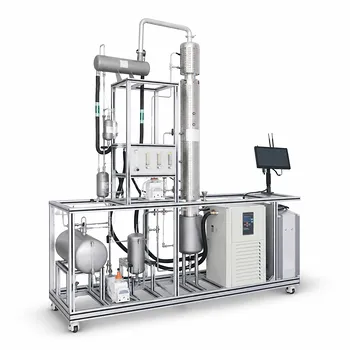
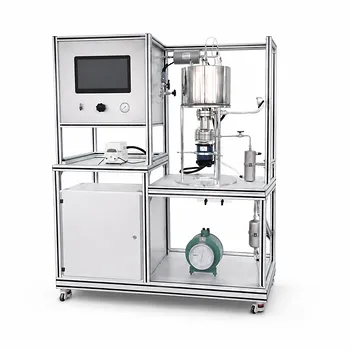
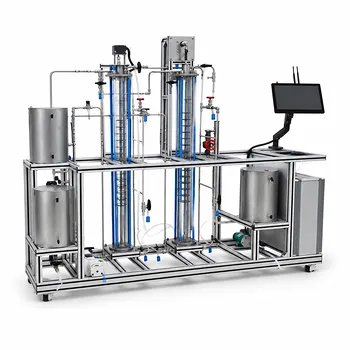
The core of any chromatography pilot plant’s educational and research value lies in how it teaches the art of separation. In chemical engineering and biotechnology pilot plants, gradient elution is used to gently sweep complex samples by continuously increasing the mobile phase’s strength, while step elution applies sudden, discrete jumps in elution power. Both are utilized to mimic real-world production processes, allowing trainees to systematically compare separation speed, peak resolution, solvent consumption, and product purity on the same automated platform.
For training and research, the true operational benefit is not just learning two techniques, but gaining the ability to optimize a process end-to-end. Automated programmable systems let users switch between gradient and step modes to directly measure trade-offs—like how much solvent you save with steps versus how much resolution you gain with a smooth gradient—and then calculate key metrics like solute recovery rate and product purity from the resulting data.
The Core Chromatography Challenge in Pilot Plants
Pilot plants are scaled-down versions of industrial separations. Their goal is to teach fundamental principles while producing meaningful quantities of purified material. The challenge is always the same: how do you separate every component in a mixture with the least time, solvent, and waste?
Why a Single Isocratic Run Fails for Complex Mixtures
In a fixed mobile phase composition, early peaks can be sharp, but later-eluting compounds broaden dramatically. This peak tailing makes it impossible to recover pure product and creates overlapping detection signals. For training, this limitation forces students to confront the need for gradient control.
How Pilot Plants Replicate Industrial Reality
Modern pilot-scale chromatography skids are equipped with multi-solvent delivery systems and precise, computer-controlled mixing. This lets them execute both linear gradient profiles and instantaneous step changes. The hands-on experience with these systems directly translates to operating large-scale biopharmaceutical or fine chemical purification plants.
Gradient Elution: Precision for Complex Mixtures
In gradient elution, the mobile phase’s elution strength is ramped up slowly over time—for example, by linearly increasing the organic solvent concentration in reversed-phase HPLC or the salt concentration in ion-exchange chromatography.
How the Gradient Narrows Peaks and Saves Time
As the mobile phase becomes stronger, the capacity factor (k) of each analyte drops. Late-eluting molecules, which would otherwise spend too long stuck to the stationary phase, are swept off the column more quickly. This compresses their peak widths, overcomes tailing, and dramatically shortens the total separation time.
The Hands-On Learning Value of a Gradient Profile
Students can adjust the slope and shape of the gradient (linear, convex, concave) and immediately see how each affects resolution. A shallow gradient may separate critical pairs better but consume more solvent. A steep gradient cuts run time but can push peaks together. This real-time cause-and-effect training is impossible with theoretical charts alone.
Step Elution: Speed and Simplicity in Purification
Step elution uses discrete changes in mobile phase composition. You might wash the column with 20% solvent to elute unbound impurities, then jump directly to 40% to collect the target product in a single sharp band.
Where Step Elution Shines in a Pilot Plant
Because step elution eliminates long ramp times, it requires less total solvent and yields a highly concentrated product pool. This makes it the method of choice for rapid, initial capture steps—for instance, in protein purification where you want to quickly wash out host cell proteins before eluting your monoclonal antibody with a single salt spike.
Training Researchers to Design Capture Steps
Research scientists in a pilot plant can test different step heights and hold times. They learn to balance product purity (is the elution step too broad, pulling in aggregates?) against recovery rate (is the step too narrow, leaving valuable product on the column?). The simplified data analysis from discrete steps also makes statistical optimization accessible to beginners.
Operational Benefits for Training and Research
The integrated, programmable nature of a pilot plant—where you can switch between gradient and step elution on the same column—creates a unique pedagogical and investigational environment.
Direct, Quantifiable Comparisons in One Experimental Session
Users can run a step elution protocol in the morning and a gradient method in the afternoon, keeping the sample and column identical. They then extract chromatograms and calculate precisely how solvent consumption, peak resolution, cycle time, and waste generation differ. This turns abstract trade-offs into measured, defensible process parameters.
Building Process-Economics Intuition
Beyond chemistry, pilot plants force engineers to think in terms of cost per gram purified. By integrating fume hood measurements with tank-level drop sensors, the automated system logs exactly how much acetonitrile or buffer each mode consumed. Trainees learn that a slightly longer gradient might actually be cheaper if it reduces downstream polishing steps.
Automation as a Teaching Multiplier
Modern pilot plants use programmable logic controllers (PLCs) to store elution profiles as recipes. This allows multiple teams to test different gradient slopes or step sequences simultaneously. The reproducibility eliminates operator variability, focusing the learning on the separation science itself rather than manual column handling.
Understanding the Trade-offs
No single method is universally superior. The pilot plant’s role is to make these trade-offs visible and measurable.
Gradient Elution’s Hidden Costs
While a gradient yields beautiful, sharp peaks for complex mixtures, it can consume more solvent and require longer column re-equilibration times between runs. For a facility running hundreds of cycles per day, that extra time and waste can erode the theoretical resolution advantage.
Step Elution’s Purity Pitfalls
A step to a strong eluent can desorb everything at once, co-eluting related impurities with the target molecule. If the step strength is miscalibrated, you might get a fast, concentrated pool that fails the final purity specification, forcing a second costly chromatography step.
The Training Imperative to Manage Both
The real skill a pilot plant instills is not picking one technique, but learning to combine them in a purification train. A capture step might use a crude, low-solvent step elution, followed by a high-resolution polishing step with a carefully optimized gradient. This mimics exactly how modern biomanufacturing works.
Making the Right Choice for Your Pilot Plant Goal
Your selection should be driven by the specific learning outcome or research milestone you are targeting.
- If your primary focus is teaching the fundamentals of peak resolution and separation science: Start with gradient elution. It visually demonstrates how k changes with mobile phase strength, and students can measure peak narrowing directly.
- If your primary focus is rapid process development and minimizing solvent waste: Lead with step elution. The simpler data sets and concentrate product pools help researchers quickly converge on an economically viable capture step.
- If your primary focus is mimicking a specific industrial platform (e.g., Protein A affinity capture): Use the plant’s programmable recipe system to lock a step elution protocol. Then, have trainees measure recovery rate and purity against the vendor’s specification, linking benchtop skills to quality system requirements.
Ultimately, the pilot plant transforms chromatography from a recipe into a system you can measure, model, and master.
Summary Table:
| Parameter | Gradient Elution | Step Elution |
|---|---|---|
| Phase Change | Continuous, gradual ramp | Discrete, sudden steps |
| Key Benefit | High resolution & sharp peaks | Low solvent use & fast runs |
| Best For | Complex mixture separation | Rapid target product capture |
| Training Focus | Separation kinetics & resolution | Process economics & optimization |
Elevate Your Practical Training with LABPARK
Bridge the gap between academic theory and industrial scale. LABPARK offers advanced Educational and Vocational Unit Operations Pilot Plants in chemical engineering, bioprocess & biotech, and environmental & water treatment. Our systems empower universities, research institutes, and enterprises to train future engineers on industry-standard chromatography workflows.
Contact our team today to find the ideal pilot plant system for your facility!
Related Products
- Multi Functional Membrane Crystallization Educational Unit Operations Pilot Plant
- Educational Unit Operations Pilot Plant for Intraparticle Diffusion Effective Factor Measurement
- Carbon Material Thermal Pretreatment Multiphase Separation Educational Pilot Plant
- Natural Product Extraction Unit Operations Training Pilot Plant
- Constant Pressure Filtration Educational Unit Operations Pilot Plant
People Also Ask
- Control Crystallization Pilot Plant Secondary Nucleation: 4 Key Adjustments
- Why is precise temperature control critical in crystallization pilot plants? Key to Scale-Up Success
- What key factors should be considered when configuring a crystallization unit operations pilot plant?
- What are the benefits of integrating online PAT tools like ATR-FTIR into crystallization unit operations pilot plants?
- How to use crystallization pilot plant agitation speed to identify diffusion vs reaction growth?