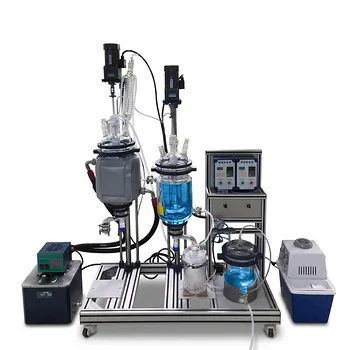
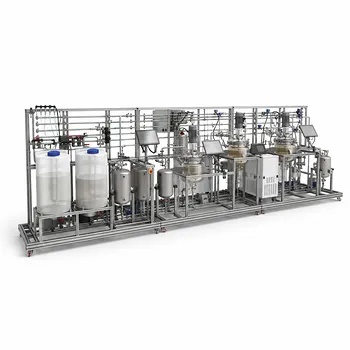
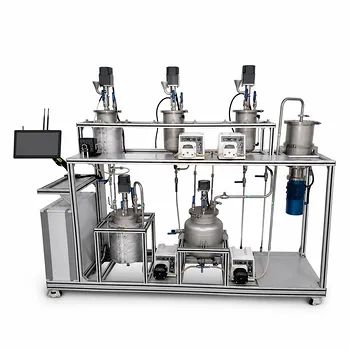
Agitation and mixing are not just a background variable in pilot-scale crystallization—they are the primary dial that controls secondary nucleation. In a stirred vessel, this specific type of nucleation, known as contact nucleation, is driven by the frequency and energy of physical collisions. When you transition from a lab beaker to a pilot plant, the chaotic fluid dynamics change, and the number of crystal-impeller and crystal-wall impacts skyrockets. This directly generates a cloud of fine particles that degrades product purity and creates a filtration nightmare downstream.
The key question is no longer "Does mixing matter?" but "How do I find the mechanical sweet spot?" The goal of scale-up is not to replicate laboratory silence, but to deliver just enough shear to maintain a homogeneous suspension without physically shattering the crystal population into fines. Investigating this requires moving beyond theoretical models to direct, observable measurement of desupersaturation kinetics and crystal habit.
Deconstructing the Mechanism of Contact Nucleation
To solve the problem, you must first visualize what is happening at the crystal surface. Secondary nucleation in an impeller-driven environment is rarely a chemical event—it's a mechanical one.
The Microattrition Reality
Secondary nucleation is microattrition. When a crystal collides with a stainless steel impeller blade or a baffle, microscopic fragments break off from the parent crystal.
These fragments act as perfect seed nuclei. Unlike primary nucleation, which requires high supersaturation, these micro-fragments simply need to survive and grow. Higher agitation speeds directly increase the collision frequency and the impact energy, producing more nuclei.
The Fines Feedback Loop
An increase in secondary nucleation is self-defeating. The process creates fine crystals that increase the total surface area in the vessel.
This massive surface area rapidly consumes supersaturation. Instead of adding mass to your existing, desirable large crystals (growth), the solute is wasted creating a fine, unprocessable powder. You lose control over the particle size distribution entirely.
Investigating Scale-Up Effects in a Pilot Environment
You cannot use a simple stir bar to predict this. Investigating these effects requires a pilot plant that acts as a diagnostic tool, allowing you to stress-test hydrodynamic parameters systematically.
Tracking the Desupersaturation Curve
The most direct window into nucleation kinetics is the solute concentration over time. Don't rely purely on particle size analyzers after the fact.
By using process analytical technology (PAT), like real-time spectroscopic monitoring, you can observe the rate of solute consumption. If an increase in RPM causes an instantaneous, sharp drop in supersaturation, you are witnessing a secondary nucleation burst. The solute is being consumed by the explosive creation of new surface area, not by growth on existing crystals.
Morphological Observation as a Clue
The crystal habit tells a story. This is particularly critical for acicular (needle-like) particles.
If your product is inherently fragile, you must monitor for broken crystals under the microscope. An increase in agitation that fragments these needles into smaller seeds represents catastrophic nucleation. In a pilot environment, you can establish the maximum tip speed your specific morphology can tolerate before fracturing.
Adjusting Impeller Design and Material
Do not treat the agitator as a fixed variable. Pilot plants allow you to swap impeller types to manage shear.
A large-diameter, pitched-blade turbine operated at lower RPM can often maintain solids suspension with significantly lower collision energy than a high-speed Rushton turbine. You can also investigate material changes. Replacing a metallic impeller with a PTFE (Teflon)-coated alternative drastically reduces impact energy during crystal contact, lowering nucleation rates without changing the mixing time.
Understanding the Trade-offs
Optimizing for nucleation alone can ruin your batch in other ways. You must navigate two critical pitfalls.
The Sedimentation Trap
The primary enemy of reducing secondary nucleation is particle settling. If you drop the RPM too low in a pilot vessel, you lose solids suspension.
This creates a stagnant bed of crystals at the bottom, starving them of growth while the liquid above remains supercooled. When the impeller eventually does remobilize this bed, the shock of high local supersaturation can trigger a massive, uncontrolled nucleation event that is far worse than the attrition you were trying to avoid.
The Homogeneity Illusion
While tip speed scaling reduces nucleation, it often fails to mix the bulk volume. In a large pilot vessel, you cannot treat the mixing volume as one homogeneous box.
Low agitation often leaves dead zones where supersaturation builds up. When this local "hot spot" bursts, it renders your careful nucleation control useless. You must confirm that the process is fully mixed, even as you reduce shear.
Making the Right Choice for Your Scale-Up Goal
Your strategy for investigating and mitigating secondary nucleation must align with your final manufacturing objective. The pilot plant is your negotiation table between particle physics and fluid dynamics.
- If your primary focus is meeting a strict particle size specification: Apply a constant energy dissipation rate (P/V) scaling rule. Calculate the pilot RPM using
N_plant = N_lab * s^(-2/3)and validate that your crystal habit isn't breaking down. This balances suspension against attrition. - If your primary focus is simply preventing fines formation: Investigate material-based solutions. Prioritize switching to a wider-diameter, slower-turning PTFE impeller to maintain fluid movement while minimizing contact energy, even if it deviates from classic geometric similarity rules.
- If your primary focus is maximizing growth rate on seed crystals: Run a series of concentration monitoring experiments to map the "nucleation threshold" RPM. Operate just below the speed where your desupersaturation curve shows a sharp change in slope, proving you are in the growth-dominated regime.
You are not simply scaling a piece of equipment; you are scaling a mechanical stress environment. By using the pilot plant to directly observe the link between the agitator's energy and the liquid's response, you gain the hard data needed to keep nucleation quiet without letting the crystals sink.
Summary Table:
| Key Factor | Impact on Crystallization | Investigation & Optimization Method |
|---|---|---|
| High Tip Speed / Shear | Causes microattrition, generating excessive fine particles. | Real-time desupersaturation tracking (PAT) & constant P/V scaling. |
| Impeller Design & Material | Metal blades increase impact energy and attrition rates. | Swap to wider-diameter, slower-turning PTFE-coated impellers. |
| Low Agitation Speed | Leads to particle settling and uncontrolled local nucleation. | Determine minimum solids suspension speed; map nucleation thresholds. |
Optimize Your Crystallization Scale-Up with LABPARK
Scaling up complex chemical processes requires precise control over hydrodynamics and thermodynamics. LABPARK provides state-of-the-art Educational and Vocational Unit Operations Pilot Plants in chemical engineering, bioprocess & biotech, and environmental & water treatment. We help universities, research institutes, and enterprises bridge the gap between laboratory research and industrial-scale production.
Whether you are optimizing crystallization kinetics, troubleshooting secondary nucleation, or teaching the next generation of engineers, our robust pilot plants deliver the reliable data and control you need.
Contact our technical experts today to find the perfect pilot-scale solution for your facility!
Related Products
- Multi Functional Membrane Crystallization Educational Unit Operations Pilot Plant
- Potassium Salt Thermal Dissolution and Crystallization Separation Educational Unit Operations Pilot Plant
- Multi-Functional Special Distillation Educational Pilot Plant
- Ethyl Acetate Synthesis Unit Operations Pilot Plant for Practical Training
- Multi-Modal Distillation Unit Operations Training Pilot Plant
People Also Ask
- Control Crystallization Pilot Plant Secondary Nucleation: 4 Key Adjustments
- Why is precise temperature control critical in crystallization pilot plants? Key to Scale-Up Success
- What key factors should be considered when configuring a crystallization unit operations pilot plant?
- What are the benefits of integrating online PAT tools like ATR-FTIR into crystallization unit operations pilot plants?
- How to use crystallization pilot plant agitation speed to identify diffusion vs reaction growth?