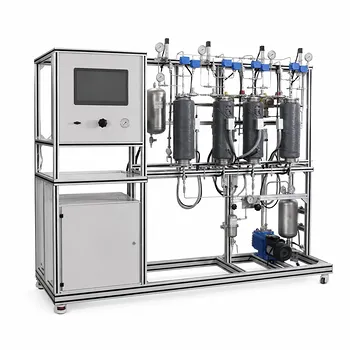
Bioprocess and environmental unit operations pilot plants are the critical proving ground where sustainability goals become engineered reality. They address the industry shift by providing scalable platforms to convert agricultural or organic waste into biofuels and bio-based chemicals, optimizing fermentation and enzymatic hydrolysis, and testing green remediation techniques. Through precise control of pH, dissolved oxygen, and nutrient feeding strategies, these systems enable the development of processes that directly slash carbon footprints and boost energy efficiency.
Pilot plants are not an optional step—they are the indispensable bridge that de-risks the leap from fossil feedstocks to renewable, biomass-driven production. By simulating continuous operations and real-world engineering constraints, they transform laboratory green chemistry into industrially viable, resource-efficient solutions.
The Critical Role of Pilot Plants in Sustainable Process Development
Scaling Up Green Chemistry from Lab Bench to Reality
Bench-scale experiments cannot replicate the heat integration, mass transfer limitations, and raw material handling challenges of production.
Bioprocess pilot plants equipped with bioreactors and fermentation units allow researchers to study these dynamics under continuous operation.
They expose the hidden friction that only appears when kilograms, not grams, of material are processed—making the optimization of yields, energy consumption, and waste streams achievable before full-scale investment.
Bridging the Training Gap for Future Engineers
The gap between academic theory and industrial practice is a steep one. Educational unit operations pilot plants close it by forcing hands-on confrontation with real constraints.
Students learn to manage feeding rates, safety hazards, and holistic lifecycle thinking on physical equipment.
This experience is essential for producing engineers who can apply process mass intensity logic—dropping from a median of 185 kg materials/kg API at preclinical stages to 45 kg/kg at commercial scale—and design inherently safer, greener processes from day one.
From Waste to Resource: Biomass Conversion and Circularity at Pilot Scale
Optimizing Fermentation and Enzymatic Pathways for Biofuels
Bioprocess pilot plants are purpose-built to study the biological conversion of biomass into bio-ethanol, biodiesel, and platform chemicals like bio-based succinic acid or polylactic acid.
They provide the controlled environment to tune fermentation parameters—such as mild pH, temperature, and dissolved oxygen—while evaluating biocatalyst stability and resolving mass transfer bottlenecks.
Researchers can also explore C1-chemistry routes (synthesis gas CO/H₂ production) without a drop of crude oil, validating the renewable production of chemicals that traditionally relied on petrochemicals.
Testing Downstream Recovery and Life Cycle Feasibility
Sustainability isn’t just about the reaction—it’s about the entire recovery chain.
Environmental and bioprocess pilot plants incorporate separation and filtration unit operations, enabling life cycle assessments and waste-to-energy conversion measurements.
This allows teams to verify that a process’s energy recovery efficiency, material circularity, and net environmental profile stand up under continuous, scaled conditions—not just in a theoretical mass balance on paper.
Green Remediation and Environmental Stewardship
Validating In-Situ Treatment with Catalytic Nanoparticles
Pilot-scale water treatment systems make it possible to simulate realistic hydraulic conditions and contaminant degradation rates.
They are used to test emerging green remediation methods, such as utilizing biodegradable materials or catalytic nanoparticles (e.g., nano-iron) to degrade chlorinated solvents.
Only at pilot scale can researchers confirm the technical and economic feasibility of these low-impact treatments before full-scale field implementation, avoiding costly and environmentally risky trial-and-error.
Navigating the Trade-offs and Pitfalls of Pilot-Scale Translation
Pilot plants are powerful, but they are not a simple magnifying glass.
Capital and operating costs are high, and constructing a truly representative system requires significant expertise. Over-optimizing under ideal controlled conditions can create a dangerous illusion—what works in a perfectly instrumented pilot may fail when confronted with the variability of industrial feedstocks or ambient fluctuations. Additionally, biological systems can exhibit nonlinear behavior across scales, meaning a parameter set that shines at the liter scale can collapse at the cubic-meter scale.
Skilled interpretation is non-n negotiable. Without it, the pilot plant can become an expensive exercise in data generation rather than a reliable scaling tool.
Making the Right Choice for Your Sustainability Goals
Pilot plant capabilities can be targeted to deliver the most value based on your primary objective.
- If your primary focus is developing a novel bio-based chemical: Prioritize a bioprocess pilot line with specialized bioreactors and downstream separations. Run extended campaigns to verify biocatalyst life, mass balances, and product purity under continuous feeding strategies.
- If your primary focus is waste-to-energy or circular economy recovery: Select a pilot platform that integrates preprocessing, biological treatment, and energy recovery monitoring. Use it to generate life cycle inventory data that confirms net carbon reduction and economic viability.
- If your primary focus is training the next generation of green engineers: Invest in a versatile unit operations pilot plant that exposes students to heat integration, raw material handling, and inherent safety design. Real-world constraints learned here will drive holistic lifecycle thinking in their future careers.
- If your primary focus is green remediation: Opt for an environmental flow-through pilot system that can simulate aquifer velocity and contaminant concentration. Validate the degradation kinetics and longevity of catalytic materials under field-like conditions before full deployment.
When used with discipline and critical analysis, pilot plants do not merely test processes—they confidently convert visionary green chemistry into resource-efficient, safe, and scalable industrial practice.
Summary Table:
| Focus Area | Key Pilot-Scale Activities | Primary Benefit & Value |
|---|---|---|
| Bio-based Chemicals | Optimizing fermentation parameters & downstream separations | Verifies product purity and biocatalyst stability |
| Waste-to-Energy | Preprocessing organic waste & monitoring energy recovery | Generates life cycle data to confirm net carbon reduction |
| Green Education | Hands-on training with safety hazards & feeding rates | Closes the gap between academic theory and practice |
| Green Remediation | Simulating aquifer velocity & validating catalytic nanoparticles | De-risks low-impact field treatment before deployment |
Accelerate Your Transition to Green Chemistry with LABPARK
Scaling sustainable processes from the lab to industrial application requires reliable, high-fidelity equipment. LABPARK provides premium Educational and Vocational Unit Operations Pilot Plants across chemical engineering, bioprocess & biotech, and environmental & water treatment.
Tailored for universities, research institutes, and enterprises, our systems enable you to:
- De-risk Scale-up: Accurately simulate continuous operations, resolve mass transfer bottlenecks, and verify process efficiency.
- Train Next-Gen Engineers: Provide students and technicians with hands-on experience in process safety, feeding rates, and lifecycle thinking.
- Validate Green Tech: Gather essential lifecycle assessment data for biomass conversion and advanced water treatment.
Empower your team with the tools to engineer a sustainable future. Contact LABPARK today to find the perfect pilot plant solution for your goals!
Related Products
- Bio-fermentation Ethanol Production Practical Training Unit Operations Pilot Plant
- Multimodal Absorption and Desorption Pilot Plant for Unit Operations Training
- Dual-Mode Rectification Pilot Plant for Practical Training Unit Operations
- Multi-Functional Membrane Separation Educational Pilot Plant for Unit Operations Lab
- Natural Product Extraction Unit Operations Training Pilot Plant
People Also Ask
- Why Use PTFE & Hastelloy in Chemical Pilot Plants? Prevent Corrosion & Ensure Safety
- Why Compare Predicted and Experimental Excess Enthalpy? Key to Accurate Pilot Plant Scale-up
- Why is the chemical plant startup schedule crucial? De-risk scale-up with pilot plants.
- Why Does a Pilot Plant Solver Return a Singular Matrix Error, and How Can You Resolve It?
- How can pilot plants demonstrate a control strategy in a design space? Practical QbD implementation.