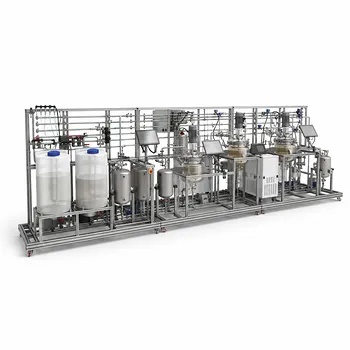
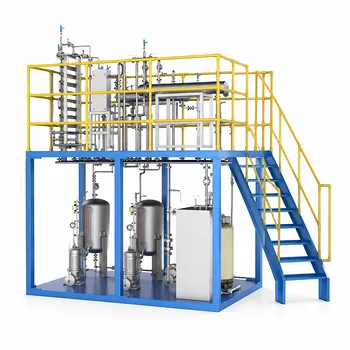
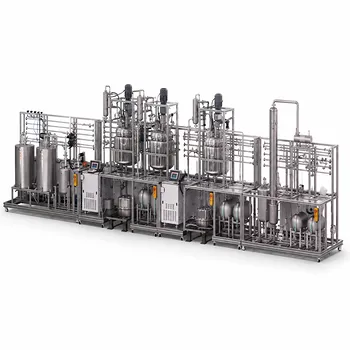
The path from a lab flask to a commercial tank is where green chemistry lives or dies. Bioprocess and chemical unit operations pilot plants are the critical bridge that allows you to systematically transition a bio-based molecule like glucaric acid from a microbial concept to a viable industrial product. In these controlled, intermediate-scale environments, you can precisely optimize the fermentation conditions that drive yield and rigorously test the downstream purification steps that define product purity, all while generating the hard data needed to prove the process is both economically and environmentally sound.
Core Takeaway: The pilot plant isn't just a bigger lab; it's a truth-telling machine. It forces you to confront the real-world mass and energy balances, transport limitations, and efficiency metrics—like atomic economy and waste reduction—that will make or break a green chemical alternative's commercial future.
The Fermentation Frontier: Mastering the Bioprocess Scale-Up
Scaling a fermentation from a shake flask to a pilot bioreactor is rarely a linear exercise. The biological system responds to its physical environment in ways that are invisible at the bench. A bioprocess pilot plant gives you the tools to see and control that environment.
Why Bench-Scale Performance Rarely Translates Directly
In a shake flask, your microbial culture experiences a chaotic world of fluctuating pH, oxygen gradients, and inconsistent mixing. Pilot-scale bioreactors impose uniformity. They maintain tight control over dissolved oxygen, pH, temperature, and nutrient feeding rates. This control reveals the true metabolic limits of your production strain—you can't hide inefficiencies behind local microenvironments.
The Power of Controlled Feeding and Environmental Control
Glucaric acid production via fermentation demands a precise balance. Push the microbe too fast with glucose, and you get overflow metabolism and byproducts. Starve it, and you lose productivity. A pilot bioreactor's automated feeding strategies let you run designed experiments to map the relationship between the growth rate and product formation, finding the sweet spot that maximizes yield while minimizing wasted carbon.
Generating the Data for a Predictive Model
Beyond trial-and-error, pilot fermentation runs provide the rich, time-series data needed to build kinetic models. By tracking off-gas CO₂, substrate consumption, and product formation under varying conditions, you can develop a process model that predicts behavior at even larger scales. This turns the pilot plant into a hypothesis-testing engine, not just a production simulator.
The Downstream Gauntlet: Purification at the Pilot Scale
Producing glucaric acid in broth is only half the battle. Separating and purifying it from a complex soup of cells, residual sugars, and metabolic byproducts is often the costliest step. Chemical unit operations pilot plants let you integrate and test entire separation sequences.
Testing Real Recovery Cascades
A pilot plant with downstream modules—membrane filtration, evaporation, crystallization, and solvent extraction—allows you to run the full purification train end-to-end. You can evaluate performance not as isolated steps, but as an interconnected system, identifying bottlenecks like membrane fouling, solvent losses, or crystal polymorph control that only appear under continuous operating conditions.
Validating the Green Metrics
The promise of a green chemical lies in its metrics. In a pilot plant, you can accurately measure the atomic economy (how much of the starting glucose ends up in the final product), the energy consumed per kilogram of product, and the volume of aqueous or solvent waste generated. These numbers are the ultimate proof your process is a genuine improvement over the petrochemical route it aims to replace. A guess from a lab-scale experiment is not credible to investors or regulators.
Using Multivariate Insight to Decode Scale-Up Phenomena
Moving from one scale to another introduces complex physical changes—mixing times, shear forces, heat transfer rates. Traditional univariate monitoring (looking at one parameter at a time) masks these interactions. Pilot plants equipped with modern sensors can capture the full picture.
The Process Signature Approach
By collecting multi-parametric data (e.g., near-infrared spectroscopy, temperature profiles, pH, dissolved oxygen) from many pilot runs, you can build a multivariate model of your "process signature." This signature reveals how input variability propagates through both the bioreactor and the downstream unit operations, helping you pinpoint exactly where scale-dependent effects—like oxygen limitation in a larger tank or uneven crystal growth in a larger crystallizer—begin to dominate.
De-risking Commercial Scale with Historical Data
Instead of waiting for a catastrophic failure at full scale, you analyze the pilot-scale multivariate data to determine the true operating space where product quality remains consistent. Using latent variable methods, you can understand how to adjust set points on a larger setup to replicate the quality you achieved at the pilot scale, effectively de-risking the final investment.
Understanding the Trade-offs and Limitations
Trust is built on objectivity, and a pilot plant is not a panacea. There are limitations you must acknowledge and manage.
- The cost of realism: Running a fully integrated bioprocess and downstream pilot plant with raw materials, energy, and staffing is expensive. You may only be able to run a limited number of experiments, forcing you to carefully prioritize which variables to study.
- The uncaptured large-scale physics: A 100-liter pilot bioreactor still has a different mixing time and shear profile than a 100,000-liter production vessel. Certain scale-up problems—such as long-term microbial genetic drift or extreme heat removal challenges—will only reveal themselves at the final scale, no matter how thorough your pilot work.
- The risk of over-engineering: Relying solely on trial-and-error in the pilot plant, without integrating mathematical modeling, can lead to an endless, expensive cycle of runs. The most effective approach uses pilot data to validate predictive models, not replace them.
How to Apply This to Your Green Chemical Project
The right pilot-plant strategy depends on your primary goal. Define it clearly.
- If your primary focus is maximizing fermentation yield: Invest your pilot runs in designing sophisticated feeding profiles and environmental stress-periment studies using your bioprocess reactor. Correlate metabolic throughput with real-time off-gas data to build a robust kinetic model.
- If your primary focus is proving commercial viability: Run the entire integrated process—from fermentation to dry purified product—at the pilot scale multiple times. Your deliverable is a mass and energy balance, along with a cost-of-goods analysis backed by pilot-scale yields, recoveries, and consumable usage.
- If your primary focus is de-risking scale-up: Use the pilot plant to generate a multivariate data set representing your full process signature. Combine this with computational fluid dynamics simulations to predict mixing and heat transfer at the target commercial scale, then run a limited number of pilot experiments at extreme conditions to verify the model's boundaries.
The pilot plant is where green ambition meets engineering discipline. Use it not just to confirm what you hope is true, but to discover what you need to know to actually succeed.
Summary Table:
| Parameter | Bench Scale (Flask) | Pilot Scale (Bioprocess Plant) | Impact on Scale-Up |
|---|---|---|---|
| Environmental Control | Chaotic (pH/O₂ fluctuations) | Uniform & automated control | Reveals true metabolic limits |
| Downstream Testing | Isolated separation steps | Integrated recovery cascades | Identifies bottlenecks like membrane fouling |
| Data Generation | Qualitative & limited | Rich, multi-parametric data | Enables predictive kinetic modeling |
| Risk Mitigation | High scale-up uncertainty | Validates green metrics & process signatures | De-risks multi-million dollar investments |
Scale Up Your Green Chemical Innovations with LABPARK
Bridging the gap between laboratory concepts and commercial success requires robust, reliable data. LABPARK provides state-of-the-art Educational and Vocational Unit Operations Pilot Plants in chemical engineering, bioprocess & biotech, and environmental & water treatment.
Designed specifically for universities, research institutes, and enterprises, our pilot plants empower you to:
- Optimize Processes: Fine-tune fermentation and downstream purification parameters with industry-grade control.
- De-Risk Scale-Up: Gather precise mass, energy, and green chemistry metrics to validate your process before commercial investment.
- Enhance Training: Provide students and researchers with hands-on experience on real-world engineering systems.
Ready to elevate your research and training capabilities? Contact LABPARK today to find the perfect pilot plant solution for your facility!
Related Products
- Bio-fermentation Ethanol Production Practical Training Unit Operations Pilot Plant
- Natural Product Extraction Unit Operations Training Pilot Plant
- Multi Pump Fluid Transport Process Piping Unit Operations Training Pilot Plant
- Multi-Reactor Educational Pilot Plant for Reaction Engineering Unit Operations
- Fixed-Bed Chemical Reaction and Gas Dust Tar Removal Unit Operations Pilot Plant
People Also Ask
- Why Use PTFE & Hastelloy in Chemical Pilot Plants? Prevent Corrosion & Ensure Safety
- Why Compare Predicted and Experimental Excess Enthalpy? Key to Accurate Pilot Plant Scale-up
- Why is the chemical plant startup schedule crucial? De-risk scale-up with pilot plants.
- When to transition from PID to adaptive control in pilot plants? Key process indicators.
- Why must batch and fed-batch fermentation pilot plants be designed to accommodate changing rheological conditions?