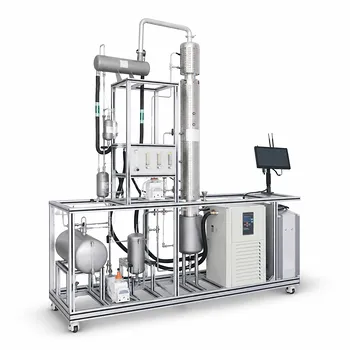
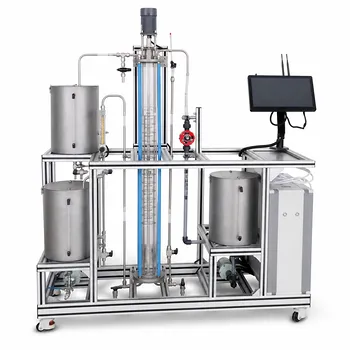
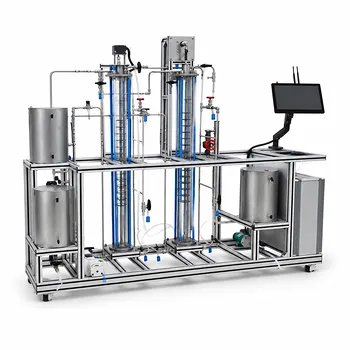
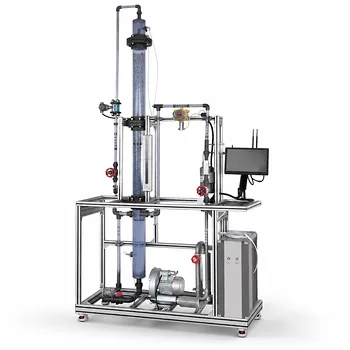
The educational versatility of a batch column is defined by its ability to do more with less.
In a unit operations pilot plant, a single batch distillation column can separate a multi-component mixture into multiple high-purity fractions sequentially, handle varying feed compositions, and vividly demonstrate transient, unsteady-state dynamics. A continuous column, by contrast, is designed to separate a feed into only two steady-state product streams, making it a focused but far less adaptable teaching tool.
While a continuous column teaches the steady-state “snapshot,” a single batch column acts as a flexible stage on which you can observe an entire separation story unfolding over time. For pilot-plant education, this dynamic behavior, combined with the ability to process small, variable batches, makes the batch column an unmatched platform for exploring the fundamentals of distillation.
The Power of One Column, Many Products
A continuous distillation train splits a feed into a distillate and a bottoms. To separate a feed into three pure components, you would need a series of multiple columns—a costly and complex setup.
A batch column achieves this separation in a single tower.
Sequential Separation in a Single Unit
You charge the still with a mixture and, by operating under a constant reflux ratio, the more volatile component is drawn off first.
As the run progresses, the overhead composition continuously changes, allowing you to collect separate, high-purity fractions at different cuts.
This transforms a lone piece of equipment into a platform for teaching fractional collection strategies, boiling-point order, and the relationship between reflux ratio and product purity—all without the need for a multi-column train.
Demonstrating Dynamic, Transient Processes
A continuous column is an island of stability. Its goal is a steady-state where flows, temperatures, and compositions do not change.
A batch column is fundamentally an unsteady-state process. The concentration of the lightest component drops over time, forcing students to monitor and respond to a shifting system.
This makes it an exceptional tool for teaching dynamic mass balances and the core challenge of unsteady-state control. Students witness the distillation curve evolve, which internalizes the difference between process design and real-time process behavior.
Unmatched Operational Flexibility for Teaching
Pilot-plant education must serve many masters: different student cohorts, variable lab schedules, and a wide range of test mixtures.
The batch column’s hardware and operating philosophy are purpose-built for this variety.
Handling Small Volumes and Variable Feeds
Continuous columns demand a steady, consistent feed flow to maintain their delicate equilibrium. They are not suited for the small, one-of-a-kind bottles often found in a teaching lab.
A batch still processes small, variable quantities by design. You simply charge the reboiler and begin. This flexibility allows you to switch from a methanol-water mixture for the morning class to an ethanol-propanol mixture for the afternoon, simply by cleaning the still and changing the charge.
This teaches students that operating parameters—like the reflux ratio—are dynamic levers, not fixed settings. They learn to adjust conditions to meet a purity specification for a feed that might be different every run.
Processing Difficult Feeds
Many educational mixtures can foul equipment. Materials containing solids, tars, or polymerizing agents can clog the feed preheaters and intricate downcomers of a continuous column.
A batch still has no continuous feed preheater or a multi-tray distribution system to clog. The residue remains in the reboiler until it is drained. This direct design makes it an excellent platform for demonstrating fouling feeds and the practical limitations of column internals without catastrophic damage.
Simplified Equipment, Reduced Footprint
A continuous demonstration often requires multiple feed pumps, preheaters, storage tanks, and a complex level-control system to manage the sump and reflux drum simultaneously.
A batch column needs only a reboiler, a column, a condenser, a reflux splitter, and a product receiver. This minimal peripheral equipment translates to lower capital cost, smaller laboratory footprint, and simplified maintenance—resources that can be redirected to other learning stations.
Bridging the Gap to Industry Practices
The multiproduct, multipurpose plants (MPPs) producing high-value fine chemicals, pharmaceuticals, and specialties rely almost exclusively on batch and semi-batch operations.
Training on a batch distillation pilot plant directly mirrors this industrial reality.
Teaching Batch vs. Continuous Philosophy
Running both a batch and a continuous column in the same lab is the ultimate pedagogical comparison. Students experience the manual, hands-on control of a batch system—managing startup, drawing cuts, and shutting down—versus the steady-state flow, automation, and real-time optimization of a continuous system.
This contrast embeds a deep understanding of when and why an engineer chooses a batch “kitchen” approach over an “assembly line” for chemical manufacturing.
Recipe-Based Control and Scheduling
Operating a batch column requires recipe-based control: a predefined sequence of heating, total reflux, product draw, and shutdown.
This teaches students the fundamentals of scheduling, cleaning between batches, and changeover procedures—critical skills for running the multiproduct plants common in the fine chemical and pharmaceutical industries. A continuous column simply cannot teach this most basic of plant-floor operational disciplines.
Understanding the Trade-offs
The versatility of a batch column is not without its pedagogical blind spots. An exclusive focus on batch distillation would leave a student’s education incomplete.
The Limit of Steady-State Pedagogy
A batch column is, by nature, transient. It cannot teach the elegant, time-invariant material and energy balances that define a continuous plant running 24/7.
To fully understand the theory of theoretical plates, constant product composition, or the thermodynamic efficiency of heat integration, a student must also work with a continuous column in a stable, steady state.
Energy Efficiency and Operational Idleness
Achieving a separation in a batch column involves constant heating and cooling, even during non-productive phases like heating to boiling or total reflux.
This makes the batch process less energy-efficient than a steady-state continuous process. When training for high-volume, bulk commodity production—where energy cost is a primary variable—this is a critical limitation to address.
Constant Operator Attention
A batch run is not a “set it and forget it” operation. The operator must actively monitor the overhead temperature, adjust reflux ratio, and make precise product cuts.
While this hands-on engagement is a strength for learning, it also introduces human variability and a significant manual workload. A continuous column’s automated, steady display of persistent instrument readings can paradoxically make the fundamental concept of mass transfer easier to isolate and study in a single lab session.
Making the Right Choice for Your Educational Goal
Your objective should dictate the primary tool. Use the goals below to decide how to prioritize batch vs. continuous columns in your pilot-plant curriculum.
- If your primary focus is teaching dynamic process control and transient behavior: A batch column is your essential tool. Its continuously changing composition over time is a living, breathing dynamic system for students to monitor and control.
- If your primary focus is multi-product flexibility with a small equipment footprint: Choose the batch column. It allows you to demonstrate multiple separations with varied feeds in a single, low-maintenance setup, maximizing your lab’s experimental throughput.
- If your primary focus is foundational steady-state balances and large-scale continuous replication: A continuous column is indispensable. Use it to teach time-invariant mass balances, steady-state efficiency, and the core principles of high-volume industrial distillation, and then use the batch column to teach the contrasting world of dynamic, small-scale, high-value processing.
By leveraging each system for its unique pedagogical strength, you transform a unit operations lab into a complete miniature version of the chemical process industry.
Summary Table:
| Feature | Batch Distillation Columns | Continuous Distillation Columns |
|---|---|---|
| Process State | Dynamic / Unsteady-state | Constant / Steady-state |
| Product Outputs | Multiple fractions sequentially | Two steady streams (distillate/bottoms) |
| Feed Requirements | Small, variable, or fouling feeds | Steady, clean, consistent feed |
| System Footprint | Small (minimal peripheral equipment) | Large (requires pumps, preheaters, tanks) |
| Core Teaching Value | Dynamic mass balances & recipe control | Steady-state design & energy integration |
Elevate Your Chemical Engineering Lab with LABPARK
Selecting the right distillation setup is key to building a robust chemical engineering curriculum. LABPARK designs and manufactures premium Educational and Vocational Unit Operations Pilot Plants in chemical engineering, bioprocess & biotech, and environmental & water treatment.
We empower universities, research institutes, and enterprises worldwide with hands-on training platforms that mirror real-world industrial operations.
Ready to enhance your lab's training capabilities? Contact LABPARK today to discuss your custom configurations and request a quote!
Related Products
- Continuous Batch Extractive Distillation Educational Pilot Plant
- Continuous Sieve-Plate Distillation Pilot Plant for Unit Operations Laboratory Education
- Multi-Functional Special Distillation Educational Pilot Plant
- Multi-Modal Distillation Unit Operations Training Pilot Plant
- Dual-Mode Rectification Pilot Plant for Practical Training Unit Operations
People Also Ask
- Wilson vs. UNIQUAC: How to Choose the Right Thermodynamic Model for Your Pilot Plant
- How does the feed thermal state influence distillation pilot plant design and utility consumption?
- Why use non-ideal VLE calculations in distillation pilot plants? Ensure accurate scale-up & purity
- How to Configure a Distillation Pilot Plant? Key Steps for Multi-Mode Setup
- How to Integrate Spectroscopy in Distillation Pilot Plants for Advanced Process Control