Knowledge Chemical Engineering Education How can engineers use pilot plants to teach energy optimization? Master waste heat recovery.
Author avatar

Tech Team · LABPARK

Updated 1 month ago

How can engineers use pilot plants to teach energy optimization? Master waste heat recovery.


A pilot plant is the closest a student gets to a real chemical plant without the risk of a multi-million-dollar mistake. University laboratory engineers use unit operations pilot plants equipped with heat exchangers, evaporators, or distillation columns to let students directly measure heat loss, calculate thermal efficiency, and physically implement heat integration strategies—such as using waste heat from one unit to preheat feed streams in another. By manipulating control variables like flow rate and reflux ratio on a live rig, students see exactly how operational choices impact energy consumption, turning abstract pinch analysis into tangible engineering judgment.

Teaching energy optimization isn’t about memorizing pinch analysis rules—it’s about letting students touch the hot pipes and cold streams, measure real losses, and redesign the process to capture waste heat. Pilot plants make that invisible flow visible, bridging the gap between theoretical energy balances and the practical compromises of industrial operation.

From Theory to Practice: The Role of Pilot Plants

Bridging the Textbook–Reality Gap

Academic curricula often teach thermodynamics and kinetics through abstract formulas. A jacketed reactor in a textbook predicts heat exchange rates. A real reactor in a pilot plant shows the student the gap: heat loss through insulation imperfections, variation in heat transfer coefficients with fouling, and the dynamic response of a cooling system. This contrast is where deep learning begins.

The Scale-Up Insight Machines

Standard laboratory glassware (gram-scale calorimeters) cannot demonstrate the heat and mass transfer limitations, fluid dynamics, or the interdependency of multiple unit operations that define industrial energy profiles. Scaled-down pilot plants—operating at kilogram or few-kilogram per hour flows—expose students to realistic heat retention challenges and the true cost of poor thermal integration. They learn what a 10% heat loss really means for a process, not just for a calculation.

Transforming Data into Energy Awareness: The Pilot Plant Audit

Instrument-Driven Discovery

Modern teaching pilot plants are rich with sensors: flow meters, precise temperature transmitters, pressure gauges, and composition analyzers. Students collect real-time data to perform dynamic energy balances. They write the chemical equations, select a basis (like hourly flow), and map the process flow diagram. Then, by comparing calculated theoretical energy demand with actual utility consumption, they identify and quantify heat loss, revealing exactly where energy bleeds away.

Calculating What Cannot Be Seen

Using the collected data, students calculate thermal efficiency for individual units—a distillation column’s reboiler duty versus useful separation work, or an evaporator’s steam economy. They see, for example, that a huge fraction of the energy supplied leaves in the cooling water, and that number is not fixed; it changes with reflux ratio or feed preheating temperature. This turns “waste heat” from a concept into a measurable stream with a price tag.

Implementing Waste Heat Recovery Live

Preheating Feed with Hot Effluent Streams

The most direct demonstration: take a hot product stream or overhead vapor that normally dumps its heat into a cooler and replay it through a heat exchanger to preheat the cold feed. By switching valves and recording the drop in steam consumption, students witness a direct reduction in primary energy demand. They learn that heat integration isn’t just about connecting streams—it’s about matching temperatures and maintaining flow stability.

Cascading Heat Across Unit Operations

A multi-effect evaporator pilot plant is a powerful teaching tool for heat recovery. Vapor generated in one effect becomes the heating medium for the next. Students measure the steam consumption and see how quadrupling the effects nearly quarters the live steam requirement. They grasp the fundamental principle of exergy cascading, turning one high-grade energy input into multiple lower-grade uses before final rejection.

Applying Pinch Analysis on the Fly

With temperature and flow data from a multi‑unit pilot setup (e.g., a reactor feeding a distillation column), students can construct composite curves and identify the pinch point. They then physically reconfigure the plant—adding a feed‑effluent heat exchanger or changing stream split—and re-measure utility usage. The pilot plant validates the pinch prediction, proving that heat integration is a practical engineering tool, not just a diagram.

Understanding the Trade-offs of Heat Recovery

The Capital vs. Energy Tug‑of‑War

Students quickly learn that adding a heat exchanger to recover waste heat also adds pressure drop, increases capital cost, and complicates controllability. A pilot plant allows them to test whether a 15% steam saving justifies the extra equipment and whether the process remains stable during startups and shutdowns. This teaches economic decision‑making, the real heart of optimization.

The Distortion of Pilot Scale

Small pilot plants often suffer from high surface‑to‑volume ratios, making heat losses proportionally larger than in industrial units. A preheater that recovers 40% of available waste heat at pilot scale might recover 70% in a well‑insulated plant. Students must critically evaluate scale‑up factors, learning not to extrapolate raw percentages but to use the physical understanding of heat transfer coefficients and insulation effects gained hands‑on.

Process Safety and Fouling Risks

Recovering heat from a hot, dirty stream may cause fouling in the cold feed line or create a hazardous temperature runaway if the heat source fails. When students connect a waste heat stream and then must design interlocks or monitor pressure drops, they internalize that heat recovery always walks hand in hand with safety and operability.

Making the Right Choice for Your Educational Goal

Adapt your pilot plant exercises to the learning outcome you need:

  • If your primary focus is foundational energy literacy: Start with a single unit—like a steam‑heated evaporator—and have students calculate thermal efficiency and loss mechanisms.
  • If your primary focus is process integration design: Use a multi‑unit pilot train (reactor + distillation + heat exchanger) and let students run pinch analysis, then implement a heat exchanger network based on their own data.
  • If your primary focus is waste minimization and sustainability: Integrate heat recovery with material recovery—for example, use waste heat to drive a solvent regeneration column and quantify the combined energy and mass reduction.

By turning invisible energy flows into loud, measurable targets, pilot plants create engineers who instinctively design processes where every joule finds its second life.

Summary Table:

Educational Focus Pilot Plant Configuration Key Student Takeaway
Foundational Literacy Single unit (e.g., steam-heated evaporator) Calculate thermal efficiency, measure heat losses, and perform dynamic energy balances.
Process Integration Multi-unit train (reactor + distillation + heat exchanger) Run pinch analysis and physically reconfigure heat exchanger networks to verify energy savings.
Sustainability & Waste Minimization Integrated heat & material recovery setup Quantify combined energy and mass reduction by driving auxiliary units with process waste heat.

Bridge the Gap Between Theory and Practice with LABPARK

Equip your students with the practical skills needed to design efficient, sustainable processes. LABPARK offers high-quality Educational and Vocational Unit Operations Pilot Plants tailored for chemical engineering, bioprocess & biotech, and environmental & water treatment.

Designed specifically for universities, research institutes, and enterprises, our pilot plants turn abstract thermodynamics into tangible engineering judgment.

Contact LABPARK today to explore our customizable training rigs and request a proposal!

Related Products

People Also Ask

Related Products

General Purpose Cosmetics Production Unit Operations Training Pilot Plant

General Purpose Cosmetics Production Unit Operations Training Pilot Plant

Integrated pilot-scale cosmetics production training plant for chemical engineering education featuring utility supply emulsification blending and filtration modules with dual touchscreen manual control customizable mobile design ideal for practical hands-on unit operations and advanced process control learning.

Multi Pump Fluid Transport Process Piping Unit Operations Training Pilot Plant

Multi Pump Fluid Transport Process Piping Unit Operations Training Pilot Plant

Industrial-scale multi-pump pilot plant for unit operations training in fluid transport and process piping, featuring real-material and semi-physical simulation modes, comprehensive pump and flowmeter calibration, and safety-enhanced two-tier platform, bridging academic theory and industrial practice for chemical engineering education.

Multi-Functional Drying Educational Unit Operations Pilot Plant

Multi-Functional Drying Educational Unit Operations Pilot Plant

Versatile multi-functional drying educational unit operations pilot plant integrating tunnel, fluidized bed, and spray drying. Enables hands-on study of drying curves, psychrometry, and gas-solid separation for chemical engineering curriculum in higher education labs.

Fixed-Bed Chemical Reaction and Gas Dust Tar Removal Unit Operations Pilot Plant

Fixed-Bed Chemical Reaction and Gas Dust Tar Removal Unit Operations Pilot Plant

Integrated educational pilot plant for studying catalytic gas-solid reactions and downstream gas purification. Features dual fixed-bed reactor, three-stage heating, and touchscreen control for hands-on engineering training. Ideal for chemical and environmental engineering curricula.

100L Continuous Loop Hydrogenation Educational Unit Operations Pilot Plant

100L Continuous Loop Hydrogenation Educational Unit Operations Pilot Plant

This 100L continuous loop hydrogenation pilot plant is designed for chemical engineering education, featuring 316 stainless steel construction, advanced gas-liquid mass transfer components, explosion-proof safety systems, and a 15.6-inch touchscreen with 5G connectivity, cloud data logging, bridging theory and industry.

Multi-Reactor Educational Pilot Plant for Reaction Engineering Unit Operations

Multi-Reactor Educational Pilot Plant for Reaction Engineering Unit Operations

Integrated bench-scale educational pilot plant for chemical engineering teaching featuring fixed bed fluidized bed and stirred tank reactors with web-based digital twin controls and safety interlocks for hands-on unit operations and reaction engineering comparative studies in one compact system.

Natural Product Extraction Unit Operations Training Pilot Plant

Natural Product Extraction Unit Operations Training Pilot Plant

Integrated natural product extraction pilot plant for chemical engineering training bridges theory and industrial practice with modular extraction and evaporation/concentration units, hybrid touchscreen and manual control, realistic process simulation, and self-contained softened water and vacuum utilities.

Ethyl Acetate Synthesis Unit Operations Pilot Plant for Practical Training

Ethyl Acetate Synthesis Unit Operations Pilot Plant for Practical Training

Modular and customizable pilot plant for ethyl acetate synthesis practical training. Integrates esterification reaction, liquid-liquid extraction, neutralization, and sieve-plate distillation unit operations. Bridging theory and real-world industrial processes. Designed for university chemical engineering labs

Multimodal Absorption and Desorption Pilot Plant for Unit Operations Training

Multimodal Absorption and Desorption Pilot Plant for Unit Operations Training

Multimodal absorption and desorption pilot plant for higher education labs. Bridges theory and industrial practice with transparent packed columns, three operational modes (real-material, simulated, semi-physical), and SCADA control. Students explore mass transfer, column hydraulics, and process control. Customizable.

Dual-Mode Rectification Pilot Plant for Practical Training Unit Operations

Dual-Mode Rectification Pilot Plant for Practical Training Unit Operations

Industrial-scale dual-mode rectification pilot plant for chemical engineering practical training. Features real-material and simulated-material operation modes, sieve-plate column with sight glasses for visual observation of hydrodynamics, and customizable SCADA control for safe, hands-on learning of unit operations and mass transfer.

Three-Tube Heat Transfer Educational Pilot Plant for Unit Operations Training

Three-Tube Heat Transfer Educational Pilot Plant for Unit Operations Training

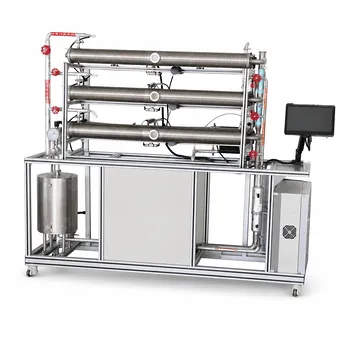
Three-tube heat transfer pilot plant for studying convective heat transfer enhancement and condensation. Allows comparison of smooth, corrugated, turbulent tubes, verifying empirical correlations. Ideal for chemical engineering education with safety and closed-loop steam recovery.

Methanol Synthesis and Catalyst Performance Evaluation Educational Unit Operations Pilot Plant

Methanol Synthesis and Catalyst Performance Evaluation Educational Unit Operations Pilot Plant

Bench-scale methanol synthesis and catalyst evaluation educational pilot plant for chemical engineering labs to study catalytic kinetics, high-pressure operations, process control, and unit operations under realistic conditions with industrial safety features, precision gas delivery, data acquisition, and intelligent monitoring.

Electrolytic Hydrogen Production Educational Unit Operations Pilot Plant

Electrolytic Hydrogen Production Educational Unit Operations Pilot Plant

Bench-scale electrolytic hydrogen production pilot plant designed for university engineering labs. Provides hands-on training in water electrolysis, gas-liquid separation, and process safety. Fully customizable system with digital PID control, corrosion-resistant components, and hydrogen gas detector. Ideal for chemical engineering curricula.

Two-Dimensional Fluidization Hydrodynamics Educational Pilot Plant for Unit Operations Training

Two-Dimensional Fluidization Hydrodynamics Educational Pilot Plant for Unit Operations Training

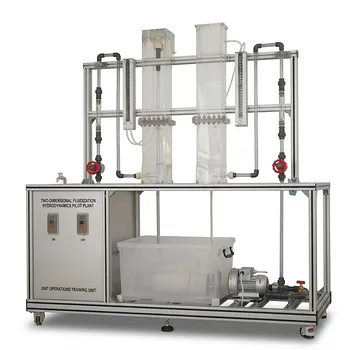
Explore gas-solid and liquid-solid fluidization hydrodynamics with our transparent 2D educational pilot plant. Ideal for chemical engineering unit operations labs, it demonstrates fixed to fluidized bed regimes, measures pressure drop, and integrates QR-code digital learning for enhanced student training.

Bio-fermentation Ethanol Production Practical Training Unit Operations Pilot Plant

Bio-fermentation Ethanol Production Practical Training Unit Operations Pilot Plant

Bio-fermentation ethanol production pilot plant for hands-on training in unit operations: fermentation, solid-liquid filtration, membrane separation, and distillation. Bridges theory with industrial practice using industrial-grade components, customizable for university labs. Hybrid automated and manual control for comprehensive learning.

Comprehensive Multi-Modal Heat Transfer Unit Operations Pilot Plant for Engineering Training

Comprehensive Multi-Modal Heat Transfer Unit Operations Pilot Plant for Engineering Training

Comprehensive multi-modal heat transfer unit operations pilot plant for engineering training. Features four heat exchanger types, multi-media switching, and three operating modes. Hands-on experience in safety, optimization, and process control. Industrial-grade design with real-time data acquisition for chemical engineering labs.

Polymerization Granulation and Pellet Processing Educational Unit Operations Pilot Plant

Polymerization Granulation and Pellet Processing Educational Unit Operations Pilot Plant

Integrated pilot plant for teaching polymer processing from polymerization to pelletizing. Includes 30L reactor, hydrolyzer, extruder-granulator, vibration dryer, crusher, and sieve. Atmospheric pressure operation for safety, corrosion-resistant SS, customizable for chemical and polymer engineering education. Ideal for university labs.

Multi-Modal Distillation Unit Operations Training Pilot Plant

Multi-Modal Distillation Unit Operations Training Pilot Plant

Multi-modal distillation pilot plant for practical unit operations training in chemical engineering education. Features real, analog, and semi-physical simulation modes, industrial construction, customizable for university labs. Hands-on fractionation columns, SCADA control, safety systems. Includes sight glasses, sampling ports, closed-loop recycling.

Educational Unit Operations Pilot Plant for Intraparticle Diffusion Effective Factor Measurement

Educational Unit Operations Pilot Plant for Intraparticle Diffusion Effective Factor Measurement

Designed for chemical engineering university labs, this pilot plant allows hands-on determination of catalyst particle intraparticle diffusion effective factors and gas-solid reaction kinetics using a fixed-bed tubular reactor with industrial touchscreen control, bridging theory and practical reactor design.

Comprehensive Fluid Mechanics Educational Unit Operations Pilot Plant

Comprehensive Fluid Mechanics Educational Unit Operations Pilot Plant

Hands-on fluid mechanics pilot plant for engineering education covering over 13 principles including pipe flow, minor losses, flowmeter calibration, and pump performance with industrial-grade components, smooth and rough piping, venturi and orifice flowmeters, and centrifugal pump testing and analysis.


Leave Your Message