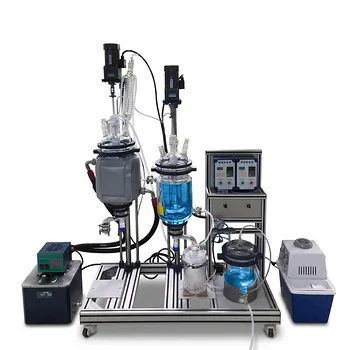
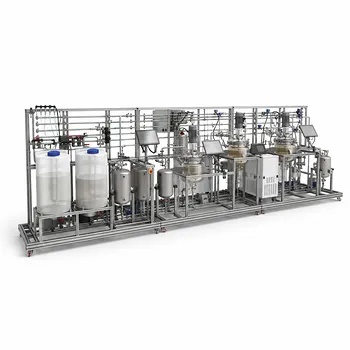
The leap from a 250 mL round-bottom flask to a 20-liter jacketed reactor is not just a matter of size—it’s a pedagogical transformation.
Universities can transition laboratory-scale organic synthesis and purification experiments, such as the preparation and crystallization of Aspirin, into vocational and educational unit operations pilot plants by deploying modular pilot-scale equipment that replicates industrial chemical engineering processes. For Aspirin, this means replacing water baths and Büchner funnels with jacketed stirred-tank reactors for precise thermal control, automated cooling crystallizers to study crystallization kinetics, and pilot-scale vacuum filtration units to master solid-liquid separation. These systems allow students to investigate heat transfer, mass balance, agitation dynamics, and filtration efficiency in a safe yet industrially relevant environment, effectively bridging the gap between benchtop chemistry and chemical engineering practice.
The transition is not about doing the same synthesis in a bigger beaker. It converts a recipe-driven chemistry lab into an engineering investigation of fundamental unit operations. Students move from following a procedure to measuring heat transfer coefficients, designing supersaturation profiles, and optimizing filtration resistance—the exact skills that define industrial chemical engineering competence.
Why Scale Up: The Educational Imperative
Making the Invisible Visible
In a beaker-scale experiment, heat transfer from a hotplate is intuitive but unmeasured. A jacketed reactor with a thermal control system changes that. Students can measure jacket inlet/outlet temperatures, calculate heat duties, and directly observe how exothermic acetylation impacts the reactor’s cooling demand. This transforms a “heat on a hotplate” instruction into a quantifiable heat transfer problem.
From Procedure to Process Understanding
Lab manuals for Aspirin synthesis often specify “heat to 80–85°C, then cool in ice.” In a pilot plant, that cooling step becomes a crystallization unit operation. Students can manipulate cooling rates, experiment with seeding, and monitor crystal size distribution. They learn that purity and yield are not fixed outcomes of a recipe, but controllable results of mass transfer and thermodynamic driving forces.
Building the Vocabulary of Industry
Pilot plants teach the language of unit operations: reaction engineering, crystallization kinetics, solid-liquid separation, and solvent recovery. Whether the student becomes a process chemist, a plant operator, or a quality engineer, this vocabulary and hands-on experience are immediately applicable. The Aspirin synthesis is simply a familiar vehicle to deliver those concepts.
The Pilot Plant Toolkit: Replicating Industrial Unit Operations
The Synthesis Reactor: From Flask to Jacketed Stirred Tank
The heart of the transition is a jacketed glass reactor, typically 10–30 liters, equipped with an anchor or pitched-blade impeller. This mirrors the stirred-tank reactors used in fine chemical production. Key educational elements include:
- Thermal control loops that replace the water bath, allowing students to program temperature ramps and study dynamic response.
- Agitation dynamics: observing how impeller speed affects mixing, gas-liquid contact if needed, and ultimately reaction rate.
- Addition ports for controlled reagent dosing, introducing concepts of fed-batch operation and stoichiometric excess management.
The Crystallizer: From Ice Bath to Controlled Cooling
Crystallization is the primary purification step in Aspirin synthesis, and a pilot-scale cooling crystallizer turns it into an engineering discipline. These units typically feature:
- Automated temperature profiling to walk through the metastable zone, avoiding uncontrolled nucleation.
- Turbidity or particle size probes for real-time monitoring of crystal growth.
- Seeding ports to practice the industrial technique of controlling crystal number and habit.
By moving from “chill in ice” to a crystallizer, students draw solubility curves, identify the supersaturation region, and translate those curves into operational parameters like cooling water flow rate and agitation speed.
The Filtration Unit: From Büchner Funnel to Vacuum Nutsche
Industrial solid-liquid separation is rarely a simple gravity filtration. A pilot-scale vacuum filtration unit—often a Nutsche filter or a vacuum belt filter simulator—introduces students to:
- Filtration resistance as a function of cake thickness, particle size, and applied vacuum.
- Washing and deliquoring steps to optimize purity and minimize solvent use.
- Scale-up calculations by measuring filtrate volume over time and comparing with theoretical models.
This transforms a simple collection step into a full separation unit operation, where yield and wash solvent efficiency become measurable outcomes.
Bridging the Control Gap: From Thermometer to Automation
Manual Mastery, Then Automation
In a lab, students might read a thermometer every two minutes. In a pilot plant, distributed control systems (DCS) or PLC-based control log data continuously. However, the educational transition should begin with manual control so students internalize the cause-and-effect relationships. Only after they can manually hold a temperature setpoint should automation be introduced to multiply productivity and introduce loop tuning.
The Data-Rich Lab Report
Pilot plants generate time-series data on temperatures, pressures, agitation speeds, and flow rates. Student reports shift from “we observed crystals” to analysis of reaction enthalpies, crystallization yields over time, and filtration rate curves. This data fluency is one of the most valuable outcomes for vocational and engineering graduates.
Understanding the Trade-offs
Initial Investment and Space
Pilot-scale equipment is expensive and demands dedicated floor space with proper ventilation, utilities, and containment. A single 20-liter jacketed reactor with a chiller and controls can cost tens of thousands of dollars. Universities must weigh this against the educational return, especially if the equipment serves multiple courses or research projects.
Safety and Supervision Complexity
Larger volumes and pressurized utilities introduce new hazards—hot oil leaks, steam lines, or chemical exposure during charging and sampling. Specialized training for instructors and clear standard operating procedures are non-negotiable. The curriculum must also dedicate time to hazard analysis and risk assessment, which is itself an industrial skill.
The Risk of “Black Box” Operation
If the pilot plant is too automated too early, students may treat it as a mysterious appliance rather than an engineering system. The best transitions expose the internals: glass vessels, visible piping, and manual override options. Transparency keeps the pedagogical value intact.
Curriculum Fit
A pure chemistry program may find heavy unit operations training a distraction from synthetic technique. Conversely, a chemical engineering or vocational technician program gains directly. The pilot plant must align with the program’s goals; otherwise, it becomes an underused trophy. Cross-departmental collaboration can spread the cost and usage.
Making the Right Choice for Your Goal
To successfully transition an Aspirin synthesis experiment into a unit operations pilot plant, match the equipment and depth of study to your primary educational mission.
- If your primary focus is chemical engineering education: Invest in a jacketed reactor with a data acquisition system and a modular crystallizer. Design experiments around heat transfer coefficients, residence time distribution, and crystallization kinetics. The Aspirin synthesis becomes the context; the reactor behavior is the core subject.
- If your primary focus is vocational and technician training: Prioritize hands-on operation and equipment maintenance. Use a robust, glass pilot plant with manual control options and clearly visible process lines. Emphasize start-up, shutdown, troubleshooting, and safety procedures over advanced kinetic modeling.
- If your primary focus is interdisciplinary research: Select a flexible, skid-mounted unit that can be re-configured for different reactions and separations. This allows undergrads to be exposed to industrial methods while also serving graduate research in process development or green chemistry.
- If budget is the main constraint: Begin with a single pilot-scale vacuum filtration unit and a simple jacketed crystallizer. Even these two unit operations, paired with a conventionally synthesized batch of crude Aspirin, can teach mass balance, washing optimization, and separation efficiency without requiring a full reactor setup.
The laboratory beaker gave students their first glimpse of a reaction; a thoughtfully implemented pilot plant gives them the tools to design, control, and optimize the entire process that makes a product real.
Summary Table:
| Unit Operation | Lab-Scale Equipment | Pilot-Scale System | Key Educational Focus |
|---|---|---|---|
| Chemical Reaction | 250 mL round-bottom flask, water bath | 10–30 L Jacketed glass reactor | Heat transfer coefficients, agitation dynamics, reagent dosing |
| Crystallization | Beaker in an ice bath | Automated cooling crystallizer | Solubility curves, nucleation control, particle size monitoring |
| Separation (Filtration) | Büchner funnel & flask | Vacuum Nutsche filter | Filtration resistance, cake washing efficiency, scale-up modeling |
Bring Industrial-Scale Learning to Your Institution
Ready to transition your chemistry labs into dynamic chemical engineering environments? LABPARK provides state-of-the-art Educational and Vocational Unit Operations Pilot Plants in chemical engineering, bioprocess & biotech, and environmental & water treatment. Designed specifically for universities, research institutes, and enterprises, our modular systems bridge the gap between benchtop theory and industrial practice.
Contact us today to design your pilot laboratory and empower the next generation of engineers.
Related Products
- Multi Functional Membrane Crystallization Educational Unit Operations Pilot Plant
- Potassium Salt Thermal Dissolution and Crystallization Separation Educational Unit Operations Pilot Plant
- Multi-Functional Special Distillation Educational Pilot Plant
- Ethyl Acetate Synthesis Unit Operations Pilot Plant for Practical Training
- Multi-Modal Distillation Unit Operations Training Pilot Plant
People Also Ask
- Control Crystallization Pilot Plant Secondary Nucleation: 4 Key Adjustments
- Why is precise temperature control critical in crystallization pilot plants? Key to Scale-Up Success
- What key factors should be considered when configuring a crystallization unit operations pilot plant?
- What are the benefits of integrating online PAT tools like ATR-FTIR into crystallization unit operations pilot plants?
- How to use crystallization pilot plant agitation speed to identify diffusion vs reaction growth?