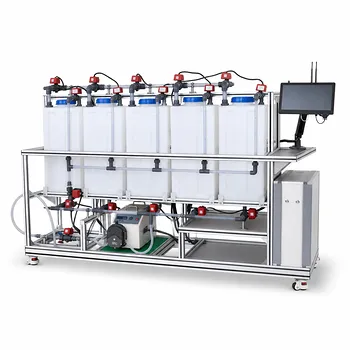
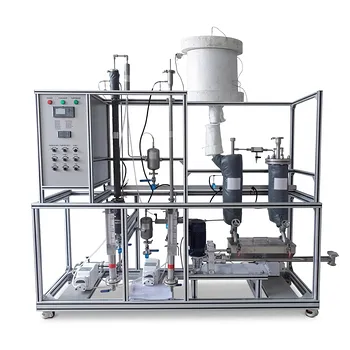
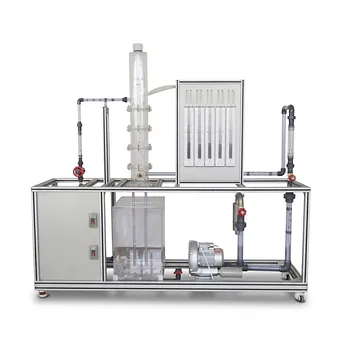
Environmental and water treatment pilot plants are the essential bridge between a nanomaterial synthesized in a lab and a validated field technology. They allow researchers and students to move beyond beaker-scale chemistry and test advanced nanotechnologies—specifically nanostructured filtration membranes and reactive nanoparticle injections—within continuous-flow systems that replicate the complex, dynamic conditions of a real aquifer or industrial treatment train. This is the only way to reliably translate high surface-area chemistry into predictable contaminant removal.
While nanomaterials demonstrate incredible promise in a petri dish, their real-world success hinges on hydrodynamic performance, not just chemistry. Pilot plants let you study the physics of particle transport in porous media and the engineering limits of nano-enhanced filters, providing the critical data on pressure drops, fouling, and longevity that determines whether a technology is scalable or just a laboratory curiosity.
Bridging the Gap from Beaker to Aquifer
New nanomaterials often fail in the field not because they don't work chemically, but because they cannot be delivered or operated effectively under realistic flow conditions. A pilot plant solves this by acting as a physical simulator for the subsurface environment.
Simulating In-Situ Reactive Zones
When studying the injection of reactive nanoparticles, such as nano-scale zero-valent iron (nZVI), a pilot plant becomes a dynamic sandbox. You aren't just mixing particles in a jar; you are pumping a slurry into a packed column or a 2D flow cell that mimics an aquifer.
This approach allows you to study transport phenomena—how far the particles travel before they agglomerate or get stuck. You can physically measure the radius of influence for an injection well under different flow velocities and geological material porosities.
Validating Reactivity Under Flow
The primary reference highlights oxidation-reduction reactions for breaking down complex organics. In a pilot system, you can inject a chlorinated solvent plume and then precisely dose nZVI, monitoring the degradation rate in real-time using in-line sensors.
Crucially, this environment reveals passivation. The continuous flow of groundwater chemistry testing helps you determine how quickly the nanoparticle surface becomes coated with precipitates, directly measuring its reactive lifespan—a variable impossible to fully grasp in a static batch test.
Rigorous Testing of Nanostructured Filtration
Nanostructured membranes, enriched with materials like graphene oxide or carbon nanotubes, face a different scale-up challenge. Their selectivity and permeability must be proven against physical constraints.
Quantifying the Selectivity-Permeability Trade-off
A pilot plant equipped with a nanofiltration module allows you to pump contaminated water across a membrane at controlled pressures. You can precisely measure the rejection rate for specific pollutants, like heavy metals or trace organics.
The goal here is optimization. By varying the cross-flow velocity, you can find the "sweet spot" where the membrane's tiny pore structure provides maximum contaminant capture without requiring excessive energy to overcome the pressure drop.
Diagnosing the Inevitable Fouling Mechanism
Membrane fouling is the single greatest operational cost in nanofiltration. The supplementary references correctly emphasize that pilot plants are essential for studying this.
In a controlled loop, you can isolate organic fouling from biofouling or inorganic scaling. Students learn to correlate a pressure increase with a flux decline and then test cleaning-in-place (CIP) protocols. Evaluating the chemical compatibility of a nanostructured membrane with aggressive cleaning agents is a critical safety and performance step before commercial deployment.
The Critical Proof-of-Scale: Integrating Injection and Filtration
Real groundwater treatment is rarely one step. It involves a process train. A pilot plant's true power lies in integration.
For example, researchers might test a remediation strategy where nZVI is injected to break a recalcitrant pollutant into simpler fragments, but that reaction spikes the iron concentration in the water. A downstream nanostructured filter can then be used to capture the mobilized iron or any remaining toxic intermediates.
Evaluating this sequential treatment lets you study unintended byproduct formation and ensures the final effluent quality meets standards. You can also test the catastrophic scenario of nanoparticle "breakthrough" from the injection zone, where a downstream filter acts as a safety net to capture migrating particles.
Understanding the Trade-offs and Common Pitfalls
Experimental enthusiasm in a pilot plant must be tempered with rigorous monitoring. The technology is not inherently perfect.
- Nanoparticle Leaching: If metallic nanoparticles are embedded in a filtration membrane, they may leach into the permeate. A pilot plant must be a closed loop for safety validation, rigorously analyzing effluent for any secondary nanomaterial contamination.
- Agglomeration in Porous Media: The primary promise of nZVI is high reactivity, but its primary failure mechanism is agglomeration. A pilot study often reveals significant pressure build-up near an injection well, requiring tuning of particle surface coatings or stabilizing polymers—variables that define economic feasibility.
- Sorption vs. Degradation: A filter might remove a pollutant through temporary adsorption, not destruction. A pilot plant reveals this by plotting a breakthrough curve. If contaminants spike after a short period, you know you have a saturation problem, requiring regeneration cycles that increase operating costs.
Making the Right Choice for Your Research Goal
Your approach to the pilot plant should be determined by your primary research objective. The platform is flexible, but the configuration must be intentional.
- If your primary focus is particle mobility and reactivity: Design the pilot plant around packed-bed column experiments and injection ports with high-resolution pressure sensors to map nZVI transport and lifespan.
- If your primary focus is water purification and selectivity: Focus on the membrane module, automated backwash systems, and in-line conductivity/turbidity meters to meticulously document rejection rates and flux decline.
- If your primary focus is scaling industrial training: Configure the pilot plant as a multi-stage train that lets students disassemble and assess fouled membranes, calculate operating costs, and manage chemical cleaning safely.
By treating the pilot plant not just as a demonstration tool but as a high-fidelity environmental simulator, you generate the data—on mass transfer, hydraulic performance, and material longevity—that is mandatory for regulatory approval and public trust in these advanced materials.
Summary Table:
| Research Focus | Key Phenomena Studied | Major Operational Challenges |
|---|---|---|
| Nanoparticle Injection (e.g., nZVI) | Transport in porous media, radius of influence, degradation kinetics | Particle agglomeration, chemical passivation |
| Nanostructured Filtration | Selectivity-permeability trade-offs, membrane rejection rates | Organic/biofouling, membrane scaling |
| Integrated Process Trains | Sequential treatment efficiency, safety bypass systems | Nanoparticle breakthrough, active material leaching |
Advance Your Water Treatment Research with LABPARK
Transitioning advanced nanomaterials from the laboratory beaker to real-world applications requires robust, scalable systems. LABPARK designs and manufactures high-performance Educational and Vocational Unit Operations Pilot Plants in chemical engineering, bioprocess & biotech, and environmental & water treatment for universities, research institutes, and enterprises.
Our custom pilot systems empower researchers to study hydrodynamic transport, membrane fouling, and multi-stage treatment trains under realistic conditions. Ready to elevate your research and engineering training? Contact us today to discuss your project requirements.
Related Products
- Fixed-Bed Chemical Reaction and Gas Dust Tar Removal Unit Operations Pilot Plant
- Electrochemical Water Treatment Educational Unit Operations Pilot Plant
- Ion Exchange Water Purification Educational Pilot Plant for Engineering Unit Operations
- Solid Waste Pyrolysis and Refining Educational Pilot Plant for Unit Operations
- Natural Product Extraction Unit Operations Training Pilot Plant
People Also Ask
- When to transition from PID to adaptive control in pilot plants? Key process indicators.
- How do deviations in estimating latent heat impact pilot plant thermal systems? Avoid hardware mis-sizing.
- Why Compare Predicted and Experimental Excess Enthalpy? Key to Accurate Pilot Plant Scale-up
- How can chemical engineering students use unit operations pilot plants to study kinetics? Master reactor scale-up!
- Why Use PTFE & Hastelloy in Chemical Pilot Plants? Prevent Corrosion & Ensure Safety