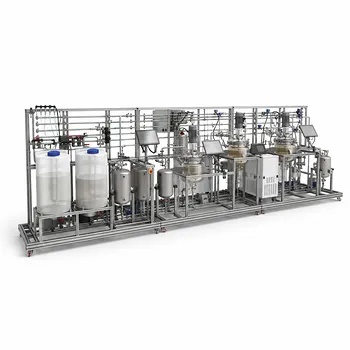
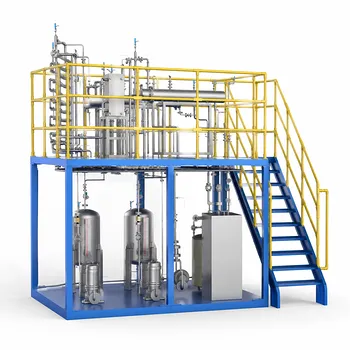
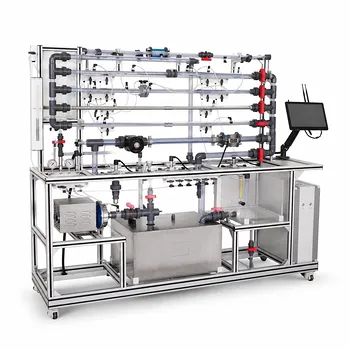
Pilot plants demonstrate QbD for raw material variability by becoming a physical sandbox for cause-and-effect learning. Instead of treating quality as a final inspection step, students and researchers use these scaled-down manufacturing lines to deliberately alter incoming material properties—like particle size, purity, or moisture content—and then trace the ripple effects through every downstream unit operation. This hands-on approach transforms abstract regulatory concepts into a tangible, data-rich exercise that teaches how to define science-based acceptance criteria and build processes that are inherently robust to variation.
Unit operations pilot plants bridge the gap between QbD theory and industrial practice by enabling the sequential physical simulation of a manufacturing train. They reveal how deliberately introduced raw material variability propagates to final product quality, forming the basis for deriving statistical acceptance criteria and a validated design space—a true science- and risk-based development paradigm.
The Core Experiment: Tracing Variability Through the Train
Simulating the Manufacturing Sequence
QbD demands that we understand how inputs relate to outputs. A unit operations pilot plant lets you run the entire process consecutively, from raw material feeding to the final product collection.
You aren't just testing a single isolated step. You start at the initial unit—a reactor, a blender, or a crystallizer—introduce a batch of raw material with a known, deliberate variation (e.g., a coarser particle size distribution), and then without stopping, observe how that change affects mixing efficiency, reaction yield, granule density, or tablet hardness at the end of the line. This sequential exposure is the only way to reveal hidden interaction effects that isolated bench-top experiments miss.
Deliberate Perturbation of Starting Materials
The key is not to work with uniform, ideal materials. You must intentionally “spike” the process with challenging raw material lots. This might mean using a feedstock with a wider particle size distribution, a higher impurity level, or a different polymorphic form.
By comparing a standard lot to a “worst-case” lot, students visually and analytically witness the cascade of deviations. They see firsthand that a small shift in raw material rheology can amplify into a large deviation in coating thickness or dissolution rate. This teaches the fundamental principle that quality cannot be tested into a product; it must be built in through a deep understanding of material-process interactions.
From Observation to Statistically Defensible Criteria
Applying Multivariate Analysis to Pilot Plant Data
Watching the process is one thing; proving a robust operating space requires numbers. Pilot plants generate the dense, multivariate data needed for rigorous statistical modeling.
Students can execute a Design of Experiments (DoE) on the pilot line, co-varying both raw material attributes and process parameters. They then apply techniques like multivariate latent variable modeling (LVM) or hypothesis testing to the resulting data. This reveals exactly which raw material characteristics are "critical" and, more importantly, establishes the multidimensional acceptance criteria—the actual numerical limits on incoming material properties—that the rest of the process can tolerate without quality failure.
Determining Process Capability and Risk
A raw material might be within specification, but still cause a process to operate dangerously close to a failure edge. Pilot plant experiments quantify this risk. By running multiple batches with materials at the edges of their expected variability, researchers can calculate a process capability index relative to the final quality target.
They learn that a statistically derived design space is not a theoretical box but a probability map. A 90% success region in a laboratory becomes an 80% region at pilot scale due to unmodeled disturbances. This teaches the critical insight that the “safe” operating zone shrinks under real-world noise, and acceptance criteria must be tighter than a simple lab analysis would suggest.
Integrating Advanced Control to Compensate for Variability
Feedforward Control as a Learning Tool
A passive process simply endures raw material variation; a QbD-driven process actively compensates. Modern educational pilot plants can be equipped with flexible control systems that allow students to implement feedforward strategies.
If an incoming raw material stream shows a higher-than-expected moisture content, the student can program the drying step to automatically increase air temperature or residence time based on a model equation. By solving these equations in real time and coding the logic into the pilot plant’s interface, students move from passive observation to active design of a robust control strategy that keeps the entire process within the validated design space, even when the input is variable.
Bridging the Gap to Real-World Commercialization
This control integration is where the pilot plant truly simulates industrial reality. A theoretical design space on paper is useless without a strategy to stay within it. By physically implementing sensor feedback loops and model-predictive adjustments, the pilot plant becomes a testbed for commercialization.
Researchers learn that raw material testing isn't just for rejection; it's a source of information for dynamic process tuning. This hands-on integration of chemometrics with control engineering is precisely what transforms a static formulation into a living, resilient manufacturing process.
Understanding the Trade-offs
The Scale-Up Disconnect
A pilot plant is not a miniature factory. The design space mapped at pilot scale will shift during industrial scale-up. Mixing dynamics, heat transfer rates, and residence time distributions differ fundamentally. Students must be taught that the pilot plant defines the functional relationship between variables, but the absolute numerical boundaries will need re-validation at full scale. This is a critical pedagogical point to prevent overconfidence in laboratory-derived limits.
The Cost of Realism and Safety
Running a complete train of unit operations with deliberately problematic materials is resource-intensive. It consumes expensive raw materials, generates waste that may require special disposal, and introduces legitimate process safety risks if reaction enthalpies or dust explosions are uncontrolled. The educational value must be balanced against these practical and safety constraints. Simulations often supplement the physical experiments for the most extreme "edge-of-failure" studies, and a clear safety protocol for every deliberate perturbation is non-negotiable.
Data Complexity and Interpretation
A pilot plant can generate a flood of data, and without proper guidance, students may drown in it. The risk is mistaking correlation for causation. A statistical link between a raw material property and a quality attribute does not automatically reveal the mechanistic reason. Educators must pair the physical experiment with the theoretical framework of mass and energy balances, surface chemistry, and transport phenomena, or the exercise becomes a "black box" data-fitting exercise rather than a true QbD knowledge-building activity.
Making the Right Choice for Your Educational or Research Goal
The best way to structure a pilot plant demonstration depends entirely on the learning objective you need to achieve. Select the approach that matches your goal.
- If your primary focus is teaching foundational QbD concepts: Start with a simple sequence of blending and compaction, deliberately vary a single raw material attribute like particle size, and ask students to manually plot the downstream quality response to derive a univariate acceptance range.
- If your primary focus is advanced statistical modeling and design space definition: Use a reactor or granulator system with a formal DoE framework, vary multiple raw material and process factors together, and have students build a multivariate latent variable model to visualize the multi-dimensional design space.
- If your primary focus is process control and robustness: Integrate a feedforward control algorithm into a crystallization or drying unit, provide students with two lots of raw material with known property differences, and task them with tuning the control model to maintain a constant product crystal size or final moisture content without human intervention.
- If your primary focus is preparing students for industrial technology transfer: Run the same DoE experiment on a laboratory-scale pilot plant and then on a slightly larger intermediate-scale line, requiring students to compare the failure boundaries and present a risk-based scale-up proposal that accounts for the shrinking design space.
A unit operations pilot plant is ultimately a time-compressed, physical argument against testing quality at the end. It proves, in a way that a textbook never can, that a robust process begins with defining the exact nature of acceptable raw materials and the dynamic strategy to handle them.
Summary Table:
| Focus Area | Experimental Setup | Key Learning Outcome |
|---|---|---|
| Foundational QbD Concepts | Simple blending/compaction; vary one raw material attribute. | Derive univariate acceptance ranges from downstream quality responses. |
| Statistical Modeling | Reactor/granulator with multi-variable DoE framework. | Build multivariate latent variable models to visualize the design space. |
| Process Control & Robustness | Feedforward control integration in crystallization or drying. | Tune control models to dynamically maintain product quality. |
| Industrial Tech Transfer | Comparative DoE runs on lab-scale and intermediate-scale lines. | Analyze shrinking design spaces and propose risk-based scale-up plans. |
Bring "Quality by Design" to Life in Your Lab
Teaching complex QbD concepts requires hands-on, physical experimentation. LABPARK provides state-of-the-art Educational and Vocational Unit Operations Pilot Plants in chemical engineering, bioprocess & biotech, and environmental & water treatment.
Designed specifically for universities, research institutes, and enterprises, our pilot plants empower your students and researchers to master raw material variability, process control, and scale-up dynamics in a safe, controlled environment.
Ready to elevate your training and research capabilities? Contact us today to explore our pilot plant solutions.
Related Products
- General Purpose Cosmetics Production Unit Operations Training Pilot Plant
- Multi Pump Fluid Transport Process Piping Unit Operations Training Pilot Plant
- Multi-Functional Drying Educational Unit Operations Pilot Plant
- Fixed-Bed Chemical Reaction and Gas Dust Tar Removal Unit Operations Pilot Plant
- 100L Continuous Loop Hydrogenation Educational Unit Operations Pilot Plant
People Also Ask
- Why is the chemical plant startup schedule crucial? De-risk scale-up with pilot plants.
- How do deviations in estimating latent heat impact pilot plant thermal systems? Avoid hardware mis-sizing.
- When to transition from PID to adaptive control in pilot plants? Key process indicators.
- Why Compare Predicted and Experimental Excess Enthalpy? Key to Accurate Pilot Plant Scale-up
- Why Use PTFE & Hastelloy in Chemical Pilot Plants? Prevent Corrosion & Ensure Safety