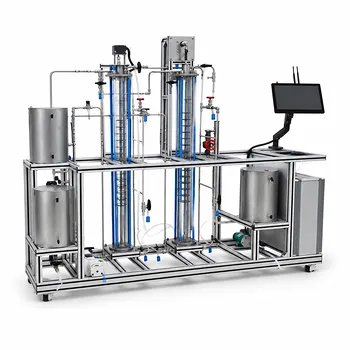
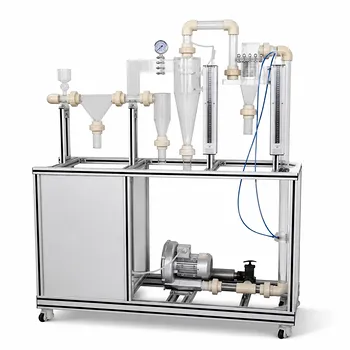
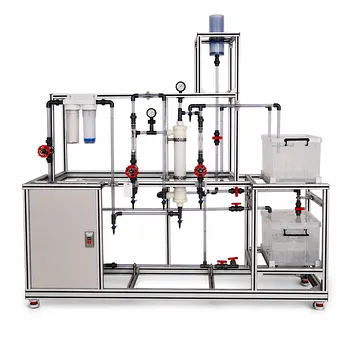
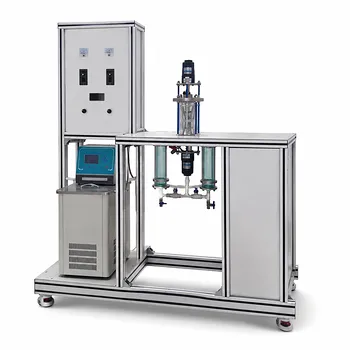
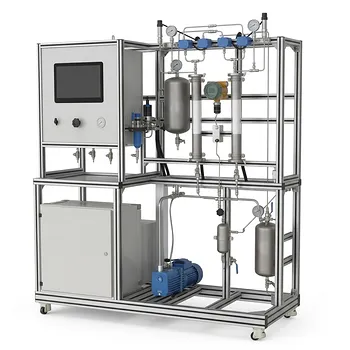
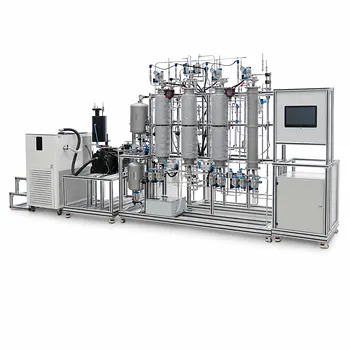
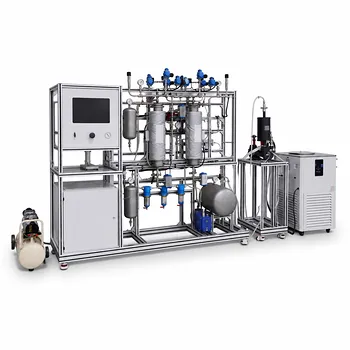
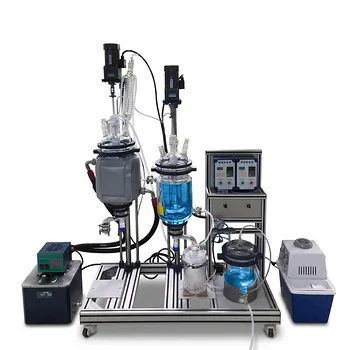
A pilot plant designed to demonstrate process intensification in water-in-crude oil emulsion separation should combine a high-voltage electrostatic coalescer with a downstream solid-state polymeric demulsifier adsorber. This configuration leverages a synergistic mechanism: the electric field rapidly grows tiny water droplets, and a hydrophilic micro-porous PolyHIPE Polymer (PHP) bed captures them with high selectivity. The result is continuous, high-rate separation in a dramatically smaller footprint than conventional gravity settlers or heated tanks.
Process intensification isn’t about simply making equipment smaller—it’s about removing inherent bottlenecks. In emulsion separation, the bottleneck is slow droplet settling. By integrating electro-coalescence with a solid-state adsorber, you create a system where neither technology alone would suffice, but together they achieve complete demulsification at flow rates and energy inputs that defy traditional models.
Configuring the Core Pilot Plant Setup
The Electrostatic Coalescer: Inducing Droplet Growth
The first module is a high-voltage electrostatic field applied to the flowing emulsion. Water-in-oil emulsions are stabilized by tiny droplets that resist natural coalescence. The field polarizes and stretches these droplets, overcoming interfacial tension and forcing them to collide and merge. This rapidly transforms a micro-emulsion into a coarser dispersion with dramatically larger water droplets, ready for capture.
The PolyHIPE Polymer Adsorber: Capturing the Coalesced Droplets
Directly downstream, the emulsion passes through a bed of hydrophilic micro-porous PolyHIPE Polymers (PHPs). These solid-state materials have an interconnected porous network with a strong affinity for water. The enlarged droplets from the electrostatic field are immediately wicked into the pores, while the continuous oil phase flows past. This mechanical adsorption step removes the water instantly, without relying on slow gravity settling or a sharp density difference.
Synergy at High Throughputs
The combination is multiplicative. At high flow rates, electrostatic treatment alone often fails because the enlarged droplets don't have time to settle. The PHP bed solves this by actively capturing them. Conversely, at lower electric field strengths—where coalescence is minimal—the PHP’s high surface area can still trap smaller droplets, provided they are somewhat pre-enlarged. The pilot plant demonstrates that complete separation can be maintained even when one mechanism is deliberately weakened, a hallmark of process intensification.
Demonstrating the Core Principles of Process Intensification
Drastically Reduced Equipment Footprint and Residence Time
Traditional separation relies on large-volume gravity settlers or centrifuges with residence times measured in minutes to hours. The integrated pilot unit slashes that to seconds, directly validating the PI goal of replacing bulky equipment with compact, rate-enhanced alternatives. Observing a stream transition from milky emulsion to clear oil in a benchtop footprint is the most compelling proof of concept.
Enhanced Separation Efficiency at Lower Energy Input
Conventional methods often heat the entire emulsion to reduce oil viscosity—an energy-intensive step. This pilot configuration shows that electrical energy applied only to the interface is far more efficient. Furthermore, because the PHP performs the final capture, the electrostatic field strength can be reduced, cutting energy use while still hitting separation targets. Measurement of power consumption versus throughput yields data that directly challenges the cost assumptions of thermal-only processes.
Visualizing the Physics Behind the Intensification
Pilot plants are teaching tools. With glass-walled electrostatic cells and transparent PHP cartridges, students can see the droplet size distribution shift in real time. They can measure pressure drops across the polymer bed, vary voltages, and sample inlet and outlet streams for analysis. This transforms abstract mass-transfer equations into tangible, measurable events. Observing that a small voltage increase cuts polymer loading in half, for example, makes the synergy tangible.
Understanding the Trade-offs and Limitations
Material Compatibility and Fouling
Not all crude oils are alike. Asphaltenes, waxes, and chemical demulsifiers can foul the PHP’s pores, gradually reducing its water uptake capacity. The pilot plant must be configured with easy-access cartridge swaps and pressure sensors to correlate fouling rates with oil composition. Long-duration runs become a critical research objective, revealing that the adsorber’s lifetime is a key economic variable that must be balanced against capital savings.
Electrical Safety and Process Complexity
High-voltage systems integrated with flammable liquids demand rigorous safety interlocks, grounding, and inert blanketing—adding complexity that a simple heated tank avoids. The pilot plant is an ideal environment to develop these protocols and to demonstrate that the knowledge gained from compact, intensified geometries far outweighs the extra engineering discipline required.
Cost and Availability of Advanced Polymers
PolyHIPE materials are still a specialty item. Their long-term mechanical stability under flow and regeneration cycling is an active area of study. While the pilot unit proves the concept decisively, translating it to industrial scale may require substituting the PHP with more widely available polymeric membranes tuned to similar surface properties. The pilot plant thus doubles as a test-bed for comparative adsorbent screening.
Making the Right Choice for Your Educational or Research Goal
The optimal pilot plant configuration depends on what you need to demonstrate.
- If your primary focus is undergraduate education: Use a benchtop system with a transparent electrostatic cell and a disposable PHP cartridge. Emphasize flow visualization and simple mass-balance experiments that directly link voltage, flow rate, and separation efficiency.
- If your primary focus is graduate research on novel materials: Build a modular rig where the adsorber section can be rapidly reconfigured to test different polymer morphologies, surface chemistries, or even inorganic membranes. Install high-frequency impedance sensors to study droplet size evolution in real time.
- If your primary focus is scale-up evaluation: Run long-duration tests with a slipstream of real crude oil. Instrument everything to track pressure drop, water cut, and polymer degradation. This configuration becomes a process qualification tool, bridging lab data and pilot-scale design correlations.
A unit operations pilot plant configured around electrostatic coalescence and solid-state adsorption does more than teach a separation technique—it reveals a design philosophy where two limiting processes are merged to eliminate each other’s weaknesses, delivering performance neither could achieve alone.
Summary Table:
| Pilot Plant Module | Key Separation Mechanism | Process Intensification (PI) Benefit |
|---|---|---|
| Electrostatic Coalescer | High-voltage field polarizes and merges micro-water droplets | Rapid droplet growth, overcoming interfacial tension bottlenecks |
| PolyHIPE Adsorber | Hydrophilic micro-porous polymer bed captures enlarged droplets | Instant water removal, eliminating large-footprint gravity settling |
Bring Hands-On Process Intensification to Your Lab
LABPARK provides high-quality Educational and Vocational Unit Operations Pilot Plants in chemical engineering, bioprocess & biotech, and environmental & water treatment. Designed specifically for universities, research institutes, and enterprises, our modular pilot plants help you bridge the gap between abstract engineering theory and real-world industrial scale-up.
Ready to elevate your research and training capabilities? Contact LABPARK today to customize the perfect pilot plant configuration for your lab!
Related Products
- Comprehensive Liquid-Liquid Extraction Pilot Plant for Engineering Education
- Bio-fermentation Ethanol Production Practical Training Unit Operations Pilot Plant
- High-Gravity Emulsification and Mass Transfer Educational Pilot Plant
- Gas-Solid Heterogeneous Separation Demonstration Educational Unit Operations Pilot Plant
- Multifunctional Membrane Separation Educational Pilot Plant with Ultrafiltration, Nanofiltration, Reverse Osmosis
People Also Ask
- How do pilot plants differentiate physical vs chemical extraction? Enhance Chemical Engineering Training
- How are ternary phase diagrams and LLE data applied in extraction experiments? Optimize Pilot Plant Scale-up
- How to Validate BIPs for LLE Pilot Plants? Steps to Align Simulations with Reality
- In a liquid-liquid extraction pilot plant, how is a ternary-phase diagram utilized to determine solvent feed requirements?
- How Do Selectivity & Distribution Coefficients Influence LLE Pilot Plant Solvent Choice?