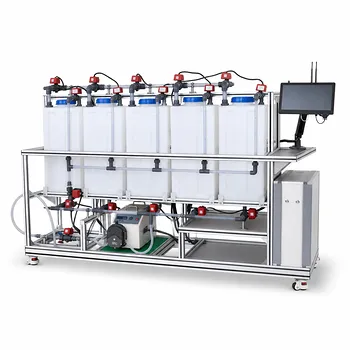
The common ion effect is best demonstrated in a chemical engineering pilot plant by adding a strong electrolyte with a shared ion to a weak electrolyte solution and then quantifying the resulting suppression of ionization through real-time pH and conductivity measurements.
For example, when solid sodium acetate (CH₃COONa) is dissolved into a dilute acetic acid (CH₃COOH) solution, the acetate ion (CH₃COO⁻) from that fully dissociated salt shifts the weak acid’s equilibrium (CH₃COOH ⇌ H⁺ + CH₃COO⁻) sharply to the left. In an educational pilot plant equipped with inline sensors, this shift becomes instantly visible as a distinct rise in pH and a measurable change in overall solution behavior. Managing the effect goes far beyond a single demonstration—it teaches students how to design buffer systems, control precipitation, and simulate the equilibrium-driven separations that underpin dozens of industrial chemical processes.
The core insight: The common ion effect transitions from a textbook abstraction to a tangible, operational tool when pilot plants combine weak electrolyte systems with real-time process analyzers. By deliberately manipulating the concentration of a common ion, students and researchers can directly control dissociation, stabilize critical pH ranges, and replicate the recovery strategies used in full-scale manufacturing—all while gathering the data needed to calculate fundamental constants like the ionization constant (Kₐ).
Demonstrating the Common Ion Effect in the Pilot Plant
A well-designed educational pilot plant moves the common ion effect from paper-and-pencil calculations to a sensory, measured phenomenon. The key is to couple a chemically predictable weak electrolyte system with instrumentation that reveals equilibrium shifts as they happen.
The Classical Acetic Acid/Sodium Acetate System
The most straightforward demonstration runs an acetic acid solution through a mixing tank or flow reactor and then introduces a common ion salt—typically sodium acetate.
What happens chemically: Acetic acid is a weak electrolyte that only partially ionizes, establishing the reversible equilibrium CH₃COOH ⇌ H⁺ + CH₃COO⁻. Sodium acetate, a strong electrolyte, dissociates completely to give Na⁺ and CH₃COO⁻. The sudden influx of acetate ions forces the equilibrium to the left, consuming hydrogen ions and forming undissociated acetic acid molecules.
The outcome is a drastic reduction in the degree of ionization of the weak acid. The hydrogen ion concentration plummets, which students read directly as an increase in pH.
Real-Time Visualization with Inline Sensors
Modern pilot plants feature inline conductivity sensors and pH transmitters that turn the abstract equilibrium shift into a live data stream.
When a strong common ion source is added, the pH sensor registers an immediate, sustained rise—proof that fewer free H⁺ ions exist in solution. Meanwhile, the conductivity sensor often shows a net increase in conductivity, because the added Na⁺ and CH₃COO⁻ ions from the salt contribute far more charge carriers than the lost H⁺ from the acid. This simultaneous observation of rising pH with rising total conductivity is a powerful lesson: it distinguishes the specific suppression of a weak electrolyte’s dissociation from the overall ionic strength of the mixture.
Running the same molarity of pure acetic acid through the pilot plant first establishes a baseline. The low conductivity and moderately acidic pH then serve as a reference, making the changes after salt addition unmistakable.
From Observation to Calculation: Determining the Ionization Constant
Measurements from the pilot plant are not just qualitative. With the equilibrium concentrations in hand—derived from pH and known feed concentrations—students can calculate the ionization constant (Kₐ) of the weak acid.
For acetic acid, knowing the initial acid concentration and the equilibrium [H⁺] from the pH reading allows a direct computation of Kₐ. When the same exercise is repeated after adding a known amount of sodium acetate, the new equilibrium confirms Le Chatelier’s principle and demonstrates how Kₐ remains constant while the relative concentrations of the species shift. This bridges the pilot plant data to the fundamental thermodynamics taught in the classroom.
Managing the Effect for Process Control and Product Recovery
Beyond demonstration, the common ion effect becomes a deliberate process lever in the pilot plant. Instructors use it to teach how industrial unit operations manipulate equilibrium for practical ends.
Buffer Design and pH Stabilization
Adding a common ion weak electrolyte system is the central mechanism behind buffer preparation. By controlling the ratio of a weak acid to its conjugate base salt (e.g., CH₃COOH/CH₃COONa), the pilot plant can be set to maintain a nearly constant pH even when small amounts of acid or base are introduced.
Students see how a formulation with a high common ion concentration resists pH change far more effectively than a diluted weak acid alone. This directly replicates the buffer systems used in fermentation broths, pharmaceutical syntheses, and wastewater treatment.
Suppressing Solubility for Crystallization
The common ion effect also operates on sparingly soluble salts. Adding a salt that shares an ion with a weakly soluble product reduces the product’s solubility, driving it out of solution.
In a pilot plant crystallizer, a common ion salt can be dosed to force a target compound to precipitate. Students measure the yield improvement and analyze the crystal size distribution, connecting equilibrium management to a classic separation technique. This is fundamental for recovering high-value fine chemicals where purity and recovery efficiency are paramount.
Simulating Industrial-Scale Recovery Processes
Many industrial product recovery schemes rely on ionization suppression to shift an equilibrium toward an extractable, insoluble, or non‑ionized species.
By managing the common ion concentration in a continuous stirred‑tank reactor or a packed column, the pilot plant can mimic processes used to recover organic acids from aqueous streams. The student sees that simply adjusting the ion balance can transform a dissolved, un‑recoverable substance into a separate phase—a lesson in green chemistry and process intensification. When coupled with solvent extraction or distillation, this common-ion‑driven preconditioning step becomes a convincing model of a real production line.
Understanding the Trade‑offs
While powerful, the common ion effect in an educational pilot plant comes with practical limitations that must be taught alongside the benefits.
- Increased ionic strength complicates advanced calculations. Adding a common ion salt raises the solution’s total ionic strength. This alters activity coefficients, making ideal‑solution assumptions less accurate. For upper‑level experiments that demand thermodynamic rigor, students must apply models like the Debye‑Hückel equation to correct for non‑ideality.
- The effect is most pronounced in dilute solutions. At higher concentrations, ion‑pairing and other intermolecular interactions can partially offset the equilibrium shift. The observed pH change may be smaller than predicted by a simple Le Chatelier interpretation, providing an opportunity to discuss solution non‑ideality.
- Salt contamination can burden downstream processing. If the pilot plant’s goal is to recover a pure product via crystallization or extraction, the added common ion salt itself often becomes an impurity. Additional washing, filtration, or ion‑exchange steps are then needed to remove it, mirroring the real‑world trade‑off between recovery efficiency and product purity.
- Sensor fouling demands maintenance. Inline conductivity and pH probes, exposed to changing salt concentrations and possible precipitates, require regular calibration and cleaning. A poorly maintained sensor can give misleading data, undermining the very lessons the experiment is designed to teach.
Making the Right Choice for Your Educational Goal
The way you incorporate the common ion effect into your pilot plant curriculum should match the primary learning outcomes.
- If your primary focus is teaching equilibrium fundamentals: Start with the acetic acid/sodium acetate batch experiment, using simple pH and conductivity measurements to show the link between ion concentration, equilibrium shift, and the constancy of Kₐ.
- If your primary focus is hands‑on process control: Design a continuous flow experiment where students must manually adjust a common ion feed rate to hold pH within a tight window, simulating buffer management in a live reactor.
- If your primary focus is product recovery and separations: Introduce a precipitation or liquid‑liquid extraction step triggered by the common ion effect, then have students measure yield and purity to balance recovery against added salt contamination.
- If your primary focus is modern green engineering: Frame the common ion effect as a non‑thermal separation tool, then challenge students to minimize salt waste by recycling the concentrated brine or by selecting ionic species that can be easily removed.
A single pilot plant can seamlessly weave together these facets, turning a simple chemical principle into a comprehensive lesson in design, measurement, and industrial reality.
Summary Table:
| Application | Chemical Mechanism | Key Measurements & Sensors |
|---|---|---|
| Equilibrium Shift | Adding common ion salt shifts weak electrolyte equilibrium | pH increase, conductivity changes |
| Buffer Design | Weak acid/conjugate base resists pH fluctuations | pH stability under acid/base addition |
| Product Crystallization | Added common ion reduces product solubility | Precipitation yield, crystal size |
| Industrial Recovery | Shifts equilibrium to extractable/insoluble species | Phase separation, product purity |
Bring complex chemical equilibrium concepts to life in your lab. LABPARK provides high-quality Educational and Vocational Unit Operations Pilot Plants in chemical engineering, bioprocess & biotech, and environmental & water treatment. Tailored for universities, research institutes, and enterprises, our systems enable hands-on learning with real-time process monitoring. Contact us today to enhance your engineering curriculum!
Related Products
- Multi-Reactor Educational Pilot Plant for Reaction Engineering Unit Operations
- Multi-Functional Special Distillation Educational Pilot Plant
- Fixed Bed Gas Solid Catalytic Reaction Educational Pilot Plant
- Carbon Dioxide Hydrogen Methanol Synthesis Educational Unit Operations Pilot Plant
- Fixed-Bed Chemical Reaction and Gas Dust Tar Removal Unit Operations Pilot Plant
People Also Ask
- How do reactor pilot plants define QbD design space? Master chemical process scale-up.
- When configuring a reactor unit operations pilot plant for highly exothermic reactions, how to prevent thermal runaway?
- How do metal ion-catalyzed reaction mechanisms inform chemical engineering pilot plant design? From kinetics to scale-up
- What role do educational pilot plants play in scaling green chemistry? Bridging the Lab-to-Industry Gap
- What are the barriers to process intensification & how do pilot plants help?