The calcium carbonate-bicarbonate equilibrium is the master switch between scaling and corrosion in water systems—and pilot plants reveal exactly how to control it. Students and technicians demonstrate this dynamic by altering pH, temperature, or chemical additives in a controlled flow-through system while measuring pH, alkalinity, and calcium hardness. The resulting precipitation or dissolution of CaCO₃ provides a tangible, hands-on lesson in managing industrial water conditioning, from preventing pipe blockages to optimizing softening processes.
At its core, the reaction (Ca^{2+} + 2HCO_3^- \rightleftharpoons CaCO_3 + H_2CO_3) is a classic equilibrium. Pilot plants turn this abstract principle into a visible, measurable process by allowing you to intentionally shift the balance and observe the immediate consequences on heat exchangers, sensors, and water chemistry.
The Chemistry You’re Manipulating
The Core Equilibrium and Its Two-Way Power
The reversible reaction governs whether calcium ions stay dissolved as bicarbonate or form solid scale.
Think of it as a seesaw: pushing more (Ca^{2+}) or (HCO_3^-) into the system forces the production of CaCO₃ precipitate (the scaling side), while removing CO₂ or lowering pH pulls it back toward dissolution (the corrosive side).
pH as the Primary Lever
Carbonate ions hydrolyze in water, naturally raising pH up to about 9.9 in pure distilled water.
By injecting acid (e.g., H₂SO₄) to drop pH to 5.5–6.0, you shift the equilibrium drastically toward the left, dissolving existing scale and releasing free (Ca^{2+}) and CO₂.
Conversely, raising the pH above 8.3 with a base or through aeration drives CO₂ out, pushing the reaction hard to the right and causing rapid calcium carbonate precipitation.
The Solubility Product: A Hard Limit
CaCO₃ has a solubility product of (4.8 \times 10^{-9}).
Once the product of calcium and carbonate ion concentrations exceeds this tiny value, precipitation becomes thermodynamically inevitable.
A pilot plant lets you approach this limit slowly, visually seeing the first crystal formation on heated surfaces or clear inline filters.
How a Pilot Plant Brings Equilibrium to Life
Replicating Real-World Conditions at Scale
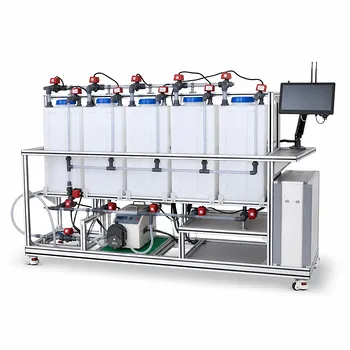
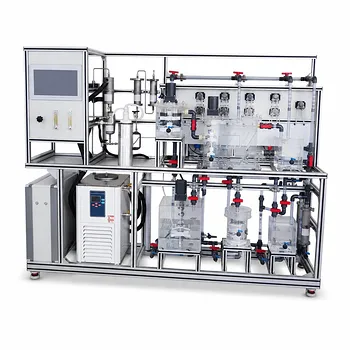
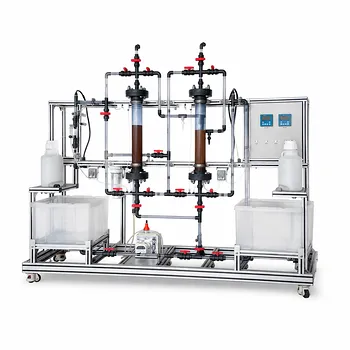
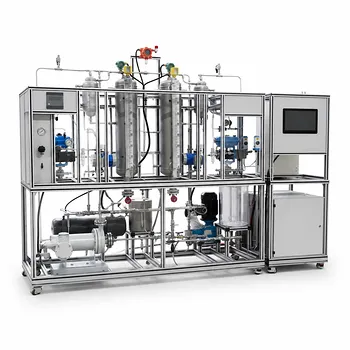
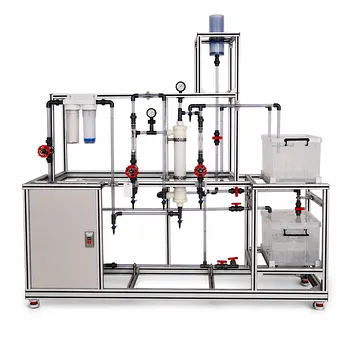
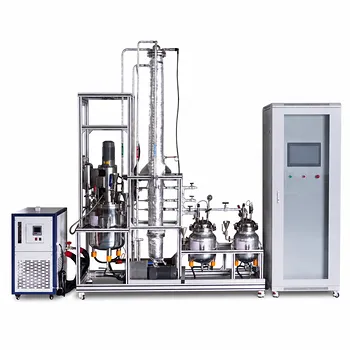
An environmental water treatment pilot plant typically includes a raw water tank, dosing pumps for chemicals, a heat exchanger, and inline sensors for pH, conductivity, and flow.
You can intentionally create scaling conditions by running hard water at elevated temperatures (50–60°C) through a heat exchanger, where the temperature rise shifts the equilibrium right, producing a CaCO₃ film in hours.
The Measurement Toolkit: M-Alkalinity and Beyond
Monitoring demonstration requires more than visual inspection.
M-alkalinity (total alkalinity to pH ~4.5) and pH measurements allow you to calculate dissolved CO₂, especially in the useful pH range of 5.3 to 8.2.
By tracking these parameters every 15 minutes, students can quantify how much CO₂ is being stripped by aeration or how much is released during acid-driven dissolution, turning a qualitative equilibrium into a calculable mass balance.
Triggering and Observing the Shifts
Three classic demonstrations illuminate the equilibrium:
- Temperature jump: Divert the flow through a heated tube; within minutes, outlet turbidity spikes as CaCO₃ forms.
- Aeration or nitrogen stripping: Bubble air through a reservoir to remove CO₂, raising pH and forcing precipitation without adding chemicals.
- Chemical precipitation: Dose lime (Ca(OH)₂) or soda ash (Na₂CO₃) to deliberately create the “softening” reaction, removing hardness before it reaches downstream equipment.
Each shift is immediately visible in changing pH, conductivity, and the appearance of a white precipitate on sensors or in a settling cone.
Translating Demonstration into Industrial Control
Preventing Scale: Decarbonation and Acid Dosing
Once you’ve demonstrated how quickly scale forms, controlling it becomes the objective.
Decarbonation by air stripping or vacuum removes CO₂ before the water enters heated processes, shifting equilibrium left and keeping calcium in solution.
Acid dosing (commonly sulfuric or hydrochloric acid) converts bicarbonate to CO₂, actively reversing the scaling reaction. The pilot plant teaches critical safety and corrosion risks when overdosing.
Deliberate Softening: Lime-Soda Softening in Miniature
The pilot plant is a perfect learning platform for lime softening.
By adding Ca(OH)₂, you raise pH drastically and supply hydroxide, which converts bicarbonate to carbonate and forces CaCO₃ precipitation.
A clarifier or sedimentation tank downstream lets you physically remove the sludge, achieving net hardness reduction that you can verify by titration before and after treatment.
Monitoring Corrosion Risk: The Other Side of the Coin
Controlling the equilibrium isn’t just about stopping scale; calcium carbonate saturation is also a corrosion inhibitor.
When you push the equilibrium too far left (by over-acidifying), water becomes aggressive and dissolves protective scale, exposing metallic surfaces.
Pilot plants often include corrosion coupons to show that the same pH adjustment that eliminates scale can also accelerate iron or copper corrosion—a critical lesson in trade-offs.
Understanding the Trade-offs
Balancing Scale and Corrosion
Aggressive scale prevention usually increases corrosion potential.
A water that is slightly scaling (positive Langelier Saturation Index) is often deliberately targeted to plate a thin, protective calcite film. The pilot plant lets you titrate chemical doses to find this narrow, safe window.
Operational Complexity and Chemical Handling
Acid dosing and lime handling are not trivial.
Dosing pumps require precise calibration, and acid tanks introduce safety hazards.
Lime softening generates sludge that needs dewatering and disposal, adding cost and footprint—factors that become tangible when you run the pilot plant for multiple cycles.
Sensor Fouling and Data Integrity
CaCO₃ scale doesn’t just block pipes; it coats pH probes and conductivity cells.
Frequent cleaning and calibration are mandatory, or your control data will drift.
This practical headache teaches the importance of maintenance in real water treatment plants.
Making the Right Choice for Your Goal
Your demonstration and control strategy must align with your primary objective. Use the pilot plant to test and validate the approach that fits your need.
- If your primary focus is pure education on equilibrium: Keep it simple—use only temperature and aeration shifts while monitoring pH and turbidity. This visually reinforces Le Chatelier’s principle without chemical complexity.
- If your primary focus is industrial scaling prevention: Implement acid dosing or decarbonation, and measure scale thickness on removable heat exchanger coupons. Optimize the dose to achieve a slight positive Saturation Index, balancing protection against corrosion.
- If your primary focus is water softening: Run a full lime-soda softening process with a clarifier. Measure hardness before and after, calculate removal efficiency, and document sludge production rates to understand operational costs.
- If your primary focus is holistic system management: Combine all methods, using inline sensors and corrosion coupons to map the safe operating envelope between scale formation and metallic corrosion. The pilot plant becomes a dynamic risk management tool.
From classroom to control room, a pilot plant transforms a chalky white precipitate into a crystal-clear understanding of water chemistry mastery.
Summary Table:
| Control Strategy | Core Action | Key Parameters | Primary Use Case |
|---|---|---|---|
| Temperature Shift | Heat water to 50–60°C | Turbidity, pH | Visual demonstration of scaling |
| Aeration/Stripping | Bubble air to remove $CO_2$ | pH, Conductivity | Chemical-free scaling prevention |
| Acid Dosing | Inject $H_2SO_4$ or $HCl$ | pH, M-Alkalinity | Scale dissolution & corrosion study |
| Lime-Soda Softening | Dose $Ca(OH)_2$ or $Na_2CO_3$ | Hardness, Sludge volume | Industrial hardness reduction |
Take Your Water Treatment Lab to the Next Level with LABPARK
Are you looking to provide hands-on, practical experience in water chemistry and process control? LABPARK supplies high-performance Educational and Vocational Unit Operations Pilot Plants designed specifically for universities, research institutes, and enterprises.
Our environmental and water treatment systems enable your students and researchers to:
- Demonstrate complex chemical equilibria like calcium carbonate-bicarbonate scaling and corrosion in real-time.
- Gain vocational skills in chemical dosing, aeration stripping, and analytical monitoring.
- Bridge the gap between theoretical chemical engineering and industrial water conditioning.
Equip your facility with robust, industry-standard training tools. Contact LABPARK today to discuss your laboratory requirements and receive a customized solution!
Related Products
- Electrochemical Water Treatment Educational Unit Operations Pilot Plant
- Thermal Desorption Exhaust Gas and Tail Water Treatment Educational Pilot Plant
- Ion Exchange Water Purification Educational Pilot Plant for Engineering Unit Operations
- Water Electrolysis Hydrogen Production and Storage Educational Pilot Plant
- Alkaline Membrane Water Electrolysis Educational Pilot Plant Unit Operations Training System
People Also Ask
- What design features do educational electrochemical pilot plants utilize to manage gas liberation and water loss?
- How can unit operations pilot plants show lead-acid concentration vs state of charge? Real-time monitoring guide.
- How do educational electrochemical pilot plants scale up electrolysis? Master industrial engineering.
- How to Estimate Sulfate in Water Treatment Pilot Plant Deposits: Gravimetric Guide
- How can foaming be managed during steam generation experiments in water treatment unit operations pilot plants? Tips