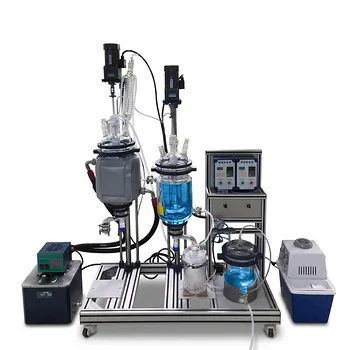
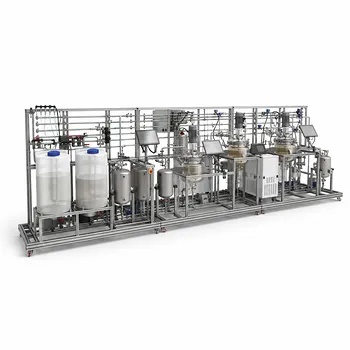
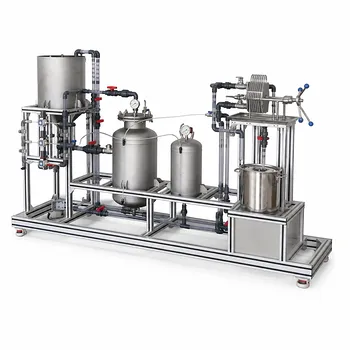
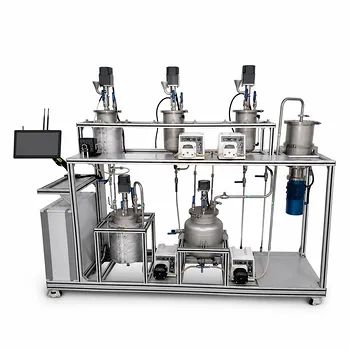
The leap from a glass beaker to a steel pilot plant crystallizer is not about abandoning your fundamentals—it's about learning to orchestrate them in a dynamic, automated system. In a university pilot plant, you translate static principles like a solubility curve and a cooling rate from a manual recipe into a live, engineered process. You will define operational parameters for industrial PLCs (Programmable Logic Controllers), such as the cooling water flow rate through a crystallizer jacket, the agitation speed (RPM), and precise seeding protocols, to achieve a target crystal size distribution (CSD) and purity.
The fundamental challenge shifts from manually achieving a single pure yield to engineering a consistent, scalable process. In the pilot plant, you stop asking "Can I make this crystal?" and start asking "How do I control heat transfer, fluid dynamics, and mass balance to make these crystals identically, predictably, and by the kilogram?"
From Parametric Inputs to Dynamic Control Loops
The core of the transition is moving from static batch controls to dynamic process control. The solubility curve, which was your lab guide for how much solute to add, becomes the blueprint for your entire crystallization mode and control strategy.
The Solubility Curve Becomes Your Process Blueprint
In the lab, you look at a solubility curve to choose a solvent. In the pilot plant, that same curve dictates the reactor's physical configuration and operational path. This is the first and most critical engineering decision you make.
- Selecting the Crystallization Mode: The shape of the solubility curve determines your method. For a solute like potassium nitrate, whose solubility increases sharply with temperature, a cooling crystallization strategy in a jacketed reactor is most energy-efficient. Conversely, for a solute with a flat solubility curve like sodium chloride, cooling is ineffective; you must run an evaporative crystallization process to remove solvent and drive supersaturation.
- Configuring the Pilot Plant: If your solute exhibits a strong positive temperature-dependence, the pilot plant must be set up as a controlled cooling system. For compounds with inverse solubility, like calcium sulfate at elevated temperatures, an evaporative setup is mandatory. You are no longer just a chemist; you are a process designer, matching hardware to physical chemistry.
Controlling Supersaturation: The Master Variable
In a beaker, you control supersaturation by turning down a hotplate or adding anti-solvent dropwise. In a pilot plant, supersaturation is the critical process variable you manipulate through a network of automated feedback loops to control the delicate balance between nucleation and crystal growth.
- Managing the Nucleation/Growth Balance: The lab principle of slow addition to manage relative supersaturation scales into a PLC controlling the feed flow rate of a reactant or anti-solvent with metering pumps. You will program automated temperature ramps not just to cool a solution, but to hold at specific temperatures for controlled seed bed generation before final cooling.
- Dynamic Agitation and Heat Transfer: The magnetic stir bar’s role is replaced by the industrial impeller. You must set an RPM not just for mixing, but to maintain crystal suspension, influence the heat transfer coefficient through the jacket, and avoid shear-induced secondary nucleation. The rate-limiting step shifts from heat loss through glass to the engineered heat transfer area of a stirred tank.
Translating Unit Operations: Beyond the Beaker
The pilot plant experience integrates separation science into a continuous chain of process engineering, showing you how an isolated lab step becomes part of a complete material balance.
From Funnel to Filtration Engineering
The transition from bench-scale recrystallization and hot filtration is stark. Replacing a Büchner funnel and filter paper with a plate-and-frame filter press or a rotary vacuum filter means you are now responsible for parameters completely invisible in the lab.
You will study and optimize filtration resistance and cake washing efficiency. The goal shifts from merely separating crystals to designing a wash cycle in the filter press that removes interstitial mother liquor without dissolving your product, directly impacting final purity and yield as part of an industrial mass balance.
Real-Time Validation and Quality-by-Design
Laboratory virtual solvent screening proposes a process based on thermodynamic models. The pilot plant is where you validate those assumptions under real fluid dynamic and heat transfer conditions. Here, you learn how your upstream process choices—like a poorly controlled cooling ramp that causes a crystal polymorph to crash out—can create catastrophic downstream manufacturing issues, such as an unstable dosage form. The pilot plant teaches you that crystal Purity and Polymorph are a direct function of your process dynamics, not just your chemistry.
Understanding the Trade-offs
A pilot plant crystallizer does not run itself, and blindly applying a lab recipe reveals hard engineering constraints. This awareness is a major part of the learning objective.
The Tyranny of Heat Transfer and Mixing
The perfectly uniform temperature in a small, stirred beaker is an unaffordable luxury at scale. In a 50-liter jacketed vessel, you face a temperature gradient from the cooling fluid at the wall to the bulk solution. An agitation speed chosen to minimize secondary nucleation might create a stagnant zone, leading to uncontrolled local supersaturation and fouling on the vessel walls. Your pilot-plant studies force you to confront this trade-off between mixing efficiency and crystal integrity, a non-issue in the lab.
Yield vs. Purity in Anti-Solvent Systems
In the lab, you can slowly drip anti-solvent with a syringe until you see a persistent cloud point. Replicating this dynamically on a pilot scale is a delicate dance. Pumping anti-solvent too fast near the solubility limit creates fatal local supersaturation peaks and oiling out or impurity occlusion. The engineering lesson is that maximizing yield often threatens purity, and the pilot plant is where you must find the economic and kinetic sweet spot using automated, subsurface delivery.
Making the Right Choice for Your Goal
Your approach in the pilot plant should be guided by what you intend to learn from this scaled-up reality.
- If your primary focus is mastering process scale-up: Treat the solubility curve as your process mandate. Focus on designing the temperature and feed profiles that allow you to operate within the metastable zone width at every stage of the batch.
- If your primary focus is product engineering: Use the pilot plant's sensors to correlate a real-time, unseeded turbidity signal with the final crystal size distribution. This connects lab-level knowledge of nucleation to a measurable, controllable industrial phenomenon.
- If your primary focus is understanding unit operations integration: Analyze the pilot plant holistically, from the crystallization reactor to the downstream filter press. Run a complete mass balance to quantify yield loss during cake washing and develop an operational protocol that minimizes it.
The pilot plant turns theoretical solubility knowledge into operational wisdom, teaching you the difference between making a crystal in isolation and manufacturing a product in a safe, repeatable, and efficient process.
Summary Table:
| Parameter | Lab-Scale (Beaker) | Pilot Plant (Industrial) |
|---|---|---|
| Control System | Manual recipes & static inputs | Automated PLCs & feedback loops |
| Heat & Mass Transfer | Uniform temperature (magnetic stirrer) | Gradient zones, impeller RPM, jacket cooling |
| Supersaturation | Manual anti-solvent drip/cooling | Automated temperature ramps & feed flow |
| Downstream Separation | Büchner funnel & filter paper | Plate-and-frame filter press / rotary vacuum |
Bring Industrial-Scale Crystallization to Your Laboratory
Bridge the gap between theoretical chemistry and practical process engineering. LABPARK provides premium Educational and Vocational Unit Operations Pilot Plants in chemical engineering, bioprocess & biotech, and environmental & water treatment. We help universities, research institutes, and enterprises train students on real-world, PLC-controlled systems.
Ready to elevate your engineering training program? Contact LABPARK today to request a catalog or discuss your pilot plant requirements!
Related Products
- Multi Functional Membrane Crystallization Educational Unit Operations Pilot Plant
- Potassium Salt Thermal Dissolution and Crystallization Separation Educational Unit Operations Pilot Plant
- Multi-Functional Special Distillation Educational Pilot Plant
- Ethyl Acetate Synthesis Unit Operations Pilot Plant for Practical Training
- Multi-Modal Distillation Unit Operations Training Pilot Plant
People Also Ask
- Control Crystallization Pilot Plant Secondary Nucleation: 4 Key Adjustments
- Why is precise temperature control critical in crystallization pilot plants? Key to Scale-Up Success
- What key factors should be considered when configuring a crystallization unit operations pilot plant?
- What are the benefits of integrating online PAT tools like ATR-FTIR into crystallization unit operations pilot plants?
- How to use crystallization pilot plant agitation speed to identify diffusion vs reaction growth?