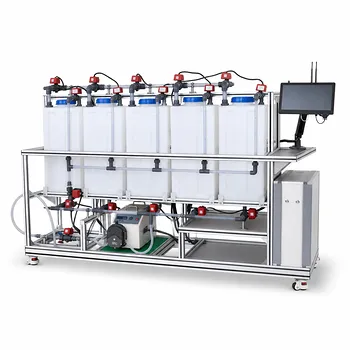
Slater’s rules are a foundational tool for predicting why a pilot‑scale ion‑exchange column or adsorbent bed selectively grabs lead, cadmium, or copper while letting sodium and calcium pass unhindered.
By calculating the effective nuclear charge (Z*) — the net positive charge experienced by the outermost electrons — you can rank metal ions by their true charge density, hydration energy, and electrostatic “stickiness.” This molecular‑level insight directly explains the removal priorities observed in environmental pilot plants and guides the deliberate tuning of pH, ligand environment, and adsorbent chemistry to sharpen selectivity for target heavy metals.
The power of Slater’s rules in water treatment lies in translating an elementary quantum‑chemical concept into a reliable predictor of adsorption and ion‑exchange affinity. When you understand that a high Z* compresses the ionic radius and strips away the hydration shell more easily, you can rationally design pilot operations where heavy metal ions with a strong effective nuclear pull displace lighter, less‑charged species from resins, membranes, or sorbent surfaces.
The Molecular Foundation of Selective Metal Removal
Before a pilot plant can scale up separation, the underlying chemical selectivity must be understood at the electron level. Slater’s rules give you that understanding.
What Slater’s Rules Reveal About a Metal Ion’s Pull
Slater’s rules break down the shielding constant (σ) contributed by each group of surrounding electrons.
The effective nuclear charge Z* = Z – σ then reflects the actual electrostatic attraction felt by valence electrons.
A high Z* directly correlates with a smaller ionic radius and a higher electronegativity.
For example, while Na⁺ (Z* ≈ 1.84) is a relatively large, low‑charge‑density ion, Cu²⁺ (Z* ≈ 3.30) and Pb²⁺ (Z* ≈ 4.05) are significantly more contracted and electron‑withdrawing.
These differences determine how tightly the ion holds onto its hydration sphere and how aggressively it seeks electron‑rich sites on adsorbents or ion‑exchange resins.
How Charge Density Drives Selectivity in Ion Exchange
Commercial ion‑exchange resins rely on electrostatic attraction between fixed charged groups and counter‑ions.
Ions with a higher charge‑to‑size ratio (i.e., high Z* per ionic radius) bind more strongly and can displace lower‑Z* ions.
In a mixed stream containing Na⁺, Ca²⁺, and Pb²⁺, the lead ion’s large Z* makes it a much more “greedy” Lewis acid.
It readily replaces sodium from sulfonate resins, even at low concentrations, explaining the high selectivity observed in pilot‑scale softening and heavy‑metal polishing units.
Linking Z* to Hydration Energy and Adsorption Behavior
A high effective nuclear charge also hydrates differently.
The tightly held electron cloud of a high‑Z* ion produces a smaller hydrated radius and a more loosely bound hydration shell.
When the ion approaches a specific adsorbent surface (e.g., an activated carbon functional group or a chelating membrane), it needs less energy to shed water molecules.
Consequently, heavy metals like mercury(II) (Hg²⁺, Z* ≈ 4.2) outcompete hydrated alkali metals for surface sites, a phenomenon visible in breakthrough curves from pilot‑scale adsorption columns.
Integrating Slater’s Rules with Coordination Chemistry in Pilot Plants
While Z* explains the fundamental affinity, pilot plants rarely operate on electrostatics alone.
Ligand‑based separations amplify or override these trends, and Slater’s rules help you predict the chemistry before you mix.
The Role of Effective Nuclear Charge in Complex Stability
A metal ion with a high Z* not only shrinks the ionic radius but also increases the polarizing power of the cation.
This strengthens the coordinate bonds with ligands such as ammonia, EDTA, or chelating polymers.
In a zinc‑magnesium mixed precipitate, adding ammonia forms the soluble [Zn(NH₃)₄]²⁺ complex selectively because Zn²⁺ (Z* ≈ 3.3) forms a far more stable complex than Mg²⁺ (Z* ≈ 2.5).
The rational design of such fractional precipitation hinges on the metal’s inherent Lewis acidity, which Slater’s rules quantify.
Using Z* to Tune pH and Ligand Concentration
When you know the relative Z* values of competing metals, you can deliberately manipulate the equilibrium.
In a pilot membrane filtration or ion‑exchange step, adjusting pH and ligand concentration changes the coordination sphere—high‑Z* metals will tend to preferentially complex, shifting the solubility equilibrium.
This transforms an empirical trial‑and‑error process into a predictive separation exercise.
The primary reference notes that students use these calculations to understand why a resin grabs one metal over another; the supplementary data shows that the same logic governs ammonia‑based zinc recovery and the conversion of soluble mercuric chloride to less soluble forms.
How These Principles Play Out in Pilot‑Scale Unit Operations
Pilot plants offer a physical testbed where Z*‑based selectivity is translated into measurable performance.
- Adsorption columns: High‑Z* heavy metals exhibit sharper breakthrough curves compared to low‑Z* background ions, confirming their stronger surface binding.
- Ion‑exchange beds: Sequencing batch experiments show that lead and cadmium (high Z*) displace sodium and calcium, aligning with the predicted affinity order.
- Precipitation tanks: By exploiting the solubility differences that arise from Z*‑driven complex stabilities, pilot operators can fractionally recover high‑purity metal sludges, as demonstrated with the zinc‑ammonia process.
In each case, the operator or researcher uses the Z* framework as a diagnostic tool—if a target heavy metal is not being retained, the likely culprit is a competing high‑Z* species or an incorrect ligand environment, not a mysterious resin failure.
Understanding the Trade‑offs
Slater’s rules are a powerful starting point, but they are not a complete engineering blueprint.
- Z* is an approximation. The shielding constant does not fully capture subtle orbital effects or relativistic contraction in very heavy elements, so the predicted ionic radius may deviate from experimentally observed selectivity series.
- Bulk‑phase complexity dominates at scale. Competing ions, dissolved organic matter, and kinetic mass‑transfer limitations can cause anomalous selectivity that overrides the static Z*‑based prediction.
- Ligand design can invert the order. While a high Z* generally favors complexation, the geometry and bite angle of a chelating resin can preferentially bind a lower‑Z* ion if the cavity size matches better.
- Over‑reliance on Z* alone risks oversimplification. An operator might assume that all high‑Z* cations will always displace low‑Z* ones, neglecting the impact of concentration gradients and resin capacity.
Acknowledging these caveats ensures that Slater’s rules are used as a screening and education tool, not as a replacement for real‑world pilot data.
Making the Right Choice for Your Pilot Plant Goal
How you apply the Z*‑based framework depends on whether you are demonstrating a concept, training operators, or optimizing a commercial process.
- If your primary focus is educational demonstration: Use Slater’s rules to let students calculate Z* values for common waste‑stream metals and then validate the predicted affinity order against the pilot‑scale ion‑exchange or adsorption column results.
- If your primary focus is rapid feasibility screening: Rank the background cations and target heavy metals by their effective nuclear charge to pre‑select which commercial resin or adsorbent class is most likely to deliver the needed selectivity, saving time over blind screening.
- If your primary focus is fractional metal recovery: Combine Z*‑based Lewis acidity predictions with ligand‑field considerations (e.g., ammonia, EDTA) to design a two‑step precipitation or chelation sequence that isolates a high‑purity product, as in the zinc‑ammonia method.
- If your primary focus is troubleshooting poor removal: Compare the Z* of the target metal with that of interfering ions; if a lower‑Z* contaminant is dominating the resin, adjust pH or introduce a selective complexing agent that preferentially shields that contaminant.
When you anchor your pilot‑plant decisions in the electron‑level insight of effective nuclear charge, you move from guessing to engineering—and that is where true, scalable selectivity begins.
Summary Table:
| Metal Ion Type | Effective Nuclear Charge (Z*) | Hydration Sphere | Adsorption & Resin Affinity |
|---|---|---|---|
| Heavy Metals (e.g., Pb²⁺, Cu²⁺, Hg²⁺) | High (Z* > 3.0) | Easily shed water shell | Strong affinity; displaces lighter metals, sharp breakthrough |
| Alkali/Alkaline Earth (e.g., Na⁺, Ca²⁺) | Low (Z* < 2.5) | Tightly bound water shell | Weak affinity; easily displaced during ion exchange |
Bring Molecular Chemistry to Life in Your Lab
Teaching or researching selective heavy metal removal requires reliable, hands-on systems. LABPARK provides premium Educational and Vocational Unit Operations Pilot Plants in chemical engineering, bioprocess & biotech, and environmental & water treatment. Tailored for universities, research institutes, and enterprises, our pilot plants allow you to validate chemical theories—like Slater's rules—with real-world, high-precision adsorption and ion-exchange data.
Contact LABPARK today to discover how our pilot plants can elevate your research and training programs!
Related Products
- Electrochemical Water Treatment Educational Unit Operations Pilot Plant
- Thermal Desorption Exhaust Gas and Tail Water Treatment Educational Pilot Plant
- Ion Exchange Water Purification Educational Pilot Plant for Engineering Unit Operations
- Water Electrolysis Hydrogen Production and Storage Educational Pilot Plant
- Alkaline Membrane Water Electrolysis Educational Pilot Plant Unit Operations Training System
People Also Ask
- What design features do educational electrochemical pilot plants utilize to manage gas liberation and water loss?
- How can unit operations pilot plants show lead-acid concentration vs state of charge? Real-time monitoring guide.
- How do educational electrochemical pilot plants scale up electrolysis? Master industrial engineering.
- How to Estimate Sulfate in Water Treatment Pilot Plant Deposits: Gravimetric Guide
- How can foaming be managed during steam generation experiments in water treatment unit operations pilot plants? Tips