Here’s the core insight: Serial diffusion mixers generate controlled concentration gradients not by forcefully blending fluids, but by repeatedly introducing side streams into a main flow at precise points, allowing diffusion alone to create stable, step-like plateaus or smooth profiles.
In bioprocess unit operations, these mixers are typically utilized to expose cells, enzymes, or assay reagents to predictable, spatially defined chemical environments. Their primary applications lie in high-throughput drug screening, reaction kinetics analysis, and studying cellular dose-response behavior—all areas where the ability to create a range of concentrations on a single chip or flow path is more valuable than simply achieving homogeneity.
The fundamental value of a serial diffusion mixer is its ability to convert a single input solution into a multi-point calibration curve or a continuous gradient using only geometric design and passive transport. This turns a simple flowing system into a powerful analytical tool for bioprocess research.
How Serial Diffusion Mixers Generate Controlled Gradients
A serial diffusion mixer operates on a principle of spatially programmed, partial mixing. Rather than trying to mix two fluids completely in a single step, it orchestrates multiple, small-scale diffusive contacts.
The Mechanism of Serial Contact
The mixer begins with a main stream carrying a base concentration (often zero) of a solute. At defined locations along the channel, side streams containing the solute are introduced.
Each side channel contacts the main stream for a very short, controlled duration. Because the flow is laminar, turbulent mixing is absent; the only exchange is molecular diffusion at the interface. By limiting the contact time and area, the mixer prevents full equilibration.
Building Concentration Plateaus Through Diffusion
After each side-stream injection, the flow continues through a section where no further inlets exist. This gives the diffusing molecules time to spread laterally across the channel, homogenizing the concentration within that segment.
The result is a discontinuous, step-like gradient: each mixing stage produces a flat concentration plateau higher than the previous one. By varying the number of side channels and their flow rates, you can design a staircase-like profile with precise, predictable steps.
Continuous vs. Discontinuous Gradients
While the step-like profile is the hallmark of serial diffusion, the same architecture can also generate continuous gradients by overlapping the diffusion zones of closely spaced inlets. When the distance between injection points is shorter than the time required to fully homogenize, the plateaus merge into a smooth, sloping concentration curve. The design choice depends entirely on the spacing and diffusion time.
Key Research Applications in Bioprocess Operations
The ability to create a stable, pre-defined concentration landscape along a single flow channel directly enables several critical bioprocess analytical workflows.
High-Throughput Drug Screening
In drug discovery, a single serial diffusion mixer can replace a 96-well plate. By creating a step-wise gradient of a drug candidate along the channel, researchers can simultaneously expose cells or target proteins to a full dose-response range.
The resulting biological response—such as cell death, protein binding, or metabolic activity—can be imaged or measured at each plateau position. This massively reduces liquid handling, sample volume, and assay time compared to batch methods.
Studying Cellular Responses to Chemical Environments
Many bioprocess engineering challenges involve understanding how cells react to gradient fields of nutrients, toxins, or signaling molecules. A serial diffusion mixer creates a controlled, static gradient in a flowing system, so researchers can observe cell migration, differentiation, or gene expression as a function of position (and thus concentration).
This is particularly valuable for stem cell differentiation studies or chemotaxis assays, where the cell's fate is directly linked to the local chemical microenvironment.
Chemical Assay Preparation and Reaction Kinetics
For enzyme or chemical kinetics, the mixer can generate a range of substrate concentrations simultaneously. By measuring reaction rates at each plateau, one can derive the kinetic parameters (Vmax, Km) from a single experiment.
In bioprocess monitoring, such mixers can also be used to automatically generate standard curves for on-line sensors, eliminating manual dilution steps and improving system reliability.
Understanding the Trade-offs
No tool is without limitations, and serial diffusion mixers are no exception. Recognizing these trade-offs is essential for deciding if they fit your specific application.
Speed and Diffusion Constraints
The sole reliance on diffusion makes these mixers inherently slower than active mixing methods. The length required for a plateau to homogenize grows with channel width squared. For large molecules with low diffusivity (e.g., proteins), the mixing channel may need to be impractically long, or the flow rates kept very low, limiting throughput.
Design Complexity vs. Parallelization
Adjusting the gradient profile often requires redesigning the microfluidic chip geometry—changing inlet spacings or channel dimensions. Meanwhile, technologies like droplet-based microfluidics offer simpler route to parallelizing discrete concentrations using rapid, chaotic mixing. If your primary goal is to test thousands of individual conditions without requiring a spatial gradient, a serial diffusion mixer may be an overly complex solution.
Laminar Flow Requirement
These mixers only function predictably under laminar flow conditions. Any pulsation or turbulent eddies will disrupt the diffusive interfaces and destroy the controlled plateaus. This mandates the use of precise, pulse-free pumping systems, which can increase system cost and complexity.
Making the Right Choice for Your Research Goal
How you deploy a serial diffusion mixer—or whether you choose one at all—should be dictated by your analytical objective.
- If your primary focus is high-throughput, multi-concentration screening: Use a serial diffusion mixer to replace liquid-handling robots. It will miniaturize your assay, conserve precious reagents, and deliver a complete dose-response curve in a single run.
- If your primary focus is studying cell behavior under gradient fields: The mixer's ability to create a stable, spatially resolved chemical landscape is ideal. It provides a direct observation platform for chemotaxis, stem cell differentiation, or wound-healing models.
- If your primary focus is on-line bioprocess analysis: Integrate the mixer into a process stream to automatically generate standard curves for sensors, enabling real-time calibration without operator intervention.
- If your primary focus is rapid mixing of sensitive biomolecules: Look elsewhere. A serial diffusion mixer is not designed for speed; an active chaotic mixer or static split-and-recombine mixer will provide much faster homogenization.
The power of the serial diffusion mixer lies in its precision, not its speed—transforming the simple act of diffusive contact into a programmable tool for bioprocess discovery.
Summary Table:
| Aspect | Mechanism & Details | Key Benefits / Limitations |
|---|---|---|
| Mechanism | Spatially programmed partial mixing via laminar flow & lateral molecular diffusion | Creates stable step-like or continuous concentration gradients without turbulence |
| Applications | High-throughput drug screening, cell microenvironment studies, & reaction kinetics | Minimizes sample volume, reduces liquid-handling steps, & automates calibration |
| Limitations | Slower than active mixing; requires precise, pulse-free laminar flow | High design complexity; not suitable for rapid homogenization of large molecules |
Optimize Your Bioprocess Education and Research with LABPARK
Are you looking to equip your facility with advanced unit operations technology? LABPARK provides state-of-the-art Educational and Vocational Unit Operations Pilot Plants in chemical engineering, bioprocess & biotech, and environmental & water treatment.
Designed specifically for universities, research institutes, and enterprises, our systems bridge the gap between theoretical principles and practical industry applications, helping you achieve unmatched reliability and precise process control.
Contact LABPARK today to discuss your laboratory requirements and discover how our pilot plants can elevate your training and research capabilities!
Related Products
- Agitation and Mixing Educational Unit Operations Pilot Plant
- Educational Unit Operations Pilot Plant for Intraparticle Diffusion Effective Factor Measurement
- Bio-fermentation Ethanol Production Practical Training Unit Operations Pilot Plant
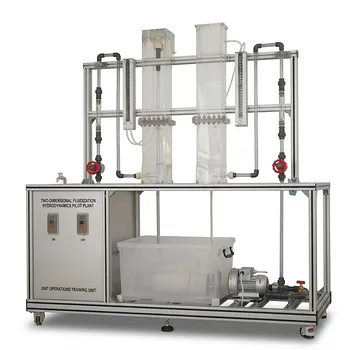
- Two-Dimensional Fluidization Hydrodynamics Educational Pilot Plant for Unit Operations Training
- Multi-Reactor Educational Pilot Plant for Reaction Engineering Unit Operations
People Also Ask
- How do cost-capacity exponents vary across chemical equipment? Scaling insights.
- What are the primary considerations when managing and scaling up shear rates in pilot plant mixing operations? Guide
- What are the differences between set-point, servo, and program control? Master unit operations training.
- Evaluate Tablet Compaction: Force, Density & Porosity in Unit Operations Pilot Plants
- Why Switch Unit Operations Flow Configurations? Impact on Experimental Measurements