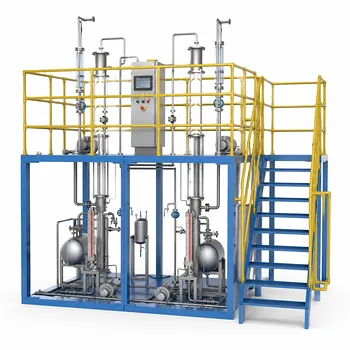
If your tablets are splitting apart, your pilot plant is the perfect diagnostic tool. Capping (the crown separating from the tablet body) and lamination (horizontal cracks within the tablet) are often resolved by systematically adjusting your formulation and compression parameters. On a pilot-scale press, you can immediately mitigate capping by reducing the amount of fines in the granulation, increasing moisture content, or adding a cohesive binder like microcrystalline cellulose. For lamination, the first levers to pull are reducing compression speed, optimizing lubricant concentration, or increasing the pre-compression force.
Capping and lamination both signal a breakdown in the tablet’s internal bonding strength during decompression and ejection. The root cause is an imbalance between the forces holding the tablet together and the stresses trying to tear it apart. A pharmaceutical pilot plant gives you the unique ability to isolate these variables—switching from formulation tweaks to machine setting adjustments in a single, controlled experiment—to permanently solve the problem.
Understanding the Root Causes of Capping and Lamination
Before you can fix a defect, you must identify whether the dominant trigger lives in your powder or your press. Pilot plants allow you to test both domains independently.
Formulation-Related Triggers
The primary reference points to specific formulation culprits. Capping frequently stems from an excessive amount of fine particles. These fines hold air and reduce the contact surface area available for solid bonding under pressure.
Similarly, a low moisture content eliminates the capillary forces that enhance particle bonding during compression. The same weak bond strength can be overcome by the shear stress of ejection. Lamination, on the other hand, is often a lubrication problem. Over-lubrication with hydrophobic lubricants (like magnesium stearate) coats particles and prevents them from forming strong interparticulate bonds, creating weak horizontal planes that separate under stress.
Process-Related Triggers
Even a robust formulation will fail if the press settings work against it. The supplementary references emphasize that rapid decompression and ejection speed are primary mechanical causes of lamination, especially in materials with high elastic recovery.
When the compression punch retracts too quickly, the tablet expands like a spring. If the internal bonds cannot accommodate this sudden elastic rebound, the tablet delaminates. This is why adjusting the compression cycle speed—specifically slowing it down—is such a critical corrective action.
The Deformation Mechanism
At the particle level, your crystal structure matters. The supplementary references highlight that materials undergoing plastic deformation bond more durably than those that fracture or rebound elastically. Pilot-scale testing helps you find the compression force limit for your specific crystal habit, whether cubic or rhombohedral.
If the compressive force is pushed too far, particles fracture and then over-consolidate, re-bonding into a dense mass with trapped internal stress. During ejection, this stress releases as catastrophic structural failure—a key pathway to lamination.
Leveraging the Pilot Plant for Systematic Troubleshooting
The pilot plant’s educational value lies in its flexibility. You can induce a defect by pushing one parameter out of spec, then methodically resolve it.
Adjusting Compression Parameters
Start with the press. A low dwell time (the time the powder spends under maximum compression) is a common capping culprit. The primary reference confirms that adjusting main compression force and speed directly influences this. Increase the dwell time by slowing the press speed and, if your machine allows, increasing the head flat diameter of the punches.
For lamination, the supplementary references recommend first scrutinizing the pre-compression force. Pre-compression expels air gently before the main compression event. Insufficient pre-compression traps air, which then expands violently upon decompression, cracking the tablet. Increasing pre-compression force can often eliminate this.
Optimizing Formulation Variables
If machine adjustment alone doesn’t suffice, the pilot plant lets you blend small batches for formulation trials. To combat capping, follow the primary reference’s advice: introduce a dry binder like pregelatinized starch or microcrystalline cellulose. Add it at low levels (5–15%) to enhance bonding without adding excessive disintegrant time.
If lamination persists, re-evaluate your lubricant. A pilot-scale V-blender allows you to test reduced levels of magnesium stearate or switch to a less hydrophobic option like sodium stearyl fumarate. The supplementary references specifically warn against mixing oily granules for too long, as this spreads the lubricant film and weakens the entire tablet structure.
The Critical Role of Pre-Compression and Dwell Time
The interaction between parameters is where pilot plant data becomes invaluable. The supplementary references reveal a strong leverage effect: the interaction between pan speed and spray rate (in a coating context) is as critical as individual factors. The same principle applies to tableting.
A statistically designed experiment (DoE) on your pilot press can model the interaction between pre-compression force and press speed. You may discover that a small increase in pre-compression allows you to run at a significantly higher production speed without lamination, an insight that directly informs scalable process parameters.
Understanding the Trade-offs in Troubleshooting
No fix is without a consequence. Blindly following a solution can create a new defect downstream.
Balancing Compressive Force
Increasing the main compression force seems like an obvious fix for weak tablets. However, as the supplementary references detail, there is a critical limit. Beyond an optimal force, you reduce the effective surface area for stable bonding and create internal stress-strain indices that exceed the material’s elastic limit.
This over-consolidation paradoxically causes lamination. Your pilot plant trials must therefore map the compression profile of your formulation, identifying the force window where hardness peaks before catastrophic failure occurs.
Lubricant vs. Bonding Strength
Lubricants like magnesium stearate prevent sticking and reduce friction, protecting your tooling and ensuring a clean ejection. Eliminating them to fix lamination can lead to picking and high ejection forces. The trade-off is clear: you must find the minimal effective lubricant concentration and blending time that satisfies both ejection physics and tablet integrity. The pilot plant is the only cost-effective place to walk this tightrope.
How to Apply This to Your Pilot Plant
Start with a methodical, process-driven diagnosis. The best approach depends on your immediate goal.
- If your primary focus is rapid defect identification: Start with formulation. Run small beaker-scale trials varying binder and lubricant levels based on the primary reference’s direct recommendations to see which has the greatest immediate impact on capping.
- If your primary focus is understanding machine mechanics: Change one process variable at a time on your pilot press. Begin by halving your press speed and observing any reduction in lamination. Next, increase pre-compression force incrementally while recording tablet hardness.
- If your primary focus is building a scale-up model: Execute a Design of Experiments (DoE) with compression force, speed, and pre-compression as factors. Map the interaction terms identified in the supplementary references, as these interactions will often dominate quality at production scale.
- If your primary focus is material characterization: Test your formulation’s compaction profile on the pilot press to find the point of over-consolidation. Pair this with ejection force data to select a lubricant level that keeps ejection stress well below internal bond strength.
The power of a unit operations pilot plant is that it transforms these defects from mysteries into solvable physics problems, giving you the confidence to prescribe precise and permanent fixes.
Summary Table:
| Defect | Root Cause | Pilot Plant Correction |
|---|---|---|
| Capping | High fines, low moisture, short dwell time | Add dry binder, adjust moisture, reduce press speed |
| Lamination | Over-lubrication, fast decompression, low pre-compression | Increase pre-compression, optimize lubrication, slow cycle speed |
Ready to scale up your pharmaceutical processes? LABPARK provides advanced Educational and Vocational Unit Operations Pilot Plants in chemical engineering, bioprocess & biotech, and environmental & water treatment. We empower universities, research institutes, and enterprises to master process optimization and resolve complex manufacturing defects. Contact us today to discover the ideal pilot plant for your needs!
Related Products
- Dual Mode Heat Transfer Pilot Plant for Unit Operations Training
- Multimodal Absorption and Desorption Pilot Plant for Unit Operations Training
- Continuous Sieve-Plate Distillation Pilot Plant for Unit Operations Laboratory Education
- Ethyl Acetate Synthesis Unit Operations Pilot Plant for Practical Training
- Dual-Mode Rectification Pilot Plant for Practical Training Unit Operations
People Also Ask
- When is ε-NTU preferred over LMTD in pilot plants? Predict heat exchanger performance without iteration.
- Why is the prevention of scale formation on heat exchanger surfaces a critical learning objective? Key Lessons
- How do unit conversions affect pilot plant calibration? Avoid errors in heat transfer data analysis
- How is the thermal resistance of a thick-walled hollow cylinder calculated? Key Equations
- How to analyze heat exchanger CAPEX vs. OPEX in pilot plants? Optimizing Process Design Education