The key is to never let the agitator’s mechanical energy exceed the crystal’s breaking point. Researchers can prevent particle attrition when drying shear-sensitive crystals in pilot-scale agitated dryers by first quantifying the material’s shear tolerance through lab-scale sensitivity tests, and then using that data to either operate pilot agitators below a material-specific critical tip speed or select inherently low-shear equipment like tumble dryers.
Particle attrition is a direct conflict between applied agitator shear and crystal strength, most dangerous in the dry, final stages of the process. The surest prevention path is a two-step approach: identify the material’s critical tip speed through lab studies, then ensure pilot-scale agitation stays under that limit—or switch to a tumble dryer when the application allows.
The Physics of Particle Attrition in Agitated Drying
Why Shear-Sensitive Crystals Break
Attrition is not a random event. It happens when the mechanical shear force transmitted by the agitator exceeds the tensile strength of the individual crystals. In an agitated dryer, the rotating blades displace particles, causing crystal-to-crystal and crystal-to-wall collisions that can initiate cracks or fracture edges. For shear-sensitive materials, even modest impeller speeds can turn a well-formed crystal bed into fines.
The Danger Zone: The Falling-Rate Drying Period
The risk of breakage is not constant throughout the drying cycle. Early on, the presence of bulk solvent acts as a lubricant and cushion, absorbing much of the agitator’s energy. The critical window is the falling-rate period, when the solvent level drops and the crystals become fully exposed to continuous mechanical agitation. At this point, the slightest excess in shear energy translates directly into particle damage.
Quantifying Crystal Strength: The Lab-Scale Pre-Study
Determining the Critical Tip Speed
Before any pilot run, researchers must conduct a shear-sensitivity study. This experiment uses a small-scale agitated vessel (often a scaled-down version of the dryer) to expose crystals to increasing levels of agitation under representative drying conditions. The goal is to pinpoint the critical tip speed—the maximum linear speed of the impeller tip at which crystal integrity is maintained. This single parameter becomes the universal boundary for all subsequent scale-up.
Scaled-Down Agitation Tests
These studies should mimic the drying process. A common approach is to hold a wet crystal slurry at a series of constant agitation speeds and sample for particle size distribution over time. When the particle size distribution begins to shift sharply—showing a drop in D50 or a spike in fines—the corresponding tip speed is recorded as the threshold. That number is your non-negotiable limit, irrespective of dryer size.
Scaling Agitation from Lab to Pilot
Tip Speed Is the Dominant Parameter
The most common scale-up mistake is transferring rotational speed (RPM) directly from lab to pilot. A small impeller spinning at 200 RPM may have a tip speed of 1 m/s, while a geometrically similar pilot impeller at the same RPM could reach 5 m/s, delivering far more energy to the particles. The invariant parameter that correlates with shear stress is tip speed, not RPM. Always translate the critical limit into pilot RPM based on the impeller’s diameter.
Adjusting RPM for Pilot Reactor Geometry
To maintain the safe tip speed, calculate the maximum allowable RPM for your pilot dryer: RPM_max = (Critical Tip Speed × 60) / (π × Impeller Diameter). Operate the agitator at or below this RPM, particularly during the high-risk falling-rate phase. If bridging or poor mixing occurs, consider intermittent agitation rather than increasing speed, as sustained high shear will erode crystals continuously.
When Agitation Is the Enemy: Choosing Low-Shear Equipment
Tumble Dryers: The Gentle Alternative
Not all pilot drying problems must be solved by throttling back an agitator. For materials where the critical tip speed is impractically low, the correct answer is often to select a tumble dryer. These units rely on gentle rotation of the entire vessel, creating a tumbling powder motion with significantly lower shear forces than any bladed agitator. They provide bulk mixing without imparting the high mechanical energy that causes attrition.
Balancing Shear, Containment, and Drying Time
The shift to a tumble dryer introduces trade-offs. Drying times can be longer, and containment for very potent or toxic compounds may be less robust than in a sealed, agitated filter dryer. In those cases, researchers must weigh the risk of particle breakage against the need for operator protection and project timelines. The pilot plant’s multiple dryer configurations exist precisely to evaluate these conflicts.
Understanding the Trade-offs
Low Shear vs. Drying Efficiency
Agitated dryers like conical and filter dryers are designed for rapid heat and mass transfer. Reducing their speed to protect crystals inevitably increases drying time and may lead to uneven drying. A perfectly intact crystal that hasn’t reached its residual solvent specification is a failure. Always cross-check that the slow-speed protocol still achieves the target loss on drying within an acceptable cycle time.
Open vs. Closed Systems for High-Potency Compounds
Tumble dryers, while gentle, are often harder to integrate into a fully contained, closed system compared to a conical dryer. For highly potent or cytotoxic APIs, the requirement for operator safety and containment can override the desire for low shear. In such cases, using a slow-speed, specially designed agitator protocol inside a conical dryer may be the only viable path—accepting a controlled, minimized level of attrition as the cost of safe processing.
Making the Right Choice for Your Application
Your prevention strategy must align directly with your project’s primary constraints.
- If your primary focus is preserving crystal size distribution at all costs: Perform a lab shear-sensitivity test to define the critical tip speed, and then either scale agitation to stay strictly below that limit or move immediately to a tumble dryer.
- If your primary focus is containment for a highly potent compound: Select a closed agitated dryer (conical or filter dryer) but operate it using an intermittent agitation profile or extremely reduced tip speed, accepting that some minor attrition may be unavoidable to maintain safety.
- If your primary focus is minimizing processing time: Start with a higher-shear dryer design but integrate real-time particle size monitoring to detect the first sign of attrition; immediately ramp down tip speed as the solvent content drops, using a segmented, phase-dependent agitation program.
Preventing attrition isn’t about finding a single magic setting—it’s about replacing assumptions with measured thresholds and making a conscious, data-driven choice between shear, time, and containment.
Summary Table:
| Drying Strategy | Shear/Attrition Risk | Key Advantage | Best Application |
|---|---|---|---|
| Standard Agitated Drying | High | Rapid heat & mass transfer | Robust materials, tight timelines |
| Controlled Tip Speed Agitation | Medium | Balanced containment & drying | Shear-sensitive, high-potency APIs |
| Tumble Drying | Low | Minimal crystal breakage | Extremely shear-sensitive materials |
Looking to optimize your drying processes or train the next generation of process engineers? LABPARK provides state-of-the-art Educational and Vocational Unit Operations Pilot Plants in chemical engineering, bioprocess & biotech, and environmental & water treatment. Designed for universities, research institutes, and enterprises, our systems deliver the hands-on control needed to master complex scaling and drying challenges. Contact us today to learn how we can support your educational and research goals!
Related Products
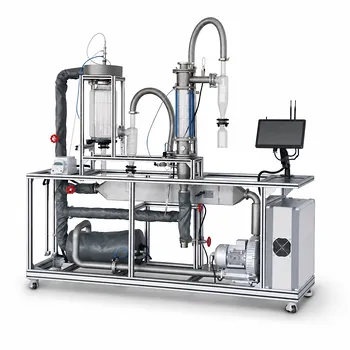
- Multi-Functional Drying Educational Unit Operations Pilot Plant
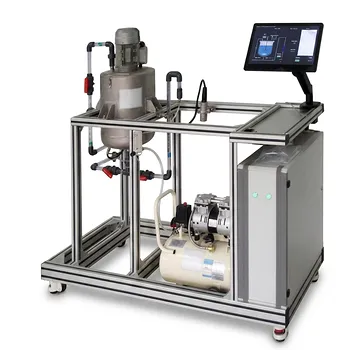
- Agitation and Mixing Educational Unit Operations Pilot Plant
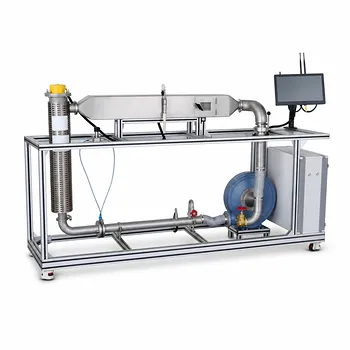
- Circulating Wind Tunnel Drying and Convective Heat Transfer Coefficient Determination Educational Pilot Plant
- Supercritical High-Gravity Flash Evaporation Educational Unit Operations Pilot Plant
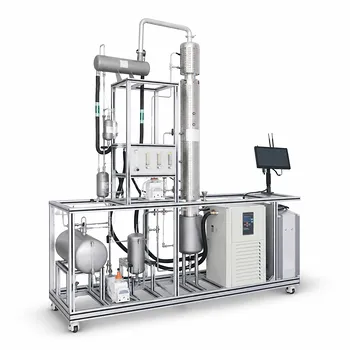
- Continuous Sieve-Plate Distillation Pilot Plant for Unit Operations Laboratory Education
People Also Ask
- How do deviations in estimating latent heat impact pilot plant thermal systems? Avoid hardware mis-sizing.
- How to study gasification in pilot plants? Compare exit gas composition & efficiency
- Why Use PTFE & Hastelloy in Chemical Pilot Plants? Prevent Corrosion & Ensure Safety
- Why is the chemical plant startup schedule crucial? De-risk scale-up with pilot plants.
- When to transition from PID to adaptive control in pilot plants? Key process indicators.