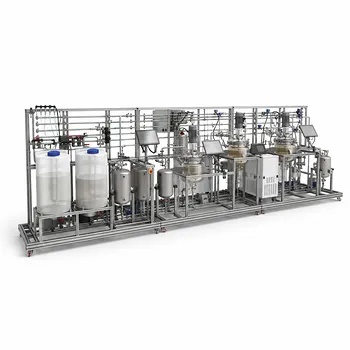
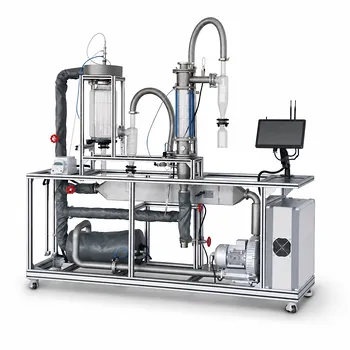
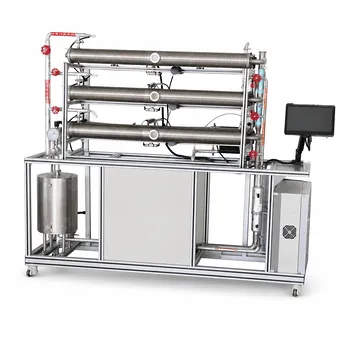
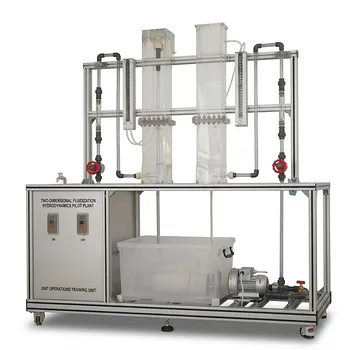
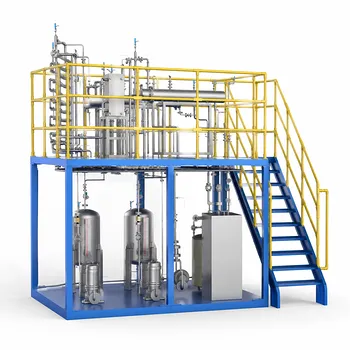
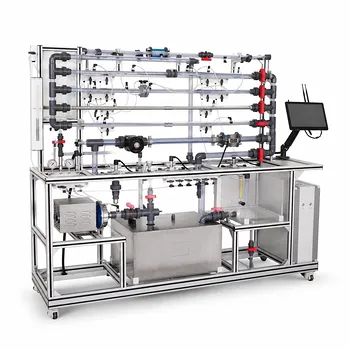
The answer lies in a structured, matrix-driven methodology that translates educational and research needs directly into engineering specifications. Quality Function Deployment (QFD) turns vague requirements like “must support hands-on learning” or “must be safe for students” into quantifiable, comparable features—such as reactor volume, sensor accuracy, and automation level. By systematically weighing the importance of each need and scoring how well different technical characteristics meet them, you can objectively select or customize a unit operations pilot plant that maximizes pedagogical value and research output within strict budget constraints.
The core insight: QFD doesn’t just help you choose a pilot plant—it forces you to define what “value” means for your specific teaching and research goals, then builds a transparent, defendable case for every feature trade-off. It ensures the final system is not merely a collection of impressive hardware, but a purpose-built tool that genuinely serves your curriculum and experimental ambitions.
Understanding the Voice of the Customer in an Academic Setting
The first step of QFD is to capture the “Voice of the Customer”—in this context, the end-users (students, researchers, and teaching staff) and the institutional stakeholders (lab managers, safety officers, department heads). Their needs are often qualitative and can seem fuzzy.
Identifying Core Educational and Research Requirements
Start by listing all non-negotiable and aspirational demands. For chemical engineering pilot plants, these typically cluster into four groups:
- Pedagogical effectiveness: Students must be able to observe classic unit operations (reaction, distillation, absorption) and manipulate key process parameters to see cause and effect.
- Research flexibility: The plant must accommodate evolving projects, from testing novel catalysts to validating process control algorithms.
- Operational safety: The system must incorporate inherent safety features and be forgiving of student errors.
- Institutional viability: It must fit within budget, available utility infrastructure, and long-term maintenance plans.
Assign each requirement a raw importance score (e.g., on a 1–5 scale) through a structured discussion with all stakeholders. For instance, a department prioritizing undergraduate education might weight “clear visualization of process flow” higher than “high-pressure hydrogen compatibility.”
Translating Qualitative Wants into Quantifiable Needs
A statement like “the plant should be safe for students” is too vague to engineer directly. QFD forces you to decompose it into concrete, measurable sub-needs. The supplementary reference demonstrates this perfectly: a safety requirement translates explicitly into specific safety valve ratings, containment features, and automatic shutdown interlocks. Similarly, “flexible research capabilities” decomposes into modular piping, bypass lines, multi-sensor ports, and a wide range of adjustable flow rates.
Document each decomposed need as a discrete row in your QFD matrix. This gives you a comprehensive, actionable list of what the pilot plant must do before you ever look at a brochure.
Building the House of Quality for Pilot Plant Selection
The core of QFD is the House of Quality matrix, which connects the “whats” (user needs) to the “hows” (technical specifications). Building this for a pilot plant is a rigorous exercise that prevents emotional or vendor-driven purchasing.
Selecting the Right Technical Specifications
Now list the engineering characteristics that can satisfy the needs. These become the columns of your matrix. For a unit ops pilot plant, key technical specs include:
- Reactor volume and type (CSTR, packed bed, etc.)
- Temperature and pressure ratings
- Sensor suite (type, accuracy, range of flow, temperature, pressure, pH sensors)
- Automation level (PLC vs. DCS, data logging frequency, manual overrides)
- Materials of construction (stainless steel, Hastelloy, glass—for visibility)
- Modularity (number of available parallel and series configurations, connection standards)
- Safety systems (relief valve set points, gas detection interlocks, emergency stop buttons)
- Utility consumption (kW rating, cooling water flow rate, steam requirement)
Ensure these specifications are directly testable or verifiable. “User-friendly interface” is a need, not a spec; its corresponding technical specs might be “graphical HMI with real-time trends” and “maximum number of screens to reach manual override.”
Populating the Relationship Matrix
For each pairing of a user need and a technical spec, the team scores the strength of the relationship (e.g., weak = 1, medium = 3, strong = 9). This is where the magic happens.
A need like “students must learn industrial process flow principles” has a strong relationship with “modularity” and “number of unit operation skids (reaction, separation, recycle),” but only a weak relationship with “maximum temperature rating.” The requirement for “low maintenance cost” relates strongly to “materials of construction” and “standardized component selection,” but weakly to “sensor accuracy.”
Multiplying each relationship score by the need’s importance weight and summing them down each column yields an absolute and relative importance score for every technical specification. This reveals, for example, that sensor accuracy might be three times more important to your goals than maximum throughput, even if your gut feeling said otherwise.
Benchmarking and Setting Target Values
The House of Quality also includes competitive benchmarking if you are comparing off-the-shelf vendor solutions. Rate how well each candidate plant satisfies each user need on a scale. This quantifies the gaps and strengths of each option. Finally, define clear target values for each critical-to-quality (CTQ) specification: “cooling water flow rate must be ≤20 L/min to match existing utilities” or “must include at least 6 thermocouple ports per reactor for DOE studies.”
Understanding the Trade-offs
QFD doesn’t magically eliminate conflicts—it makes them visible and manageable. The matrix will reveal inherent design tensions that must be addressed, not ignored.
Common Conflicts in Pilot Plant Design
A few classic trade-offs surface repeatedly:
- Pedagogical visibility vs. industrial realism: Glass reactors let students see mixing and boiling, but they limit pressure/temperature envelopes and are fragile. An all-stainless-steel plant mirrors industry but hides the phenomena.
- Instrumentation richness vs. overwhelming complexity: A unit covered in sensors provides rich data for Quality by Design (QbD) studies and design of experiments (DOE), but can intimidate novice students and hide fundamental principles behind a screen’s worth of numbers.
- Modularity vs. cost and footprint: Quick-connect bypass lines and numerous parallel paths maximize flexibility for research, but they significantly increase capital cost, leak potential, and laboratory space requirements.
- Advanced automation vs. hands-on learning: Full DCS control enables complex control strategy research; however, it can reduce students’ instinct for manual valve adjustments and direct observation of system dynamics. The pilot plant that best teaches a new operator may be a poor research platform for advanced control.
The QFD matrix forces you to weight these conflicts transparently. If “support advanced research” has an importance of 5 and “teach basic manual control” has an importance of 4, the scoring will correctly tilt the specification priorities toward a higher automation level, with a conscious plan to incorporate manual override exercises.
Making the Right Choice for Your Goal
The final QFD output isn’t a single “best” machine—it’s a clear, prioritized list of what matters most and a defensible ranking of your options. Apply these insights based on your primary mission.
- If your primary focus is maximizing undergraduate teaching value: Prioritize visual clarity, simple modularity with clear labeling, robust manual controls, and inherent safety through low pressures/temperatures. Let QFD highlight where you can trade high-end sensor accuracy for a more intuitive and physically accessible design.
- If your primary focus is enabling cutting-edge research: Amplify the importance weights for a wide sensor suite, high-accuracy data acquisition, high-pressure/temperature ratings, and flexible materials of construction. Use the matrix to justify the additional cost of a fully automated system with bypass lines for non-standard reconfiguration.
- If your primary focus is simulating an entire industrial continuous process for capstone design: Give maximum weight to a complete modular train (raw material prep → reaction → separation → recycle → waste treatment) and robust utility integration. Use QFD to ensure you don’t sacrifice the recycle loop and product recovery stages for a fancier main reactor.
- If your primary focus is a shared facility balancing teaching and research: Use the relationship matrix to identify the “sweet spot” specifications that serve both needs (e.g., a reactor with multiple sensor ports and a glass window, but limited to moderate pressure). The matrix will make explicit where you must design a compromise and where small additional investments yield large dual-purpose returns.
A rigorous QFD process doesn’t just give you a specification sheet—it gives you the narrative and the numbers to make a confident, lasting investment in your institution’s chemical engineering program.
Summary Table:
| Focus Area | Key User Needs | Critical Technical Specifications |
|---|---|---|
| Teaching | Visual clarity, manual operation, high safety | Glass reactors, manual valves, moderate temp/pressure |
| Research | System flexibility, precision data, automation | Modular piping, extensive sensor suite, PLC/DCS control |
Align Your Lab Requirements with the Perfect Pilot Plant
Are you planning to upgrade your lab? LABPARK provides state-of-the-art Educational and Vocational Unit Operations Pilot Plants in chemical engineering, bioprocess & biotech, and environmental & water treatment for universities, research institutes, and enterprises.
We help you apply structured methodologies to customize systems that fit your curriculum and research goals perfectly. Contact LABPARK today to design your pilot plant!
Related Products
- General Purpose Cosmetics Production Unit Operations Training Pilot Plant
- Multi Pump Fluid Transport Process Piping Unit Operations Training Pilot Plant
- Multi-Functional Drying Educational Unit Operations Pilot Plant
- Fixed-Bed Chemical Reaction and Gas Dust Tar Removal Unit Operations Pilot Plant
- 100L Continuous Loop Hydrogenation Educational Unit Operations Pilot Plant
People Also Ask
- How do deviations in estimating latent heat impact pilot plant thermal systems? Avoid hardware mis-sizing.
- Why is the chemical plant startup schedule crucial? De-risk scale-up with pilot plants.
- When to transition from PID to adaptive control in pilot plants? Key process indicators.
- Why Compare Predicted and Experimental Excess Enthalpy? Key to Accurate Pilot Plant Scale-up
- How to study gasification in pilot plants? Compare exit gas composition & efficiency