A straightforward chloride-to-hardness ratio comparison can reveal hidden scale.
If you compare the total hardness ratio of your recirculating water to its chloride ratio, a significantly lower hardness ratio tells you that calcium is leaving the solution—depositing as calcium carbonate scale on heat exchangers and pipe walls. The chloride ratio (sump concentration divided by makeup concentration) acts as your benchmark for evaporative cycles; any hardness shortfall relative to that benchmark points directly to ongoing precipitation.
Scale detection in a recirculating cooling system does not require plant shutdown or physical inspection. By treating chloride as a conservative tracer for cycles of concentration, you can compare the theoretical concentration factor for hardness with the actual measured value. A persistent, large negative divergence means calcium carbonate is no longer traveling with the water—it is scaling your equipment.
How the Ratio Method Works
Cycles of Concentration Track Evaporation
In a cooling tower, pure water evaporates while dissolved solids remain behind. The ratio of a completely soluble, non-precipitating ion like chloride in the recirculating water to its concentration in the makeup tells you exactly how many times the raw water has been concentrated. This chloride ratio is your cycle-of-concentration ruler for the entire system.
Hardness Should Rise in Step with Chloride
Total hardness (calcium plus magnesium), if fully soluble, would concentrate at the same rate as chloride. By calculating the hardness ratio—the sump hardness divided by the makeup hardness—you obtain an expected concentration factor. In a scale-free system at steady state, the hardness ratio and chloride ratio will be nearly identical, accounting only for blowdown losses.
The Simple Math That Flags Scaling
Subtract the hardness ratio from the chloride ratio. A small drift may occur naturally, but when the hardness ratio falls significantly below the chloride ratio (e.g., chloride ratio = 5.0, hardness ratio = 2.8), the missing hardness has precipitated. This mass balance gap is your direct field indicator that calcium carbonate scale is forming inside the loop.
Getting Reliable Numbers in a Pilot Plant
Sampling Points and Timing
Draw simultaneous samples from the cooling tower sump and the makeup water line. Sample during stable operation, after the system has run long enough to reach steady-state cycles—typically several turnover periods. Inconsistent sampling will corrupt your ratio analysis and hide real trends.
Measuring Hardness and Chloride Accurately
Total hardness is determined by EDTA titration with Eriochrome Black T indicator (wine-red to clear blue endpoint). For a sharper focus on calcium carbonate, you can isolate calcium hardness by raising the pH to ~11.5 to precipitate magnesium and titrating with murexide indicator (salmon-pink to orchid). Chloride can be measured by titration, ion chromatography, or electrode. The key is consistent, repeatable lab work to generate trustworthy ratio trends.
Understanding the Limitations and Trade-offs
Chloride Must Be a Truly Conservative Tracer
The entire logic rests on chloride neither precipitating nor being added. If your treatment chemical itself introduces chloride, or if you have a softener backwash cycling chlorides, the tracer ratio becomes misleading. Always verify that the chloride balance in the loop behaves conservatively under your specific operating regime.
The Method Detects Total Calcium Loss, Not Just Scale
A falling hardness ratio confirms calcium is leaving solution, but it cannot distinguish between scale on a heat exchanger surface and calcium precipitated as suspended solids that later settle. Pair the ratio test with turbidity monitoring or filter analysis to confirm that the lost hardness is truly forming a tenacious deposit.
Hardness Ratio Alone Won’t Predict Scaling Tendency
The ratio test is a lagging indicator—it tells you scaling has already occurred. To predict potential, you still need a scaling index (LSI or RSI) based on temperature, pH, and alkalinity. The ratio method is best used as a surveillance tool to validate that your pretreatment or chemical inhibitor program is actually stopping precipitation, not just masking it.
Applying This to Your Daily Operation
If your primary focus is early detection of scale formation:
Compare the total hardness ratio to the chloride ratio every shift. A divergence greater than 10–15% from the chloride baseline triggers immediate investigation of scaling risk.
If your primary focus is evaluating a threshold inhibitor program:
Track how the hardness ratio responds to different inhibitor doses (e.g., 0.3–1.2 ppm polyphosphate). A dose that brings the hardness ratio close to the chloride ratio is effectively preventing precipitation; a low ratio shows the inhibitor is not holding enough calcium in solution.
If your primary focus is teaching or research in water treatment unit ops:
Use the ratio method as a hands-on mass balance exercise to connect water chemistry theory with real system behavior, reinforcing the measurable consequences of scaling on heat transfer and flow.
By making the simple chloride-to-hardness ratio a routine check, you gain a direct, data-driven window into the hidden world of scale without ever opening a pipe.
Summary Table:
| Parameter | Formula / Definition | No Scale Condition | Scaling Indicator |
|---|---|---|---|
| Chloride Ratio | Sump Cl⁻ / Makeup Cl⁻ | Benchmark cycle factor | Benchmark cycle factor |
| Hardness Ratio | Sump Hardness / Makeup Hardness | Equals Chloride Ratio | Significantly lower than Chloride Ratio |
Optimize Your Water Treatment Training and Research
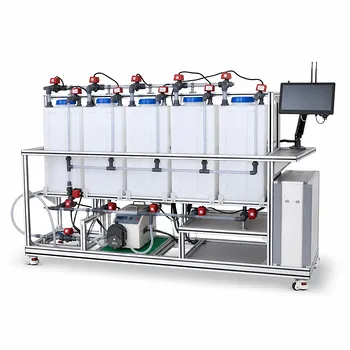
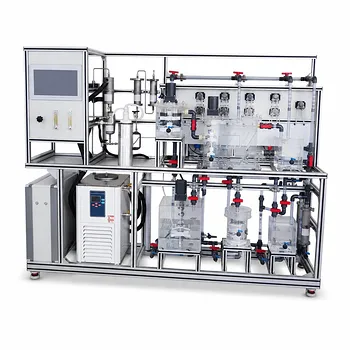
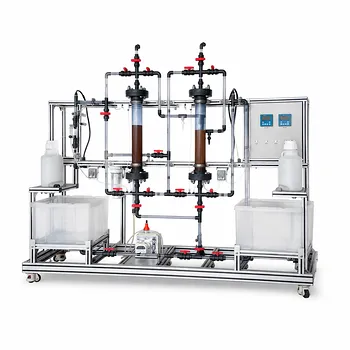
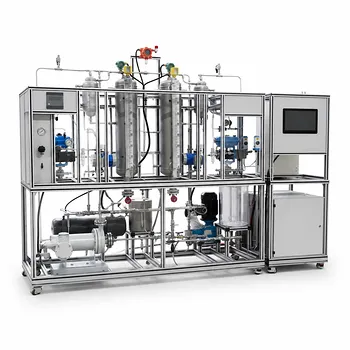
Looking to equip your lab with advanced, hands-on learning systems? LABPARK provides state-of-the-art Educational and Vocational Unit Operations Pilot Plants in chemical engineering, bioprocess & biotech, and environmental & water treatment. Designed specifically for universities, research institutes, and enterprises, our pilot plants bridge the gap between theoretical chemistry and real-world industrial operations.
Ready to elevate your engineering curriculum or research capabilities? Contact us today to request a quote or custom design!
Related Products
- Electrochemical Water Treatment Educational Unit Operations Pilot Plant
- Thermal Desorption Exhaust Gas and Tail Water Treatment Educational Pilot Plant
- Ion Exchange Water Purification Educational Pilot Plant for Engineering Unit Operations
- Alkaline Membrane Water Electrolysis Educational Pilot Plant Unit Operations Training System
- Water Electrolysis Hydrogen Production and Storage Educational Pilot Plant
People Also Ask
- Lime-Soda vs. Cation Exchange Softening: How Do Effluent Characteristics Compare in Pilot Plants?
- How to demonstrate advanced membranes in pilot plants? Validate smart materials and adsorption pre-treatment.
- What buffers and pre-treatments eliminate hardness titration interferences in pilot plants? Expert Guide
- How is P, M, and B alkalinity applied in pilot plants? Prevent Boiler Scaling & Corrosion
- What sample matrix factors cause false results in water pilot plant assays? Avoid Testing Errors