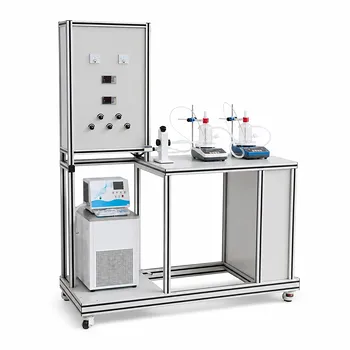
Observational data from a pilot plant is the bridge between an elegant equation and a messy reality. Pilot plants model water-hydrocarbon systems by implementing the Peng-Robinson (PR) equation of state with carefully tuned binary interaction parameters, which are regressed from experimental data to account for the extreme non-ideality of these mixtures. This approach transforms theoretical thermodynamics into a predictive, validated tool for two- and three-phase equilibrium.
A multi-phase equilibrium pilot plant's true value is not just running an equation; it generates the high-fidelity experimental data needed to calibrate the model’s binary interaction parameters—turning an otherwise inaccurate simulation into a reliable digital twin of a water-bearing process stream.
The Thermodynamic Engine Inside the Pilot Plant
Why the Peng-Robinson Equation is the Starting Point
The Peng-Robinson equation of state is the workhorse for modeling hydrocarbon systems because it adequately captures the pressure-volume-temperature behavior of non-polar gases and liquids. In a pilot plant, PR solves the fundamental equality of fugacities required for phase equilibrium: the chemical potential of each component must be identical in every coexisting phase.
For water-hydrocarbon systems, the challenge escalates immediately. The PR equation applies a single mixing rule with an adjustable parameter that defines the unlike-pair interactions between water and each hydrocarbon. That single parameter must absorb all the non-ideality arising from hydrogen bonding, polarity differences, and size asymmetry.
The Non-Ideality Problem: When Water Breaks the Rules
Water does not mix well with hydrocarbons because of strong self-association. Standard cubic equations of state like PR were developed for non-polar, van der Waals-like fluids. Without modification, they grossly mispredict solubility, azeotropes, and three-phase splits in water-hydrocarbon systems.
This is why the binary interaction parameter ($k_{ij}$) for each water-hydrocarbon pair is non-negotiable. It is not a universal constant; it is highly system-specific and often temperature-dependent. Using a default $k_{ij}$ of zero, or a generic value, will typically fail to reproduce even the qualitative phase envelope of a water-bearing stream.
The Pilot Plant as a Parameter Regression Laboratory
Pilot plants solve this by generating data where theory alone cannot be trusted. A multi-phase equilibrium rig—operating a controlled two-phase or three-phase separator—can sample each phase at steady state. These stream compositions and temperatures give you the exact fugacity constraints needed to regress the $k_{ij}$.
Researchers systematically vary the water content, hydrocarbon type, and pressure. For each run, they compare the predicted phase split using a guessed $k_{ij}$ against the measured data, then iteratively optimize the parameter until the model matches reality. This transforms the pilot plant from a demonstration tool into a calibration instrument.
Navigating the Real-World Complexity
The Three-Phase VLLE Challenge
When water exists as a separate liquid phase alongside a hydrocarbon liquid and a vapor phase, the modeling triples in complexity. The PR equation must simultaneously solve for two liquid-phase compositions and one vapor composition, each with its own fugacity coefficients. Convergence algorithms frequently stall near the critical point or when three phases nearly vanish.
Pilot plants reveal these algorithmic pain points directly. The physical existence of a second liquid phase in the sight glass validates the model’s prediction—or forces the operator to re-examine the convergence strategy and the quality of the interaction parameters.
Hydrate Formation and the Expanded Phase Space
Beyond simple vapor-liquid-liquid equilibrium, water-hydrocarbon systems can form hydrates at low temperature and high pressure. Modeling hydrate equilibria requires extending the PR framework with a hydrate formation model that predicts the solid-like hydrate phase composition.
Pilot plant experiments become essential here because hydrate formation boundaries are extremely sensitive to small errors in $k_{ij}$. A plant that can isolate a hydrate slurry, measure its composition, and track the dissociation pressure provides the gold-standard data needed to tune both the equation of state and the hydrate sub-model.
Computational Pitfalls and Convergence Failures
Simulating water-hydrocarbon equilibrium in the critical region frequently triggers numerical instabilities. Phase identification (liquid vs. vapor) becomes ambiguous, and stability analyses can converge to trivial solutions. In a pilot plant, you always know which phases exist; you can then use that physical knowledge to initialize the solver and validate the final result.
Educators use these failures as teaching moments. When a simulator crashes because the guessed $k_{ij}$ is wrong, students learn that thermodynamics is not a solved problem—and that experimental backup is the ultimate arbiter.
Understanding the Trade-offs
Accuracy vs. Generality with Binary Interaction Parameters
The PR model with fitted $k_{ij}$ parameters is powerful but narrow. A parameter regressed from n-hexane–water binary data will not accurately describe a methane–water or even a toluene–water system. The pilot plant must be dedicated to calibrating the exact mixture of interest. This makes the method high-accuracy but low-throughput, as every new hydrocarbon requires a new experimental campaign.
The Cost of Neglecting Temperature Dependence
A single $k_{ij}$ value at one temperature will degrade at another, especially in wide-boiling systems where the water-rich phase chemistry changes. Pilot plants that operate across a broad temperature range expose this dependency. The trade-off is that a more accurate, temperature-dependent expression introduces more regressable parameters, demanding even more experimental data and increasing the risk of overfitting.
Simplicity vs. Fidelity: Why Not a More Complex Model?
More sophisticated models like CPA (Cubic-Plus-Association) explicitly account for hydrogen bonding and can predict water solubility with a fixed, built-in parameter set. Why then rely on PR with ad-hoc $k_{ij}$? Because PR is fast, universally implemented, and remains the standard for process simulators. The pilot plant approach using PR and regressed parameters offers a pragmatic middle ground: high industrial relevance with accuracy enforced by experiment rather than by theoretical assumption.
How to Apply This to Your Pilot Plant
Your pilot plant’s role depends on your primary objective. Here’s how to align the method to your goal.
-
If your primary focus is teaching fundamental thermodynamics: Use the pilot plant to demonstrate the failure of default PR and the power of binary interaction parameters. Show students how experimental data corrects the model, reinforcing the lesson that equations of state are semi-empirical tools, not perfect predictors.
-
If your primary focus is process design for water-hydrocarbon separation: Operate the pilot plant to regress $k_{ij}$ values for your specific feedstocks. Prioritize gathering data at the operating conditions where the model is most sensitive—near three-phase boundaries and the critical region—to minimize scale-up risk.
-
If your primary focus is developing new thermodynamic models or simulation algorithms: Treat the pilot plant as a truth source for algorithm validation. Use its unambiguous phase identification to debug convergence failures and prove that your next-generation model captures the complex phase behavior without collapsing.
Experimental validation is not a check-box exercise; it’s the foundation of predictive capability when water and hydrocarbons collide. By controlling what the equation cannot initially predict, your pilot plant becomes the definitive builder of reliable thermodynamic knowledge.
Summary Table:
| Challenge | Thermodynamic Model Issue | Pilot Plant Solution |
|---|---|---|
| Water Polar Non-Ideality | Default $k_{ij}$ parameters fail to predict phase envelope | Measures stream compositions to regress accurate, system-specific $k_{ij}$ |
| Three-Phase VLLE | Numerical algorithms stall near critical/limit points | Physically validates phase boundaries and stabilizes solver initialization |
| Hydrate Formation | Highly sensitive to small parameter errors | Tracks dissociation pressures and isolates slurry to calibrate models |
Bring Thermodynamic Theory to Life with LABPARK
Bridging the gap between complex equations and real-world process engineering requires reliable, hands-on validation. LABPARK provides state-of-the-art Educational and Vocational Unit Operations Pilot Plants in chemical engineering, bioprocess & biotech, and environmental & water treatment.
Designed specifically for universities, research institutes, and enterprises, our pilot plants empower students and researchers to master multi-phase equilibrium modeling, calibrate thermodynamic systems, and run high-fidelity simulations.
Ready to elevate your engineering lab's capabilities? Contact LABPARK today to discuss your custom pilot plant needs!
Related Products
- Ternary Liquid-Liquid Equilibrium Educational Pilot Plant
- Carbon Material Thermal Pretreatment Multiphase Separation Educational Pilot Plant
- Multi-Reactor Educational Pilot Plant for Reaction Engineering Unit Operations
- Multi Functional Membrane Crystallization Educational Unit Operations Pilot Plant
- Multi-Functional Drying Educational Unit Operations Pilot Plant
People Also Ask
- Why is precise temperature control necessary in LLE experiments? Ensure accurate pilot plant data
- How do pilot plants explain ternary phase diagrams? Bridge thermodynamic theory and practice
- How do liquid-phase reactor pilot plants address mass transfer limitations like the 'cage effect'?
- What is the thermodynamic basis for phase equilibrium? How pilot plants validate Gibbs energy & fugacity.
- How to resolve emulsion in liquid-liquid extraction? 5 ways to ensure efficient phase separation