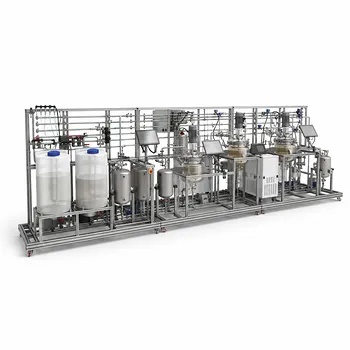
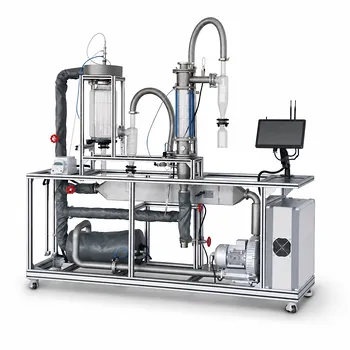
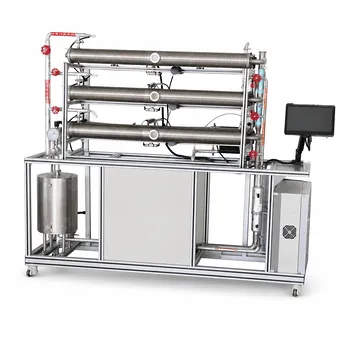
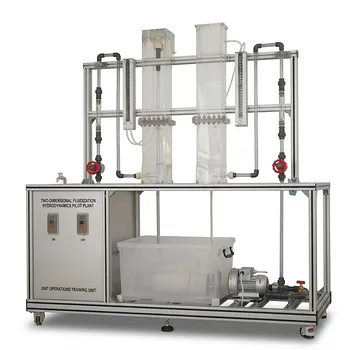
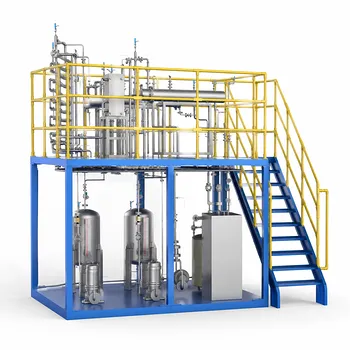
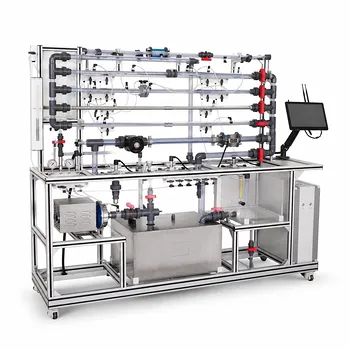
The gap between textbook theory and the plant floor is closed not by reading about advanced control, but by physically manipulating a process that pushes back.
Modern unit operations pilot plants prepare students for recent industrial advancements by integrating hardware-based energy-saving designs—like dividing wall columns—with software-driven automation tools, including real-time optimization. This dual upgrade transforms the lab from a simple demonstration of boiling points into a dynamic simulator for the core economic and sustainability challenges of a modern refinery or pharmaceutical plant.
The real lesson of a modern pilot plant isn’t just how to achieve 99.9% purity, but how to do it using 30% less energy and in a way that adapts automatically to a fluctuating feedstock. It teaches the economic and environmental calculus of separation.
Re-engineering the Hardware: Beyond the Simple Column
The traditional distillation pilot plant teaches the fundamentals of phase equilibrium. The modern one teaches process intensification, mirroring the industry’s move to shrink equipment footprints while boosting efficiency.
Integrating Process Intensification Concepts
Students no longer have to imagine energy savings in a heat-integrated distillation setup; they can operate it. A modern pilot plant physically couples the rectifying and stripping sections or uses a dividing wall column (DWC).
Running a DWC demonstrates how a single shell can replace multiple columns, slashing capital expenditure. The hands-on challenge of balancing a DWC’s internal liquid and vapor splits provides a visceral understanding of why these units save up to 30% energy but are notoriously harder to control.
Bridging Reaction and Separation
The clear boundary between reactor and separator is dissolving in favor of reactive distillation. A pilot plant that combines a catalytic section within the column teaches students to drive equilibrium-limited reactions to completion.
This directly mirrors industrial strategies to reduce recycle streams and avoid hot spots. Manipulating feed locations and catalyst volumes to maximize yield and purity shows how process synthesis isn't just a series of discrete boxes, but an integrated whole.
Decoding the Economic Dial
A pilot plant converts abstract cost estimation formulas into tangible reality. When a student measures the pressure drop across a sieve tray or the temperature profile down a stainless steel column, they are gathering the raw data for the six-tenths rule and factorial cost estimation.
By scaling up the measured heat transfer area and column diameter to industrial specifications, they can calculate Inside Battery Limits (ISBL) costs. This connects a physical decision—like switching from carbon steel to stainless steel—directly to a capital expense line item.
Reprogramming the Brain: The Shift to Predictive Control
Automation in a pilot plant isn't about pushing a start button. It’s about teaching students to predict a process’s future state and act on that prediction, mirroring the highest layers of the industrial automation pyramid.
Moving from PID to Model Predictive Control (MPC)
Teaching simple feedback loops is no longer sufficient. A modern pilot plant equipped with Model Predictive Control (MPC) forces students to manage multivariable, constrained systems.
An MPC controller manipulates reflux ratio and reboil duty simultaneously to hit a purity target while keeping the column below a flooding limit. The core lesson for the student is understanding the dynamic matrix controller's need for an accurate process model—garbage model in, garbage control out.
Embedding Real-Time Optimization (RTO)
If MPC is the steering wheel, Real-Time Optimization (RTO) is the GPS. A pilot plant running RTO allows students to find the most profitable operating point automatically as feed compositions or costs change.
The deep need this serves is teaching economic process operations. Students learn that the "optimal" reflux ratio isn't a fixed number from a textbook graph; it’s a moving target calculated minute-by-minute based on the live cost of steam and the market price of the top product.
Applying Quality by Design (QbD) via PAT
For pharmaceutical training, the pilot plant must reflect the shift from testing quality at the end to building it in from the start. Integrating Process Analytical Technology (PAT) tools—like inline Raman or NIR probes—into the column loop accomplishes this.
Students practice real-time monitoring of a Critical Quality Attribute (CQA). They program control logic that adjusts temperature based on the inline composition analysis, not a lab result that arrives 30 minutes later, directly simulating continuous process verification (CPV) standards.
Understanding the Trade-offs
Advanced hardware and software are not free; they introduce complexity and brittle points of failure that a simple manual column avoids. Ignoring these trade-offs creates engineers who are dangerous rather than dangerous.
The Scalability Trap of Intensification
A dividing wall column is an elegant solution, but it introduces a single point of control for three product streams. Students must learn that the very feature that saves capital—internal thermal coupling—also destroys the degrees of freedom available to reject disturbances. They learn that a technological marvel on a pilot skid can be an operational nightmare at scale if the controllability is not assessed.
The Automation Paradox
Advanced software can obscure fundamental knowledge. A student can "optimize" a column in a simulator without ever touching a valve, but loose wiring, a fouled pressure tap, or a dead leg in the piping will invalidate the perfect model. The pilot plant must be designed to fail, teaching that sensor validation and physical diagnostics are the first steps of any control strategy, not an afterthought to the algorithm.
Making the Right Choice for Your Goal
The configuration of your pilot plant determines the mindset of the graduates it produces. The goal shouldn't be to buy the most advanced technology, but to teach the most relevant problem-solving framework.
- If your primary focus is teaching fundamental thermodynamics: A robust, instrumented binary column is essential, but ensure the data acquisition system is capable of exporting mass and energy balance data for closure exercises.
- If your primary focus is process design and debottlenecking: Invest in a modular dividing wall or heat-integrated skid where students can physically reconfigure the piping valving and feel the hydraulic limits of integrated operation.
- If your primary focus is modern control engineering: Prioritize a column with a fast-acting, fully actuated control system and open software architecture, allowing you to overwrite the native PID loops with a custom MPC or RTO algorithm coded by students.
- If your primary focus is pharmaceutical continuous manufacturing: The column hardware is secondary to the PAT sensor suite; ensure the system can run a multivariate model for real-time release in a closed loop.
The modern pilot plant is a time machine that compresses years of operational intuition into a single semester, ensuring the next engineer sees a chemical plant not as a static machine, but as an adaptive organism.
Summary Table:
| Focus Area | Key Technology | Educational Value & Impact |
|---|---|---|
| Process Intensification | Dividing Wall Columns (DWC), Reactive Distillation | Teaches energy-saving designs and handling of complex internal splits. |
| Advanced Automation | Model Predictive Control (MPC), Real-Time Optimization (RTO) | Prepares students for multivariable control and economic process operations. |
| Quality by Design | Process Analytical Technology (PAT) (Raman/NIR) | Simulates continuous pharmaceutical manufacturing and real-time release. |
| Economic Integration | Capital cost calculation (ISBL) from physical measurements | Connects physical operation decisions directly to capital expenses. |
Elevate Your Engineering Curriculum with LABPARK
Bridging the gap between classroom theory and real-world industrial operations requires hands-on experience with modern, scale-up systems. LABPARK provides state-of-the-art Educational and Vocational Unit Operations Pilot Plants in:
- Chemical Engineering (including advanced distillation & process control systems)
- Bioprocess & Biotech
- Environmental & Water Treatment
Designed specifically for universities, research institutes, and enterprises, our customizable pilot plants integrate advanced control systems (like MPC and DCS) to prepare the next generation of engineers for actual industry challenges.
Ready to upgrade your laboratory capabilities? Contact our experts today for a custom configuration and quotation.
Related Products
- General Purpose Cosmetics Production Unit Operations Training Pilot Plant
- Multi Pump Fluid Transport Process Piping Unit Operations Training Pilot Plant
- Multi-Functional Drying Educational Unit Operations Pilot Plant
- Fixed-Bed Chemical Reaction and Gas Dust Tar Removal Unit Operations Pilot Plant
- 100L Continuous Loop Hydrogenation Educational Unit Operations Pilot Plant
People Also Ask
- How do deviations in estimating latent heat impact pilot plant thermal systems? Avoid hardware mis-sizing.
- Why is the chemical plant startup schedule crucial? De-risk scale-up with pilot plants.
- When to transition from PID to adaptive control in pilot plants? Key process indicators.
- Why Compare Predicted and Experimental Excess Enthalpy? Key to Accurate Pilot Plant Scale-up
- Why Use PTFE & Hastelloy in Chemical Pilot Plants? Prevent Corrosion & Ensure Safety