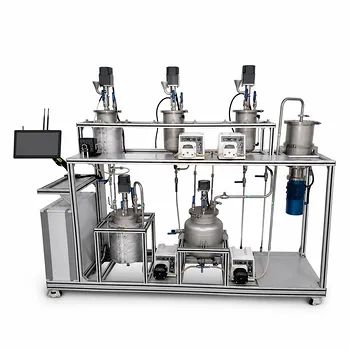
In-situ spectroscopic techniques like NIRS and Mid-IR spectroscopy serve as the eyes of a modern pilot-scale fermentation, enabling real-time, non-destructive measurement of critical process parameters without breaking sterility. By coupling fiber-optic probes directly to the bioreactor, NIRS can estimate biomass, cell density, substrate levels (like glucose), and even physical properties like viscosity. Mid-IR spectroscopy, while requiring more careful optical design, offers highly selective monitoring of specific metabolites and is robust to physical changes inside the tank like agitation speed or backpressure.
The true value of these real-time sensors lies not just in data density, but in their ability to facilitate dynamic process control loops. However, their accuracy hinges entirely on a robust, often painstaking calibration strategy. The primary operational barrier is not the hardware installation itself, but the effort required to create a chemometric model that can untangle the chemical signal from the physical noise of a living, churning bioreactor.
Dissecting the Role of In-Situ Spectroscopy
To understand the deep need—achieving reliable, automated quality control—you must move beyond seeing these instruments as simple concentration probes and view them as components of a holistic Process Analytical Technology (PAT) framework.
Real-Time Tracking of Critical Biomarkers
In-situ NIRS measures the overtones and combination bands of molecular vibrations (C-H, O-H, N-H), allowing it to penetrate dense, aqueous cell cultures without dilution.
- Biomass and Cell Density: By analyzing light scattering and absorption, a fiber-optic NIR probe can track the growth phase of a culture immediately. This eliminates the lag time of offline dry cell weight measurements and maintains the sterile boundary of the vessel.
- Substrate and Metabolite Profiling: The primary reference confirms that both techniques monitor glucose and ethanol. The supplementary references deepen this, showing that with advanced filtering, NIRS can selectively measure structurally similar amino acids like glutamine and asparagine—a vital capability for controlling mammalian cell culture feeds.
- Physical State Monitoring: In aerobic fermentations, the rheology of the broth changes. NIRS can correlate spectral shifts to viscosity changes, offering a proxy for the physical state of the mixing process that is invisible to standard electrochemical probes.
The Strategic Advantage of Mid-IR
While NIR dominates process environments, Mid-IR spectroscopy fills a specific, high-selectivity niche in the pilot plant.
- Fundamental Fingerprinting: Mid-IR probes capture the fundamental vibrations of molecular bonds, providing a sharper, more chemically distinct "fingerprint" than NIR. This makes it exceptionally powerful for quantifying specific organic acids or metabolites in complex media.
- Operational Robustness: A critical insight from the primary reference is that Mid-IR sensors are often unaffected by standard fermenter dynamics such as agitation, airflow, and backpressure. This physical stability solves one of the key noise problems that plague NIRS.
Navigating the Operational Pitfalls
Installing a probe is the easy part. The deep challenge is ensuring the signal coming from that probe accurately reflects the biology, not the physics of the reactor.
Taming the Physical Noise
The harsh environment of a pilot-scale vessel actively conspires against spectral accuracy.
- Agitation and Aeration Artifacts: Vigorous stirring and sparged air bubbles create significant scattering noise in NIR spectra. The primary reference warns that to maintain accuracy, operators must often hold these parameters constant or employ advanced signal optimization to mathematically scrub the bubble noise out of the data.
- Temperature-Induced Spectral Shift: Temperature fluctuations change the hydrogen bonding in water, which dominates the spectral background. A model built at 30°C will likely fail at 32°C. Your chemometric model must either include temperature as a variable during calibration or utilize non-linear algorithms (like neural networks) capable of compensating for this thermal drift.
The Core Limitation of NIRS
You cannot escape a fundamental truth: NIR is a secondary technique. It doesn't measure concentration directly; it measures the optical response to it.
- The Calibration Burden: To work, a spectrometer must be trained against a primary reference method (like HPLC or an enzymatic assay). The supplementary references stress that building this calibration is the hardest part in a pilot plant.
- Biological Scope Creep: During a multi-week fermentation campaign, the background matrix of the broth changes drastically as cells secrete byproducts and die. If your calibration model wasn't trained on this full biological spectrum, its predictions will drift into irrelevance.
Understanding the Trade-offs
Objectively evaluating these technologies requires recognizing that the choice between NIR and Mid-IR is a trade-off between robustness and ease of use.
While Mid-IR offers selective detection of fundamental bands and higher resistance to agitation noise, it suffers from a physical limitation: the signal is too strong. Mid-IR light is almost completely absorbed by water in the standard transmission mode. To function in an aqueous bioreactor, it requires attenuated total reflectance (ATR) crystals, which are susceptible to biofouling—a film of cells coating the crystal face can blind the sensor. NIR, with its weaker absorption coefficients, can shoot light directly through millimeters of culture via a simple, cleanable window, bypassing this biofouling nightmare entirely but requiring more complex mathematics to extract the signal.
Making the Right Choice for Your Goal
Deploying these technologies successfully depends on matching the technique to your specific process objective and tolerance for model maintenance.
- If your primary focus is maximizing product yield through dynamic feeding: Implement NIR spectroscopy with a Partial Least Squares (PLS) model optimized for your limiting substrate (e.g., glucose or glutamine). Prioritize building a library of offline reference samples that captures the full expected biological variability of your campaign.
- If your primary focus is monitoring a single biomarker in a vessel with highly variable agitation: Evaluate Mid-IR with a fouling-resistant ATR probe. Its resilience to physical noise makes it a strong candidate for processes where stirring profiles change frequently, provided you can manage the surface cleanliness of the sensor tip.
- If your primary focus is pilot-plant flexibility where you can’t build a new model for every new strain: Understand that calibration transfer is critical. Begin offline by developing a master calibration on a benchtop unit using a wide variety of process samples; never rely solely on the minimal data from a short pilot run to build a model from scratch.
By treating these spectroscopic tools not as plug-and-play meters but as complex information systems requiring rigorous mathematical training, you transform them from expensive sources of noisy data into the bedrock of autonomous bioprocessing.
Summary Table:
| Feature / Parameter | Near-Infrared Spectroscopy (NIRS) | Mid-Infrared Spectroscopy (Mid-IR) |
|---|---|---|
| Measurement Type | Overtones & combination bands (secondary) | Fundamental molecular vibrations (direct "fingerprint") |
| Key Parameters Tracked | Biomass, cell density, glucose, viscosity | Specific metabolites, organic acids, amino acids |
| Sensitivity to Agitation/Bubbles | High (requires advanced signal filtering) | Low (highly robust to physical dynamics) |
| Biofouling Risk | Low (allows non-contact measurement through windows) | High (requires ATR crystals prone to cell film coating) |
| Calibration Effort | High (demands extensive chemometric model training) | Moderate (sharper bands simplify modeling) |
Scale Up Your Bioprocess Control with LABPARK
Are you looking to implement advanced process analytical technologies (PAT) like inline spectroscopy in your facility? LABPARK provides state-of-the-art Educational and Vocational Unit Operations Pilot Plants in chemical engineering, bioprocess & biotech, and environmental & water treatment.
Whether you are a university training the next generation of engineers, a research institute developing novel bioprocesses, or an enterprise scaling up fermentation workflows, our customizable pilot plant systems provide the ideal platform to master real-time monitoring and process control.
Why partner with LABPARK?
- Advanced Integration: Pilot plants designed with flexible sensor ports for seamless NIRS and Mid-IR probe integration.
- Hands-on Training & Research: Ideal for teaching calibration transfer, chemometric modeling, and automation loops.
- Industry-Standard Design: Robust, reliable systems built to vocational and industrial research standards.
Ready to elevate your training or research capabilities? Contact the LABPARK team today to request a quote and discuss your pilot plant requirements!
Related Products
- Bio-fermentation Ethanol Production Practical Training Unit Operations Pilot Plant
- Natural Product Extraction Unit Operations Training Pilot Plant
- Multi-Functional Special Distillation Educational Pilot Plant
- Continuous Batch Extractive Distillation Educational Pilot Plant
- High-Gravity Emulsification and Mass Transfer Educational Pilot Plant
People Also Ask
- Why Use PTFE & Hastelloy in Chemical Pilot Plants? Prevent Corrosion & Ensure Safety
- Why Compare Predicted and Experimental Excess Enthalpy? Key to Accurate Pilot Plant Scale-up
- Why is the chemical plant startup schedule crucial? De-risk scale-up with pilot plants.
- When to transition from PID to adaptive control in pilot plants? Key process indicators.
- Why must batch and fed-batch fermentation pilot plants be designed to accommodate changing rheological conditions?