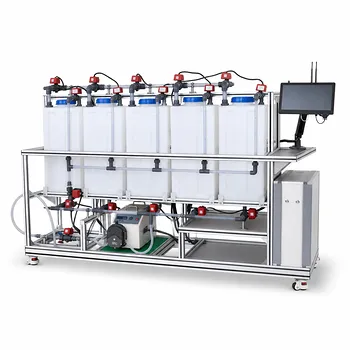
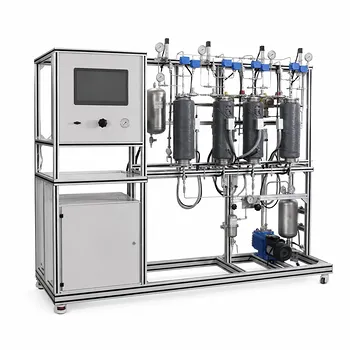
Let’s be direct. Environmental and water treatment unit operations pilot plants are the essential, non-negotiable bridge between a green chemistry concept proven in a beaker and a validated, deployable remediation technology. They function as a controlled, scaled-down version of a full treatment system, allowing you to evaluate a novel green reagent—like catalytic nanoparticles or a biodegradable compound—under dynamic, real-world conditions such as continuous flow and fluctuating contaminant loads, without the cost and risk of a full-scale failure.
The core value of a pilot plant is de-risking innovation. It transforms the evaluation of a green chemistry technology from a simple question of "does it react in a flask?" to a decisive question of "can it function reliably, efficiently, and affordably in a simulated environment?" This is where technical and economic feasibility are proven.
Beyond the Beaker: The Pilot Plant's Strategic Function
A green chemistry breakthrough in a laboratory is often an isothermal, perfectly mixed batch reaction with a single, pure contaminant. Reality is far messier. A pilot plant’s fundamental role is to introduce that messiness in a structured, measurable way.
Simulating Continuous, Dynamic Flow
Real-world remediation is rarely a batch process. Pilot plants force you to confront continuous flow dynamics. You can pump contaminated water through a fixed-bed column of your novel nano-zero valent iron (nZVI) or a supported enzymatic catalyst.
This reveals non-ideal flow patterns, mass transfer limitations, and pressure drops that are invisible in a stirred beaker. It’s the only way to generate a meaningful breakthrough curve, which directly dictates the usable life of your green reagent and determines the system's economic viability.
Measuring Degradation Kinetics Under Realistic Hydraulic Conditions
A published reaction rate constant from a batch study is a starting point, not a design parameter. A pilot plant allows you to measure the apparent degradation kinetics under site-relevant hydraulic retention times.
By spiking a chlorinated solvent like trichloroethylene (TCE) into the influent and monitoring its concentration at multiple points along the system’s flow path, you validate the actual destruction efficiency. This data is critical for sizing full-scale reactors and predicting compliance with discharge limits.
Actionable Evaluation of Green Technologies
The pilot plant is not a theoretical exercise; it’s a test rig for specific, measurable performance criteria. You can directly quantify the three pillars of a green technology: performance, stability, and life-cycle impact.
Quantifying Performance of Nano-Enabled and Bio-Based Agents
The evaluation process for advanced agents requires continuous operation.
- For catalytic nanoparticles: You evaluate not just initial reactivity, but long-term performance. A pilot system lets you cycle your carbon nanotube or graphene oxide adsorbent through multiple regeneration cycles, measuring its adsorption capacity each time to prove its functional longevity.
- For bioremediation: You can seed a pilot-scale biofilter with a specialized consortia, like Pseudomonas species, for oil degradation. By precisely controlling nutrients and aeration, you monitor the kinetics of Chemical Oxygen Demand (COD) removal in the effluent, proving the biological process’s resilience against influent variability.
Iterative Optimization of Process Parameters
A laboratory test offers a final result. A pilot plant offers a process understanding. You can systematically adjust the flow rate, pH, or nutrient dose of your green reagent and directly observe the effect on effluent quality.
This creates a feedback loop for optimization. It allows you to find the lowest effective dose of a biodegradable flocculant or the exact hydraulic loading rate that maximizes a constructed wetland cell's phytoremediation capacity for heavy metals. This optimization minimizes waste and operational costs, core tenets of green chemistry itself.
Generating Data for a Life Cycle Assessment (LCA)
A green technology is only truly green if its entire life cycle has a lower impact than the conventional method it replaces. A pilot plant provides the empirical data needed to prove this. You can’t conduct an accurate cradle-to-grave LCA with simulated data.
By running the unit operation at scale, you can physically measure the total energy input of the pumps, the actual consumption of your "safer" solvent, and the volume of any secondary waste stream produced. This data identifies hidden environmental hotspots, like a reagent synthesis step that uses immense energy, which would otherwise nullify the technology's downstream green benefits.
Understanding the Trade-offs
A pilot plant’s greatest gift is brutal honesty about a technology’s limitations.
The capital and operational cost of a pilot study is significant. It requires dedicated space, skilled operators, and consistent analytical support. System complexity often introduces challenges absent in the lab, such as biofouling of membranes or unanticipated corrosion from reactive nanoparticles. Direct scale-up is rarely linear. The data from a pilot plant provides the basis for a mathematical model, but the behavior of a heterogeneous environmental system at a 10x or 100x scale will still hold surprises.
The goal is not to eliminate all uncertainty, but to reduce it to an acceptable, calculated risk before committing significant capital to a full-scale implementation.
Making the Right Choice for Your Goal
The way you configure and use a pilot plant must be dictated by the specific development stage of your green technology.
- If your primary focus is early-stage proof-of-concept: Configure the pilot system for a single, critical unit operation, like an adsorption column. Prioritize the generation of a complete mass balance and a breakthrough curve to validate the technical feasibility of your novel sorbent under continuous flow.
- If your primary focus is long-term durability and cost: Run the pilot plant for an extended period, forcing the green reagent—be it a biocatalyst or nano-material—through multiple regeneration and reuse cycles. The key metric is the functional lifespan per unit cost of the material.
- If your primary focus is a holistic sustainability claim: Use the pilot plant as a data-generation engine. Meter every energy and material input and characterize every output stream to feed a rigorous, comparative Life Cycle Assessment against the incumbent technology.
A pilot plant doesn't just test a green chemistry method; it forces the method to mature, exposing its weaknesses in a controlled environment so its strengths can be engineered into a reliable, real-world solution.
Summary Table:
| Evaluation Focus | Pilot Plant Function | Key Performance Indicators |
|---|---|---|
| Flow Dynamics & Kinetics | Simulates continuous flow & measures degradation rates | Breakthrough curves, hydraulic retention time (HRT) |
| Agent Stability | Tests durability of nano-enabled & bio-based agents | Regeneration cycles, COD removal efficiency |
| Process Optimization | Identifies optimal operating conditions | Reagent dosage, energy input, pH levels |
| Life Cycle Assessment | Collects empirical data for sustainability analysis | Net energy use, secondary waste volumes |
Scale Up Your Remediation Technology with LABPARK
Transitioning green chemistry innovations from lab beakers to industrial application requires robust validation. LABPARK provides state-of-the-art Educational and Vocational Unit Operations Pilot Plants in chemical engineering, bioprocess & biotech, and environmental & water treatment.
Designed specifically for universities, research institutes, and enterprises, our systems enable you to accurately simulate continuous flow, optimize process parameters, and generate the empirical data needed for reliable Life Cycle Assessments (LCAs).
De-risk your environmental technology and prove its economic viability—contact our technical experts today to find the perfect pilot plant configuration for your research.
Related Products
- Electrochemical Water Treatment Educational Unit Operations Pilot Plant
- Ion Exchange Water Purification Educational Pilot Plant for Engineering Unit Operations
- Multi-Functional Membrane Separation Educational Pilot Plant for Unit Operations Lab
- Solid Waste Pyrolysis and Refining Educational Pilot Plant for Unit Operations
- Dual-Mode Rectification Pilot Plant for Practical Training Unit Operations
People Also Ask
- What design features do educational electrochemical pilot plants utilize to manage gas liberation and water loss?
- How can unit operations pilot plants show lead-acid concentration vs state of charge? Real-time monitoring guide.
- How do educational electrochemical pilot plants scale up electrolysis? Master industrial engineering.
- How to Estimate Sulfate in Water Treatment Pilot Plant Deposits: Gravimetric Guide
- How can foaming be managed during steam generation experiments in water treatment unit operations pilot plants? Tips