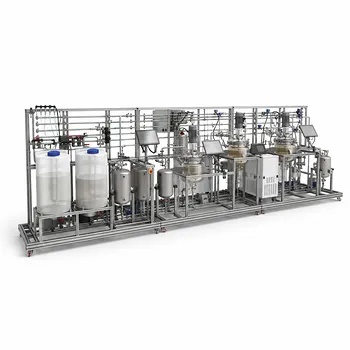
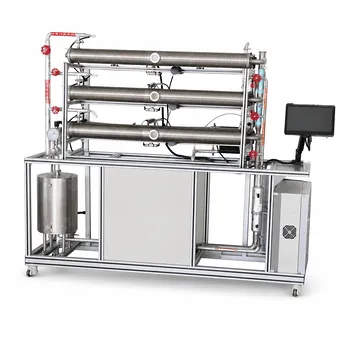
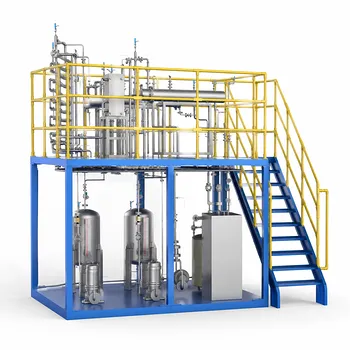
The bridge between theoretical economics and engineering reality is forged in the pilot plant. Educational unit operations pilot plants teach cost estimation by transforming abstract textbook variables into tangible, measurable physical parameters. Students physically interact with the column diameter, measure the heat exchanger's surface area, and note the materials of construction. This hands-on engagement allows them to apply scaling laws like the six-tenths rule and factorial cost estimation methods, using their own experimental data to predict the Inside Battery Limits (ISBL) capital cost of a full-scale chemical plant.
Cost estimation is not a guesstimate—it is a direct mathematical consequence of a piece of equipment's physical size, metallurgy, and operating pressure. Pilot plants demystify this process by allowing students to measure the core inputs—heat transfer area, column diameter, and flow rates—and then immediately connect them to industrial capital cost formulas.
The Core Link: Translating Physical Dimensions to Price
The primary reference states that pilot plants reveal the "physical specifications" needed for cost models. This is the pedagogical foundation.
Moving from a Textbook Variable to a Measurable Reality
In a classroom, "heat transfer area" is often a solved value at the bottom of a problem set. In a pilot plant, it is a specific bundle of tubes you can trace.
Students measure the inlet and outlet temperatures and flow rates of a shell-and-tube heat exchanger. They calculate the Log Mean Temperature Difference (LMTD) and experimental overall heat transfer coefficient ($U$). With the thermal duty ($Q$) determined, they calculate the required area ($A$). This calculated area is not an abstract number; it is the physical property that drives the equipment cost.
Quantifying Cost with the Exponent Rule
The economic leap happens when that measured area is plugged into the scaling principle. The supplementary references confirm the specific rule for floating head heat exchangers: $C_{p1}/C_{p2} = (A_1/A_2)^{0.6}$.
It is a visceral lesson in the economy of scale. A student might measure their 2 $m^2$ pilot-plant exchanger and calculate its cost. When they scale the process up to a 200 $m^2$ industrial unit, the cost does not increase by a factor of 100. It increases by a factor of about 16. This is because the exponent is 0.6, not 1.0. The pilot plant provides the reference point ($A_1$, $C_{p1}$) that makes the industrial prediction ($C_{p2}$) possible.
Applying the Full Industrial Cost Model
Determining the purchased cost of the core component is just the first step. A true educational pilot plant allows students to complete the entire capital cost picture.
Factoring in Materials and Pressure
A steel column and a glass-lined reactor handle pressure differently and have vastly different costs. The supplementary reference introduces the critical Material Factor ($F_m$)—a multiplier that can range from 1.0 for carbon steel to 12.0 for titanium.
Students learn to apply a Pressure Factor ($F_p$) as well. A distillation column operating under vacuum or high pressure requires a thicker shell and different internals. The process of identifying these factors from standard tables and multiplying them together to get the bare module factor ($F_{bm}$) directly mirrors the industrial workflow. The final calculation, $C_{bm} = C_p \times (F_p \times F_m)$, moves the estimate from a theoretical device to a real, installed object.
Demonstrating Process Intensification and Cost Reduction
A reactive distillation column, described in the supplementary references, serves as the perfect contrasting case study against a conventional reactor-plus-distillation train.
By combining reaction and separation in a single shell, the equipment count drops. There is no separate reactor, fewer pumps, and less piping. Students can perform a line-by-line equipment cost estimate for both configurations. They will immediately see that eliminating process steps dramatically slashes the total installed project cost, even if the single reactive distillation column itself is more complex and has a higher initial material factor. This directly demonstrates how process design is a primary driver of project economics.
Expanding the View: Inside and Outside Battery Limits
A pilot plant teaches that the equipment itself is only one part of the plant. The primary reference correctly identifies the need to estimate both ISBL and OSBL.
Defining the Total Installed Cost
Once students calculate the bare module cost for their column, they must account for the cost of installation. This includes structural steel, painting, insulation, instrumentation wiring, and piping to connect it to the rest of the plant.
Educational pilot plants are often on a skid with visible tubing, a control panel, and local gauges. An instructor can use this to model the factors. They can point to a flow transmitter and explain that in a factorial estimation model, that instrumentation adds a percentage multiplier to the bare module cost of the column. This visual, physical link makes the abstract "installation factors" concrete.
Understanding the Trade-offs
No educational model is without its pedagogical risks. The pilot-plant scale can create misconceptions if not framed correctly.
The "Flexibility Trap" and Its Economic Distortion
A supplementary reference highlights a critical difference: pilot plants use flexible, sequential setups, while manufacturing uses standardized, parallel operations.
Students may falsely assume the pilot plant’s configuration is the optimal industrial layout. The instructor must emphasize that a factory doesn't use one pump to serve three different reactors sequentially. It uses three dedicated pumps in parallel. The cost estimation for the full-scale plant must reflect the materials handling logic of high-volume manufacturing, not the multi-purpose flexibility of a lab. This is a crucial lesson in design philosophy, not just equipment sizing.
The Limits of Exponents and Factors
The scaling exponent of 0.6 is a powerful rule of thumb, but it is not a physical constant. It applies within specific size ranges.
A student cannot use it to scale a 4-inch pilot column to a 40-foot diameter monster and expect perfect accuracy. At extreme scales, the exponent changes, and construction methods shift from vertical vessel erection to field-welded columns on site. The same issue arises with material factors—a factor for 316L stainless steel does not capture the premium a specific nickel alloy might demand in a specialty chemical application. Teaching these limits prevents a false sense of numerical precision.
Making the Right Choice for Your Educational Goal
The way you deploy a pilot plant depends on the curriculum's objective. The equipment is just a tool; the pedagogical framing is what creates the learning.
- If your primary focus is teaching core scaling principles: Use a simple shell-and-tube heat exchanger to have students calculate the cost impact of doubling the area using the 0.6 exponent.
- If your primary focus is on total project economics: Use a full distillation skid to model the multi-factor installation costs, requiring students to account for piping, control instrumentation, and steel supports separately.
- If your primary focus is on debottlenecking and intensification: Use a reactive distillation column to challenge students to compare the total installed cost and energy profile of an integrated system versus a conventional series of unit operations.
- If your primary focus is a pharmaceutical or specialty chemical context: Emphasize the material of construction factors, allowing a cost comparison between an identical reactor sized in glass-lined steel versus Hastelloy.
The value of a pilot plant is that it makes the invisible logic of a capital cost estimate visible, transforming a student from a formula memorizer into an empirical economic analyst.
Summary Table:
| Pedagogical Focus | Equipment / Concept | Scaling & Cost Principle Applied |
|---|---|---|
| Core Scaling Rules | Shell-and-Tube Heat Exchanger | Exponent rule ($C_{p1}/C_{p2} = (A_1/A_2)^{0.6}$) for economy of scale |
| Material & Pressure Factors | Distillation Columns | Bare module factor calculations ($C_{bm} = C_p \times F_p \times F_m$) |
| Process Intensification | Reactive Distillation | Comparing system integration costs vs. conventional trains |
| Total Installed Cost | Modular Skid Pilot Plants | Visualizing ISBL/OSBL and instrumentation installation factors |
Bring Industrial Reality to Your Chemical Engineering Curriculum
Empower your students to master equipment scaling, process intensification, and real-world economics with LABPARK.
We provide high-quality Educational and Vocational Unit Operations Pilot Plants tailored for universities, research institutes, and enterprises. Covering chemical engineering, bioprocess & biotech, and environmental & water treatment, our pilot plants bridge the gap between abstract textbook formulas and hands-on industrial practice.
- Enhance Learning: Give students tangible equipment to calculate real heat transfer areas, column diameters, and module factors.
- Industry-Standard Design: Robust, skid-mounted pilot plants equipped with industrial instrumentation.
- Tailored Solutions: Customized systems designed to fit your specific research and educational objectives.
Ready to upgrade your lab? Contact LABPARK today to discuss your project requirements and receive a detailed consultation!
Related Products
- General Purpose Cosmetics Production Unit Operations Training Pilot Plant
- Multi Pump Fluid Transport Process Piping Unit Operations Training Pilot Plant
- Multi-Functional Drying Educational Unit Operations Pilot Plant
- Fixed-Bed Chemical Reaction and Gas Dust Tar Removal Unit Operations Pilot Plant
- 100L Continuous Loop Hydrogenation Educational Unit Operations Pilot Plant
People Also Ask
- Why is the chemical plant startup schedule crucial? De-risk scale-up with pilot plants.
- How do deviations in estimating latent heat impact pilot plant thermal systems? Avoid hardware mis-sizing.
- When to transition from PID to adaptive control in pilot plants? Key process indicators.
- Why Compare Predicted and Experimental Excess Enthalpy? Key to Accurate Pilot Plant Scale-up
- Why Use PTFE & Hastelloy in Chemical Pilot Plants? Prevent Corrosion & Ensure Safety