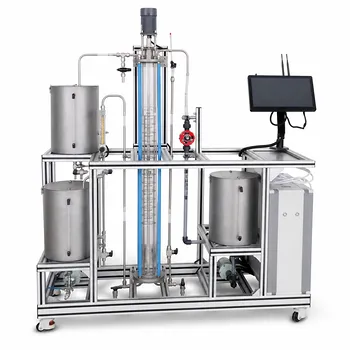
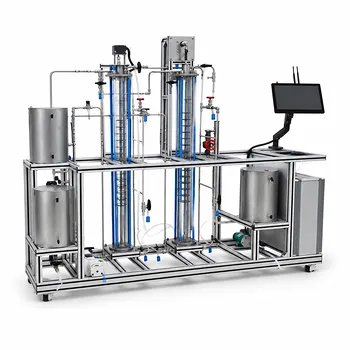
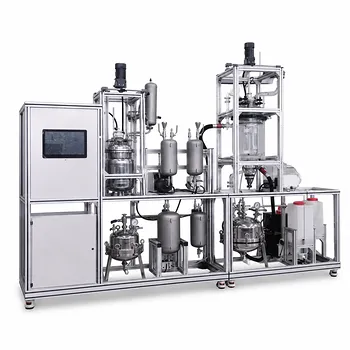
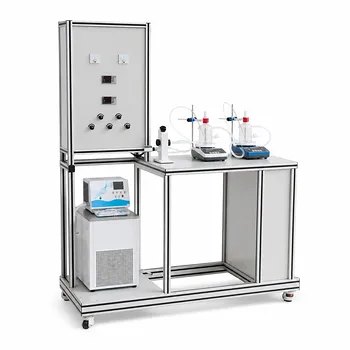
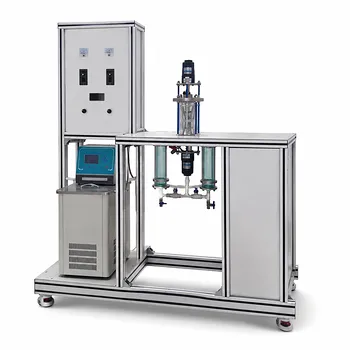
The real power of an educational extraction pilot plant lies in its ability to make the invisible visible.
Students can move from a series of separatory funnels—which require many laborious batch steps to simulate a few equilibrium contacts—to a continuous countercurrent process. By measuring solute concentrations at each physical stage once the pilot unit reaches steady state, they directly plot operating lines against equilibrium curves and compare the actual performance of real hardware to the number of theoretical stages predicted by graphical or analytical methods. This hands‑on comparison transforms abstract phase equilibria and mass‑transfer theory into concrete, quantifiable stage efficiencies.
A pilot‑scale countercurrent extraction unit bridges the gap between textbook theory and industrial reality. Instead of merely stepping off stages on paper, students run a continuous process, gather real composition data, and calculate the very same theoretical stage numbers—but now with an awareness of why real equipment always requires more stages than the ideal minimum.
Why a Pilot Plant Changes the Game
From Batch Funnel Chains to Steady‑State Operation
Classroom demonstrations often simulate a countercurrent cascade using a sequence of separatory funnel contacts that need roughly n+3 manual cycles to approximate n equilibrium stages.
A pilot plant replaces this tedious, error‑prone sequence with a single continuous flow process.
Once feed and solvent flow rates stabilize, stage compositions remain constant, allowing precise sampling and direct comparison with theoretical predictions.
Making Stage‑Wise Composition Profiles Tangible
The defining educational advantage is the ability to sample the raffinate and extract phases at multiple points along the column or between mixer‑settler cells.
These samples let students plot the actual operating line on a ternary phase diagram or an X‑Y distribution chart.
Placing real data points on the same graph as the equilibrium curve makes the concept of driving force—and where it is lost—immediately visible.
Demonstrating the Stage‑by‑Stage Process
Running the Countercurrent Experiment
Students set a known feed flow rate F, solvent flow rate S, and feed composition x_F.
They allow the unit to reach steady state and then draw samples from the final raffinate R_n and the final extract, as well as from intermediate stages if the design allows.
The solute recovery φ = (F·x_F – R_n·x_n) / (F·x_F) can be computed directly, giving an immediate check against the theoretical recovery predicted by graphical stage‑by‑stage construction.
Sampling Points Are Diagnostic Tools
The pilot plant’s real strength is that intermediate samples reveal where mass transfer is falling short.
If a stage shows a composition far from equilibrium, that indicates a low local stage efficiency.
Students can then explore reasons—poor dispersion, insufficient residence time, or an inadequate solvent‑to‑feed ratio—instead of assuming every tray is ideal.
Verifying Theoretical Stages Graphically
For Partially Miscible Systems: The Ternary Diagram
When the carrier and solvent are partially miscible, the Hunter‑Nash graphical method on a triangular diagram is the go‑to verification tool.
After plotting the solubility curve, students locate the feed point F and solvent point S, then calculate the mixture point M using the solvent‑to‑feed ratio.
The operating point Δ is found, and stages are stepped off from the desired raffinate composition toward the extract end. By overlaying the real‑plant operating points, students see exactly how many theoretical stages the column would need to achieve the same separation.
For Completely Immiscible Systems: The X‑Y Chart
If the carrier and solvent are practically immiscible, verification moves to a rectangular X‑Y diagram.
The equilibrium curve is plotted alongside an operating line with slope –B/S (carrier‑to‑solvent mass ratio).
Students step off stages between the operating line and equilibrium curve.
When the distribution coefficient K is constant, the Kremser equation gives the number of theoretical stages directly:
[ n = \frac{\ln\left[\frac{X_F - Y_s/K}{X_n – Y_s/K}\right]}{\ln(1 + A_m)}\quad\text{with the extraction factor } A_m = \frac{K \cdot S}{B}. ]
Plugging in the measured feed X_F, final raffinate X_n, and solvent‑inlet Y_s yields a theoretical stage count that can be compared immediately to the physical stages present.
Calculating Stage Efficiency—The Ultimate Verification
The Efficiency Ratio
The overall stage efficiency E_o is the clearest number for students to grasp: E_o = (theoretical stages) / (actual physical stages) × 100%.
A low E_o triggers discussion of mass‑transfer resistance, phase entrainment, or axial mixing.
A high E_o can still mask local inefficiencies, so point or Murphree efficiencies per stage, calculated from sampled compositions, provide a more detailed diagnostic.
Why Real Stages Are Never 100% Efficient
Even a perfectly designed pilot unit cannot achieve one‑to‑one correspondence with an equilibrium stage because the two phases never reach true equilibrium in a finite contactor.
Pilot‑plant demonstrations turn this limitation into a learning opportunity: students can vary agitator speed, feed flow, or solvent temperature, then watch how stage efficiency responds.
This closes the loop between the abstract diagram and the real constraints of fluid dynamics and mass transfer.
Matching Equipment to the Target Learning Outcome
Stage Count Dictates Hardware Choice
The equipment itself determines how effectively students can see the stage concept.
For systems needing 3 or fewer theoretical stages, a simple packed or spray tower is sufficient and keeps the demonstration visually simple.
When the required stages rise to 4–10, a sieve‑plate column or a pulsed column gives distinct stage separation and better sampling access.
Separations demanding 10–20 theoretical stages—or involving high‑viscosity, low‑density‑difference fluids—need energy‑input devices like reciprocating plate columns, rotating disc contactors, or mixer‑settler banks to maintain fine dispersion.
Mixer‑Settler Trains Offer the Clearest Stage Isolation
Mixer‑settler units have a unique educational advantage: each vessel is an unambiguous discrete stage.
Samples taken from the settling chamber of each stage directly reflect the approach to equilibrium at that point.
This makes stepping off stages on a diagram feel almost like a direct map to the hardware, reinforcing the concept that a theoretical stage represents a single, perfectly efficient equilibrium contact.
Understanding the Trade‑offs
The Sacrifice of Simplicity for Continuity
Running a pilot plant requires more preparation, safety supervision, and chemical handling than a simple separatory‑funnel exercise.
Setup time, solvent recovery, and the need for steady‑state operation mean that one experimental run can consume a full laboratory period.
Educators must balance the depth of insight gained against the time and complexity cost.
The Risk of Over‑Interpreting a Single Run
A single steady‑state measurement can mislead if students do not verify that true equilibrium has been achieved or if flow meters are not properly calibrated.
Without a systematic variation of the solvent‑to‑feed ratio, they may wrongly attribute a low efficiency to the equipment when it is simply an operating point far from the expected M location on the tie‑line.
The pilot plant works best when students repeat runs at different ratios and compare the resulting stage‑efficiency profiles.
Material Property Pitfalls
Solvent systems with extremely fast mass transfer can make the column appear nearly ideal, masking the very inefficiencies the pilot plant is meant to uncover.
Conversely, systems that foam, emulsify, or have an interfacial tension so low that phases do not cleanly separate can turn the demonstration into a frustrating troubleshooting exercise rather than a verification of theory.
Selecting a well‑characterized, forgiving system—like methyl ethyl ketone extraction from water—keeps the focus on the principles of staging.
Making the Most of Your Pilot Plant Demonstration
Use the plant as a deliberate bridge, not just a spectacle. The following goal‑oriented practices help students extract genuine understanding from the experiment:
- If your primary focus is teaching graphical stage‑determination methods: Have students construct the full Hunter‑Nash diagram or X‑Y operating line before the run, then overlay the measured stage compositions. The visual mismatch immediately anchors the discussion of efficiency.
- If your primary focus is quantifying mass‑transfer limitations: Measure at least three intermediate stage compositions (if accessible) and calculate point efficiencies. Vary the agitator speed and plot efficiency versus power input to give the theoretical stages a tangible, controllable dimension.
- If your primary focus is exposing students to industrial‑scale thinking: Choose a mixer‑settler train with clear, discrete stages and have them vary the solvent‑to‑feed ratio while computing the overall stage efficiency at each ratio. The resulting curve shows that “theoretical stages” are a property of the system, not a fixed column attribute.
- If your primary focus is comparing analytical and graphical methods: Use a completely immiscible system so both the Kremser equation and the X‑Y stepping method can be applied. Require students to explain any numerical discrepancy between the two calculated stage counts and to link it to the assumption of a constant distribution coefficient.
When students leave the pilot plant with a set of real concentration data and a graph that shows both predicted and actual stage counts, they no longer see theoretical stages as an abstract equation—they see them as a measurable performance gap they can diagnose and minimize.
Summary Table:
| Target Stages | Recommended Equipment | Key Educational Advantage |
|---|---|---|
| 1–3 Stages | Packed or Spray Tower | Visually simple, ideal for basic demonstrations. |
| 4–10 Stages | Sieve-Plate or Pulsed Column | Clear stage separation with accessible intermediate sampling points. |
| 10–20+ Stages | Mixer-Settler Trains / RDC | Distinct stage isolation; easiest path to map physical stages to theory. |
Enhance Your Chemical Engineering Curriculum with LABPARK
Bring complex thermodynamic and mass-transfer theories to life. LABPARK provides premium Educational and Vocational Unit Operations Pilot Plants in chemical engineering, bioprocess & biotech, and environmental & water treatment.
Designed specifically for universities, research institutes, and enterprises, our pilot systems empower students and researchers to perform precise, hands-on verification of theoretical stages and process efficiencies.
Ready to upgrade your laboratory capabilities? Contact LABPARK today to get started!
Related Products
- Educational Rotary Disc Liquid-Liquid Extraction Pilot Plant
- Comprehensive Liquid-Liquid Extraction Pilot Plant for Engineering Education
- Gallium and Indium Selective Extraction Educational Pilot Plant
- Ternary Liquid-Liquid Equilibrium Educational Pilot Plant
- Liquid-Liquid Mass Transfer Coefficient Determination Educational Pilot Plant
People Also Ask
- How do density and IFT affect liquid-liquid extraction pilot plants? Optimize Column Performance
- How are ternary phase diagrams and LLE data applied in extraction experiments? Optimize Pilot Plant Scale-up
- In a liquid-liquid extraction pilot plant, how is a ternary-phase diagram utilized to determine solvent feed requirements?
- How Do Selectivity & Distribution Coefficients Influence LLE Pilot Plant Solvent Choice?
- How to Validate BIPs for LLE Pilot Plants? Steps to Align Simulations with Reality