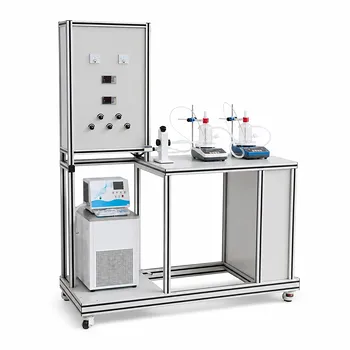
A simple demonstration on a distillation pilot plant turns an abstract chemical concept into a physical, measurable phenomenon. By carefully operating a column with carefully chosen mixtures—like ethanol with water and hydrogen chloride with water—students can observe how minimum and maximum boiling point azeotropes defy normal distillation rules. They gather real temperature data, sample compositions, and see firsthand why a conventional column can never separate these constant-boiling mixtures.
Educational distillation pilot plants let students measure the flat temperature profiles and fixed compositions that define azeotropes. Running binary mixtures that exhibit strong positive or negative deviations from Raoult’s law reveals exactly where and why ordinary distillation stops, transforming core thermodynamic principles into an active investigation.
Seeing a Minimum Boiling Azeotrope in Action
Selecting the Right System: Ethanol and Water
The classic educational pair is ethanol and water. Pure ethanol boils at 78.5 °C (351.5 K), and pure water at 100 °C (373 K), yet their mixture forms a positive deviation azeotrope that boils at just 78.1 °C (351.1 K)—lower than either component.
Students load the pilot plant with a carefully measured ethanol-water feed and bring the column to total reflux. As the column reaches steady state, they record temperatures on every stage. The top of the column settles at a constant minimum boiling point, typically around 78 °C. This uniform temperature profile is the first clue.
The Evidence in Temperature and Composition
Students sample the distillate and analyze its composition. The overhead stream stabilizes near 95.6% ethanol by mass (roughly 89 mol%), no matter how much reflux or how many theoretical stages the column provides. This composition is the azeotropic point. The liquid and vapor have the same composition; no further enrichment is possible.
This demonstration makes the vapor-liquid equilibrium (VLE) diagram tangible. On the T-x-y diagram, the liquid and vapor curves meet at a minimum. The instructor can overlay the measured data onto the diagram, proving that the curves intersect exactly where the separation stalls.
Observing Compositional Limits in the Pot
Students can also monitor the residue composition in the reboiler. When the initial feed is richer in ethanol than the azeotrope, the pot will progressively approach pure ethanol. If the initial feed is richer in water, the pot will drift toward pure water. In either case, the distillate remains locked at the azeotrope composition. Running both scenarios teaches the principle that a single distillation column can only cross the azeotropic boundary with external help.
Witnessing a Maximum Boiling Azeotrope
The Hydrogen Chloride-Water System
To contrast, a maximum boiling azeotrope demonstration uses hydrogen chloride and water. Hydrogen chloride boils at -85 °C (188 K), and water at 100 °C (373 K), but the mixture forms a negative deviation azeotrope that boils at 108.6 °C (381.6 K)—higher than either pure substance.
Educational pilot plants designed with corrosion-resistant materials can safely handle this system. When the column is run, the temperature rises to a maximum at the top. The distillate, now richer in HCl, stabilizes at a constant composition of about 20.2% HCl. No matter how much the column is refluxed, the overhead never reaches pure HCl.
The T-x-y Diagram Inverts
Here, the T-x-y diagram shows the liquid and vapor curves meeting at a maximum point instead of a minimum. The instructor uses live temperature readings to illustrate that, at this azeotrope, the mixture behaves as though it were a single pure component with a higher boiling point. The distillate dew-point and bubble-point lines coalesce at one composition, halting separation.
Linking to Molecular-Level Behavior
The pilot plant data gives students a concrete reason to explore activity coefficients. A maximum azeotrope arises from strong negative deviations from Raoult’s law, where unlike molecules attract more strongly than like molecules do. In an HCl-water plant run, the observed higher boiling temperature confirms that intermolecular forces are holding the mixture together, making it harder to vaporize one component over the other.
Using the Pilot Plant to Teach Separation Limits
Why Simple Distillation Fails
Through these two experiments, students understand that an azeotrope is not a chemical compound but a thermodynamic barrier. The relative volatility equals 1.0. The vapor leaving the liquid is identical in composition, so no amount of staging can break the deadlock.
The pilot plant renders this concept unmistakable. Students can vary the reflux ratio, change the feed location, and even add stages. The overhead composition remains stuck. This hands-on frustration is the best teacher—it cements why auxiliary methods, such as adding an entrainer, become necessary.
Reading an Azeotrope from a T-x-y Diagram
Instructors often use the pilot plant’s digital data to project a live T-x-y diagram. As the run proceeds, each measured (x, y, T) point plots directly on the equilibrium curve. Students see the curve pinch at the azeotrope in real time. This dynamic visualization, grounded in their own data, replaces theoretical numbers with immediate understanding.
Extending the Lesson to Advanced Separation Concepts
Demonstrating Pressure Swing Distillation
Once students grasp the barrier, the same pilot plant can be configured with two columns at different pressures. For a minimum-boiling azeotrope like ethanol-water, reducing the pressure shifts the azeotropic point to a higher ethanol concentration. Students can now cross the old boundary and obtain pure ethanol. Running this second configuration links thermodynamic theory directly to an industrial solution.
Introducing Extractive Distillation
Another powerful demonstration adds a third component. In an ethanol-water system, introducing a heavy entrainer like glycerol alters the relative volatilities. Students track how the azeotrope “disappears” because the solvent changes the activity coefficients. The pilot plant’s instrumented stages show a smooth temperature gradient where a sharp pinch once existed. A bottom product of nearly pure ethanol verifies that the thermodynamic barrier has been removed.
Observing Ternary Azeotropes and VLLE
For advanced learners, a three-column azeotropic distillation setup—using benzene with ethanol-water—creates a ternary azeotrope. The overhead vapor condenses and splits into two liquid phases in a decanter. Students observe vapor-liquid-liquid equilibrium (VLLE) directly, learning how a solvent-rich phase can be recycled while water is purged. The pilot plant’s ability to model this complex process demystifies multi-column industrial designs.
Understanding the Trade-offs
Safety and Material Constraints
Running an HCl-water mixture demands careful material selection. Even in educational settings, corrosion can damage equipment and pose safety risks. Many schools substitute a safer system like acetone-chloroform for a maximum-boiling azeotrope, but the demonstration loses some of the stark temperature contrast. The educational value must always be weighed against practical feasibility.
Measurement Fidelity vs. Theory
Pilot plants are real, not perfect. Heat losses, imperfect insulation, and transient conditions can cause measured temperatures to lag or deviate slightly from equilibrium. Students must learn to identify these artifacts and distinguish them from genuine thermodynamic behavior. Without this critical thinking, the data could mislead rather than enlighten.
Time and Operational Complexity
Reaching steady state in a pilot column—especially for a maximum azeotrope system—can take considerable time. Educational programs must balance the richness of the demonstration with lab-session constraints. Pre-heating feeds, stabilizing column hydraulics, and waiting for equilibrium require patience, which is itself a valuable lesson but one that demands careful curriculum planning.
Making the Right Choice for Your Educational Goal
How you design the azeotropic demonstration depends on what you want students to learn.
- If your primary focus is core thermodynamics: Use the ethanol-water system to show a minimum boiling azeotrope and a suitable safe substitute for a maximum boiling system (like acetone-chloroform). Emphasize temperature profile measurements and direct comparison with T-x-y diagrams.
- If your primary focus is process troubleshooting and limits: Load different initial feed compositions and let students “hit the wall” at the azeotrope. Then introduce an entrainer or a second column at a different pressure to show the only practical ways forward.
- If your primary focus is advanced separations: Run the full ternary azeotropic distillation with a decanter or integrate a pervaporation module. Use the pilot plant to collect data that confirms the VLLE region and validate the recycle strategy.
- If your primary focus is data collection and model validation: Challenge students to measure equilibrium points across the entire composition range, estimate activity coefficients, and compare their results with UNIFAC predictions. Let them see firsthand the limitations of predictive models.
By selecting the right mixture and pilot plant configuration, you transform an abstract azeotrope from a textbook footnote into a commanding, hands-on lesson in thermodynamic reality.
Summary Table:
| Azeotrope Type | Example System | Deviation from Raoult's Law | Boiling Point Behavior |
|---|---|---|---|
| Minimum Boiling | Ethanol + Water | Positive (Strong) | Lower than both pure components |
| Maximum Boiling | Hydrogen Chloride + Water | Negative (Strong) | Higher than both pure components |
Bring Thermodynamic Principles to Life in Your Lab
LABPARK provides premium Educational and Vocational Unit Operations Pilot Plants in chemical engineering, bioprocess & biotech, and environmental & water treatment. Tailored for universities, research institutes, and enterprises, our distillation systems help students visualize complex VLE behaviors and master advanced separation techniques.
Ready to upgrade your laboratory and enhance hands-on learning? Contact LABPARK today to consult with our experts!
Related Products
- Multi-Functional Special Distillation Educational Pilot Plant
- Continuous Batch Extractive Distillation Educational Pilot Plant
- Continuous Sieve-Plate Distillation Pilot Plant for Unit Operations Laboratory Education
- Electrolyte Distillation Purification and Formulation Educational Pilot Plant
- Multi Functional Membrane Crystallization Educational Unit Operations Pilot Plant
People Also Ask
- How does operating pressure influence Methylal/Methanol VLE? Discover its impact on distillation
- Why does simple distillation yield higher efficiency than flash distillation? Key thermodynamic differences.
- How to Estimate Distillation Pilot Plant Tray Efficiency? O'Connell's Correlation Guide
- How to Integrate Spectroscopy in Distillation Pilot Plants for Advanced Process Control
- Why is the acentric factor important in pilot plants? Fluid property prediction.