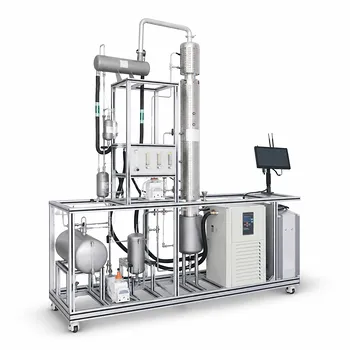
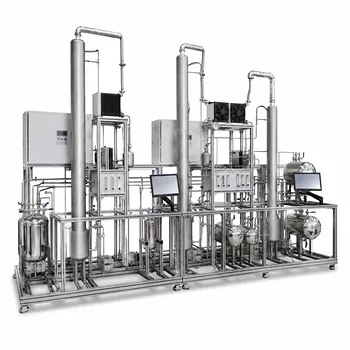
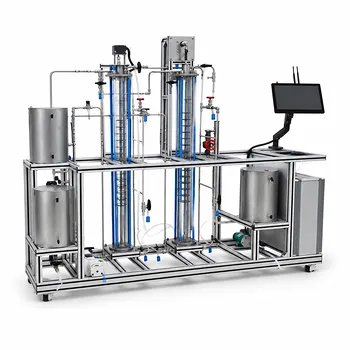
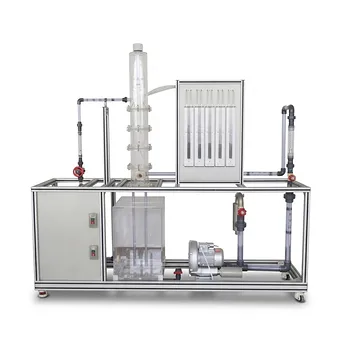
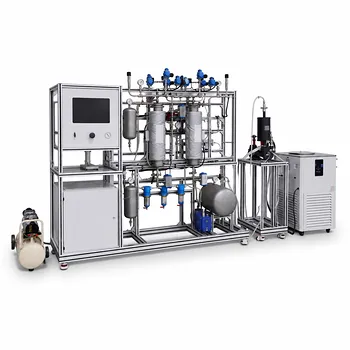
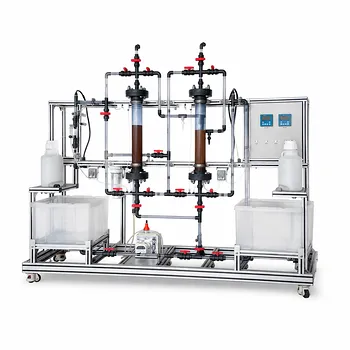
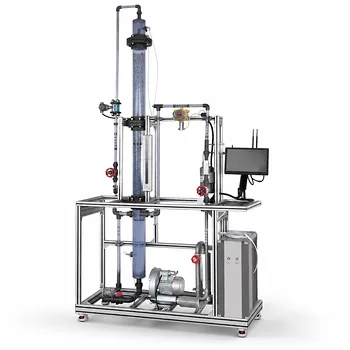
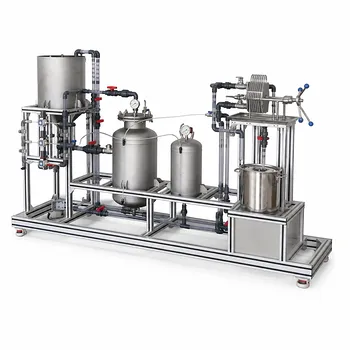
The answer lies in letting students push a column to its limits. Distillation pilot plants allow students to physically induce flooding by increasing feed rates, measure the resulting hydraulic crisis, and then test engineering remedies—such as upgrading internals or adding modular pre-fractionation—turning the abstract theory of debottlenecking into a visceral, quantitative learning experience.
Flooding is the ultimate capacity bottleneck. A properly equipped pilot plant transforms this complex hydrodynamic limit into a teachable moment: students can plot the exact pressure-drop curve that defines stability, then immediately experiment with the three core industrial solutions—increasing vapor cross-section, raising stage count to lower reflux ratio, or adding a pre-fractionator—to see the bottleneck dissolve.
From Theory to Observation: Making Flooding Tangible
Textbooks describe flooding as a loss of separation efficiency when vapor velocity becomes excessive. In a pilot plant, it becomes a measurable event.
The Power of the Pressure Drop Curve
Students connect theory to reality by generating experimental pressure drop versus gas velocity curves. Educational pilot plants are fitted with differential pressure sensors across the packed bed and precise liquid/gas flow controllers.
By slowly increasing the gas velocity at a constant liquid load, they observe the loading point—where liquid holdup begins to sharply increase—and the flooding point—where pressure drop skyrockets and liquid can no longer drain.
This hands-on measurement links directly to the generalized pressure drop correlation found in design textbooks. Instead of a static formula, students see it as a dynamic boundary they must respect.
Visualizing the Two Flooding Mechanisms
Pilot columns with transparent sections let students observe the physics. They distinguish between entrainment flooding, where high gas velocity carries liquid upward and chokes the cross-section, and downcomer flooding, where restricted downcomers cause liquid to fill the space between trays.
This visual diagnosis is critical because each mechanism demands a different solution. Seeing the liquid back up on a tray in real time cements the concept far more deeply than any simulation.
Quantifying the Performance Limit
By systematically varying feed rates, students map the column’s performance diagram. They find the flooding limit curve that defines the maximum stable vapor and liquid loads. They experience firsthand why industrial columns are typically operated at about 80% of the flooding velocity, with a design pressure drop of 15–80 mm H₂O/m of packing.
This frames flooding not as a sudden failure, but as a predictable thermodynamic and hydraulic boundary that can be managed.
Diagnosing the Bottleneck: Why Flooding Limits Capacity
The question “how can we increase throughput?” often starts with “where is the hydraulic limit?” The pilot plant lets students identify that limit with precision.
The Vapor Velocity-Capacity Link
When feed rate increases, the vapor boiling must also increase to maintain separation. This directly raises vapor velocity through the column’s cross-section. Above a critical velocity, entrainment or downcomer backup begins, until the column floods. In the pilot plant, students can alter the heating duty and measure the corresponding rise in pressure drop, building a correlation between feed rate, vapor velocity, and the onset of flooding.
Efficiency Losses Under Flooding Conditions
Flooding is not just a pressure-drop problem; it destroys mass transfer efficiency. Students take samples of distillate and bottoms at varying loads and calculate the overall column efficiency using the Fenske equation and Gilliland correlation (or McCabe‑Thiele analysis). They see efficiency drop steeply as the flooding point is approached, reinforcing that the bottleneck is a combination of hydraulics and loss of theoretical stages.
This teaches the principle that debottlenecking is fundamentally about either accommodating the higher vapor flow or reducing the vapor demand per unit of product.
The Pilot Plant as a Debottlenecking Laboratory
Once students have caused flooding, the real learning begins: they implement and compare industrial debottlenecking strategies on the same unit.
Strategy 1: Increase Vapor Flow Cross-Sectional Area
The most direct hydraulic fix is to increase the column’s open area for vapor flow. In a modular pilot plant, this can mean swapping a narrow packed section for a wider one, or replacing a tray stack with a design featuring larger downcomers or greater tray spacing.
Students quickly measure that the same vapor load now produces a lower velocity and a far lower pressure drop. The flooding limit shifts upward, graphically demonstrating how a column’s capacity is proportional to its cross-sectional area.
Strategy 2: Raise Stage Count to Reduce Reflux Ratio
Sometimes the bottleneck isn’t just hydraulics; it’s the excessive reflux ratio required by a column with too few stages. High reflux means high internal vapor traffic, which drives up velocity.
A pilot plant with exchangable internals can show this beautifully. By installing high-efficiency packing or closely spaced trays to increase the number of stages, students can achieve the same separation at a much lower reflux ratio. They then observe the vapor velocity drop, the pressure drop fall, and the column’s throughput capacity rise—all without changing the column diameter.
Strategy 3: Demonstrate Pre-Fractionation
For substantial capacity upgrades, industrial practice often adds a pre-fractionation column with its own reboiler and condenser. A modular pilot plant can be reconfigured with two columns in series to teach this.
The pre-fractionator performs a rough split, reducing the thermal load and reflux required in the main column. Students measure how the combined system processes a higher feed rate without flooding, while also improving energy efficiency. It’s a direct lesson in how process intensification can resolve bottlenecks.
Understanding the Educational Trade-offs
No teaching tool is perfect. While pilot plants are invaluable, their limitations must be part of the lesson.
Scale and Wall Effects
A pilot column’s small diameter can exaggerate wall effects and liquid maldistribution that behave differently in full-scale columns. Students need to understand that flood points measured on a 50 mm column cannot be linearly scaled to a 2 m industrial tower; the relationship is non-linear and dependent on packing geometry.
The Cost of Modularity
Columns designed for quick internal changes and pre-fractionator add-ons are expensive. Educational programs must balance the breadth of demonstration against the reality that each configuration takes time to clean, reassemble, and achieve steady-state. This can limit how many strategies students can test in a single session.
Safety and “Safe” Flooding
Even at pilot scale, flooding can cause rapid pressure rises, liquid carryover into vapor lines, and damage to instrumentation. The educational value must be weighed against the possibility of harming equipment or creating a volatile mixture hazard. Good pilot plants are engineered to let students approach the flood point safely, not to operate in a full blow-through. The learning occurs at the loading transition, not at catastrophic failure.
Making the Right Choice for Your Curriculum
The specific learning outcomes you want to achieve will dictate how you configure and use the pilot plant.
- If your primary focus is teaching hydrodynamic theory: Invest in a column with precise differential pressure sensors and flow controllers. Let students generate pressure drop curves and compare them against the generalized pressure drop correlation; this nails the fundamentals.
- If your primary focus is plant troubleshooting and debottlenecking: Choose a modular column that allows swapping of trays, packings, and even the addition of a pre-fractionation column. The lesson shifts from “what is flooding?” to “how do I fix it?”
- If your primary focus is energy efficiency and sustainable design: Emphasize Strategy 2 and 3—show how more stages or pre-fractionation slash reflux demand, vapor velocity, and heating utility load, turning a capacity problem into an energy-saving opportunity.
- If your primary focus is operator training for process disturbances: Design experiments where feed rates are intentionally ramped up or heating is mismanaged, requiring students to recognize the characteristic pressure drop signature of flooding and take corrective action before tripping the system.
Ultimately, a distillation pilot plant transforms flooding from a lecture-room warning into a solved puzzle; students leave not just knowing the definition of a bottleneck, but carrying the practical intuition of how to widen it.
Summary Table:
| Debottlenecking Strategy | Industrial Mechanism | Educational Insight |
|---|---|---|
| Increase Cross-Sectional Area | Swap to wider packed sections or larger downcomers to lower vapor velocity | Demonstrates how column capacity scales with physical dimensions |
| Raise Stage Count | Install high-efficiency packing to reduce the required reflux ratio | Shows how thermodynamic efficiency lowers vapor load and pressure drop |
| Implement Pre-Fractionation | Add a secondary column in series to perform a rough initial split | Teaches process intensification and energy-efficient system design |
Bring Hands-On Process Troubleshooting to Your Lab
Ready to transform abstract engineering theory into practical skills? LABPARK provides premium Educational and Vocational Unit Operations Pilot Plants in chemical engineering, bioprocess & biotech, and environmental & water treatment. Designed specifically for universities, research institutes, and enterprises, our modular systems allow students and researchers to safely simulate, analyze, and resolve real-world bottlenecks like column flooding.
Contact LABPARK today to discover how our tailored pilot plants can elevate your training curriculum!
Related Products
- Continuous Sieve-Plate Distillation Pilot Plant for Unit Operations Laboratory Education
- Multi-Functional Special Distillation Educational Pilot Plant
- Multi-Modal Distillation Unit Operations Training Pilot Plant
- Continuous Batch Extractive Distillation Educational Pilot Plant
- Dual-Mode Rectification Pilot Plant for Practical Training Unit Operations
People Also Ask
- Why is vacuum operation capability an essential feature for a distillation unit operations pilot plant? Unlock Efficiency
- What are the primary reflux ratio control strategies? Master Distillation Unit Operations
- How does catalyst water concentration affect distillation pilot plant design? Key separation train choices.
- How to select the right activity coefficient model (Wilson, NRTL, UNIQUAC) for distillation pilot plants?
- How can real-time carbon number prediction improve distillation pilot plants? Optimize control.