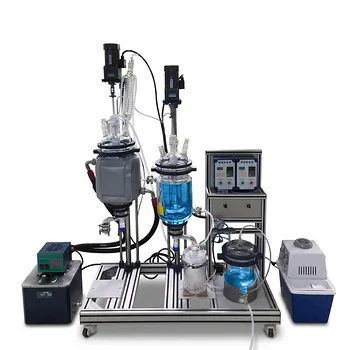
Pilot plants transform the classic aspirin synthesis from a simple lab exercise into a powerful, scaled-down industrial training platform. By replacing beakers and hot plates with jacketed reactors, industrial crystallizers, and vacuum filtration units, they allow students to study reaction kinetics, heat and mass transfer, and crystallization dynamics at a process-relevant scale. This directly addresses the educational gap between memorizing organic chemistry steps and mastering the engineering principles that govern commercial pharmaceutical production.
Aspirin synthesis is an ideal pedagogical vehicle. On the benchtop, it teaches basic organic reaction and purification. In a unit operations pilot plant, it becomes a full chemical process – reaction, crystallization, and solid-liquid separation – that forces students to confront real-world scale-up challenges like exothermic heat removal, crystal size distribution, and filtration throughput.
From Benchtop to Pilot Plant: Scaling Up the Aspirin Process
The laboratory-scale synthesis of aspirin is delightfully simple: mix salicylic acid and acetic anhydride, hold at 80-85°C, then cool to crystallize and vacuum filter. Yet every one of those steps hides engineering complexity that only emerges at larger volumes. A unit operations pilot plant purposely amplifies those hidden factors to teach process design.
The Reaction Step: Thermal Control Becomes the Dominant Challenge
In a test tube, the acetylation reaction’s exotherm dissipates almost instantly. In a pilot-scale jacketed glass reactor, the same chemistry generates a significant thermal load that must be actively managed. Students must learn to operate industrial heating/cooling systems, tune PID controllers, and ensure the jacket fluid rapidly removes heat to maintain the narrow 80-85°C window. Without this, a temperature exotherm can runaway, producing impurities or even creating a safety hazard.
This forced engagement with reaction calorimetry teaches principles no beaker can convey. Students see how reactor geometry, agitator speed, and jacket flow rates directly influence reaction rate and product quality. They can take samples over time to construct rate laws, verifying that the acetylation follows second-order kinetics under their actual mixing conditions.
Crystallization: From Simple Cooling to Controlled Crystal Engineering
The lab manual says “cool in an ice bath and collect crystals.” In a pilot plant, cooling a jacketed crystallizer reveals the profound effect of cooling rate, agitation, and seeding on crystal size distribution and purity. Students can add a concentrated aspirin solution to a cooling crystallizer and track the nucleation and growth phases using in-line particle size analyzers.
This shifts the lesson from “get crystals” to “engineer crystals that filter well.” They learn that rapid cooling creates a fine sludge that clogs filters, while a controlled cooling profile with a maintained seed bed produces large, regular crystals that drain quickly in the next unit operation. This connection between crystallization dynamics and downstream efficiency is a core chemical engineering insight that the benchtop experiment completely misses.
Solid-Liquid Separation: Filtration at a Process-Relevant Scale
Vacuum filtration of a few grams on a Büchner funnel is a trivial step. A pilot-scale vacuum filtration unit forces students to confront cake resistance, filter media selection, and washing efficiency. They measure filtrate flow rate over time, calculate cake compressibility, and discover that the very crystals they engineered in the previous step now determine the filtration cycle time.
This hands-on experience with an industrial unit operation cements the concept that separation steps often consume more energy and capital than the reactor itself. It also allows them to explore continuous alternatives, such as a rotary drum filter, linking batch crystallization directly to a continuous downstream step.
The Educational Bridge: What Students Truly Learn
The value of a pilot plant lies not in making more aspirin, but in exposing students to the interconnected nature of chemical processes. The aspirin synthesis is a friendly Trojan horse for delivering fundamental engineering concepts.
Heat and Mass Transfer Become Tangible
In glassware, mixing is assumed perfect and temperature uniform. In a pilot reactor, students measure temperature gradients across the vessel and see how baffles and impeller type affect homogeneity. They can deliberately create mass transfer limitations – for example, by under-powering the agitator during the acetylation step – and watch the reaction slowdown. The concept of a transport-limited reaction is no longer an abstract lecture slide; it’s an experimental variable they control.
Real-Time Process Analytical Technology
Modern educational pilot plants integrate sensors like conductivity probes, pH meters, and even Raman spectroscopy. During the aspirin crystallization, a turbidity probe or focused beam reflectance measurement (FBRM) tracks chord length distribution in real time. Students correlate this data with cooling profiles to develop a fundamental understanding of process analytical technology and how it enables quality-by-design in pharmaceutical manufacturing.
Integrating Separate Unit Operations into a Flowsheet
The ultimate lesson is process integration. A modular pilot plant allows students to run the reactor, transfer the hot reaction mixture to a holding tank, then feed it into a crystallizer, and finally pump the slurry to a filter. Coordinating these steps teaches them about scheduling, buffer tank sizing, and the consequences of a blockage upstream on the rest of the line. This systems-level thinking is impossible with individual beakers.
Understanding the Trade-offs and Limitations
Despite the immense educational value, teaching with pilot plants comes with real trade-offs that must be acknowledged.
- Cost and Space: Even a modular, benchtop-scale pilot plant requires a significant capital investment and dedicated laboratory space with utilities. The aspirin synthesis, while safe in glassware, demands robust engineering controls (ventilation, secondary containment) at pilot scale.
- Complexity Overload: For a student’s first organic synthesis, the sheer number of operational parameters (jacket temperature profiles, agitator RPM, filter cloth selection) can obscure the core chemistry. The instructor must carefully scaffold the learning experience, perhaps by first performing the synthesis in glassware to cement the reaction scheme, then moving to the pilot plant to explore the engineering.
- Batch vs. Continuous: Most educational pilot units for crystallization are batch-operated, mirroring the lab synthesis. While this is excellent for teaching batch process control, it may not fully prepare students for the industry’s growing shift toward continuous manufacturing, where a continuous stirred-tank crystallizer coupled with a continuous filter would demonstrate higher throughput and consistent crystal quality. However, a pilot plant with a multistage extraction column and continuous crystallizer can be added to demonstrate this specific advantage.
- Not a Perfect Scale-Down: A 10-liter jacketed reactor still behaves very differently from a 10,000-liter industrial vessel due to surface-to-volume ratios and mixing geometries. Instructors must emphasize that the pilot plant teaches principles of scale-up, not direct numerical scale factors.
How to Incorporate This into Your Curriculum
The decision to invest in a pilot plant for teaching aspirin-unit-type operations depends on your educational goals. The answer is not “always” or “never,” but a strategic choice.
- If your primary focus is to teach organic chemistry fundamentals: A traditional lab with glassware and a hot plate is more than sufficient. The simplicity keeps students focused on the reaction mechanism and basic recrystallization technique.
- If your primary focus is to bridge the gap to chemical engineering and process design: A modular unit operations pilot plant is invaluable. Use the aspirin synthesis as a familiar chemical system, then ask students to optimize yield, improve crystal size distribution, or reduce filtration time. The familiar reaction makes the unfamiliar engineering challenges safe to explore.
- If your primary focus is on pharmaceutical industrial training or continuous manufacturing: Invest in a pilot plant that goes beyond just the reactor and crystallizer. Add an extraction column for purification or a continuous crystallizer to demonstrate the step-change in throughput and product consistency. This mirrors the actual needs of kilo labs and pilot production.
When chemistry meets engineering in a purpose-built pilot plant, students stop simply making a product and start understanding the process that makes the product possible.
Summary Table:
| Process Step | Benchtop Lab Scale | Pilot Plant Scale |
|---|---|---|
| Reaction | Beaker mixing; instant heat dissipation. | Jacketed reactor; active thermal control & PID tuning. |
| Crystallization | Ice bath; uncontrolled crystal sizes. | Controlled cooling & seeding; optimized crystal growth. |
| Separation | Büchner funnel; simple scale. | Industrial filter; measures cake resistance & cycle times. |
Elevate Your Chemical Engineering Lab with LABPARK
Bridge the gap between textbook theory and industrial reality. LABPARK designs and supplies premium Educational and Vocational Unit Operations Pilot Plants in chemical engineering, bioprocess & biotech, and environmental & water treatment.
We help universities, research institutes, and enterprises equip their labs with hands-on systems for mastering crystallization, reaction control, and solid-liquid separation.
Contact LABPARK today to find the perfect educational pilot plant solution for your institution!
Related Products
- Multi Functional Membrane Crystallization Educational Unit Operations Pilot Plant
- Potassium Salt Thermal Dissolution and Crystallization Separation Educational Unit Operations Pilot Plant
- Multi-Functional Special Distillation Educational Pilot Plant
- Ethyl Acetate Synthesis Unit Operations Pilot Plant for Practical Training
- Multi-Modal Distillation Unit Operations Training Pilot Plant
People Also Ask
- Control Crystallization Pilot Plant Secondary Nucleation: 4 Key Adjustments
- Why is precise temperature control critical in crystallization pilot plants? Key to Scale-Up Success
- What key factors should be considered when configuring a crystallization unit operations pilot plant?
- What are the benefits of integrating online PAT tools like ATR-FTIR into crystallization unit operations pilot plants?
- How to use crystallization pilot plant agitation speed to identify diffusion vs reaction growth?