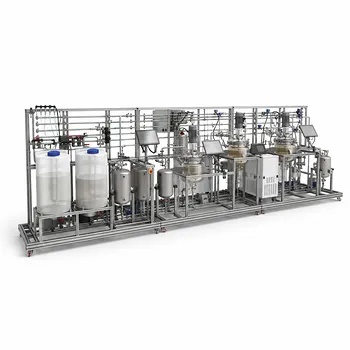
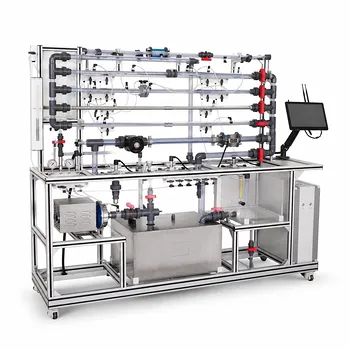
Hands-on learning with pilot-scale unit operations lets you directly compare the real-world performance of control valves and variable frequency drive (VFD) pumps. By configuring a pilot plant with interchangeable flow control elements, you can run side-by-side experiments to measure power consumption, pressure drop, system dynamics, and overall process impact. This transforms textbook theory into tangible insight, revealing the true economic and operational trade-offs between throttling flow with a valve and modulating motor speed with a VFD.
Pilot plants demystify the choice between flow control strategies by turning abstract energy equations into measurable differences. With the right experimental setup, you don’t just calculate life-cycle costs—you see, record, and feel how each method affects process stability, efficiency, and downstream unit operations.
Why a Pilot Plant is the Ideal Classroom for Flow Control
Bridging the Gap Between Theory and Industrial Reality
Standard lab glassware cannot demonstrate the fluid dynamics, energy losses, and control-loop interactions that dominate at production scale. Pilot plants are scaled-down replicas of industrial equipment—complete with pumps, piping, instrumentation, and real-time data acquisition—so they replicate the challenges students will face on the plant floor.
Building a Modular, Switchable System
A well-designed educational pilot plant lets you swap control strategies without rebuilding the process. You can install a control valve on a bypass loop and a VFD on the pump motor, then select which one actively governs flow. This modularity makes head-to-head comparison clean, repeatable, and directly linked to a common process objective, such as maintaining a setpoint in a distillation feed or reactor cooling loop.
Designing Experiments that Teach the Real Differences
Creating a Fair Head-to-Head Comparison
The core experiment involves running the same process at identical flow rate setpoints—first using the control valve to throttle flow, then using the VFD to adjust pump speed. While the process holds the same flow, you simultaneously record:
- Electrical power drawn by the pump motor
- Pressure drop across the control element
- Valve position or VFD frequency
- Process stability (e.g., variability in flow or downstream temperature)
This direct comparison transforms energy conservation from a lecture slide into a number your students measure themselves.
Observing Energy Consumption Right at the Meter
A control valve maintains excess pump head and then dissipates that energy as friction and heat. In contrast, a VFD reduces motor speed so the pump delivers only the required pressure. By reading power meters during identically controlled runs, students see that the VFD consumes far less electricity at reduced flow rates. This single observation often becomes the most memorable lesson in process optimization.
Capturing System Dynamics and Controllability
Steady-state efficiency is just one part of the story. A pilot plant equipped with a programmable logic controller (PLC) or distributed control system (DCS) allows you to introduce setpoint changes and disturbances. Students can record how quickly each method restores the desired flow, whether it overshoots, and how it interacts with other loops. A valve may respond faster but induce pressure oscillations; a VFD may offer smoother ramps but require careful tuning to avoid motor resonance.
Connecting Flow Control to Downstream Process Outcomes
Flow Disturbances Become Purity Problems
In a fully integrated pilot plant, the flow control strategy affects more than pump electricity. A fluctuating feed rate can disturb a distillation column’s tray loading, alter reactor residence time, or shift extraction efficiency. By running the same upstream process with the two control methods, students witness how a seemingly small flow ripple propagates into measurable changes in product purity or yield. This drives home the principle that process control is never an isolated decision.
Real-Time Monitoring With Process Analytical Technology (PAT)
Educational pilot plants often include inline sensors—such as flowmeters, pressure transmitters, and near-infrared probes—for continuous data logging. Students can trend valve position or VFD frequency alongside critical quality attributes. This mirrors modern industry practices where decision-making is driven by real-time evidence rather than speculation about energy savings.
Modeling Life-Cycle Cost From Real Data
Beyond the instantaneous power reading, a pilot plant lets students log cumulative kilowatt-hours over days and then extrapolate to annual operating costs. Pairing these numbers with equipment quotes for valves and VFDs introduces genuine economic analysis: when does the higher capital cost of a VFD pay back through energy savings? The data collected in the lab become the foundation for a defensible business case.
Understanding the Trade-offs Between Valves and VFDs
Energy Efficiency Is Not the Whole Picture
VFDs shine in variable-flow applications where the pump operates far from its best efficiency point for long periods. If the process runs at a nearly constant high flow, the energy advantage shrinks. A control valve, when sized correctly, may present a simpler, lower-maintenance option that still meets the control objective without the complexity of power electronics.
Capital Cost and Infrastructure
A control valve is often less expensive to purchase and install. A VFD requires a compatible motor, potentially filtered power cables, and panel space. In an existing plant, retrofitting a VFD might involve significant electrical work. The pilot plant allows you to model these project-cost differences and weigh them against operating savings.
Reliability, Harmonics, and Turndown Limitations
Control valves have well-understood wear mechanisms (trim erosion, seat leakage) and may demand regular maintenance in abrasive or high-pressure-drop service. VFDs introduce electrical noise and harmonics that can affect sensitive instrumentation, and motors can overheat at very low speeds due to reduced cooling. The pilot environment is the safe place to learn these practical constraints—a wrong setting in a class does not cause a plant outage.
Dynamic Responsiveness
A fast-acting valve can correct a flow deviation almost instantly, which might be critical in a reactor with hazardous runaway potential. A VFD, by contrast, has the inertia of the motor and pump, so its response can be smoother but slower. Testing both under the same process conditions teaches the nuanced truth: the “better” strategy is the one that best matches the process safety and agility requirements.
Making the Right Choice for Your Process Goal
Once the pilot plant has revealed the numbers and dynamic behavior, the decision becomes contextual. Use your experimental data to align the flow control strategy with your real-world priorities.
- If your primary focus is minimizing energy consumption: Favor a VFD when the process operates at variable flow for extended periods. The pilot data will likely show a significant reduction in kilowatt-hours compared to throttling.
- If your primary focus is rapid disturbance rejection and tight flow control: You may lean toward a fast-acting control valve, especially if safety or stringent quality limits demand split-second response and the energy penalty is acceptable.
- If your primary focus is lowest upfront cost and simplicity: A control valve often wins. Let the pilot plant’s capital-cost model show how much operating savings are needed to justify the VFD investment.
- If your primary focus is long-term reliability in harsh conditions: Evaluate both options carefully; the pilot plant can simulate slurry or corrosive service to expose maintenance differences before you commit to full-scale design.
Ultimately, the pilot plant transforms flow control from a prescribed formula into a decision you can own. By measuring, comparing, and analyzing both strategies under real process conditions, you build the kind of judgment that no textbook can provide.
Summary Table:
| Feature | Control Valves | VFD Pumps |
|---|---|---|
| Energy Efficiency | Lower (dissipates excess energy as friction) | Higher (adjusts motor speed to meet demand) |
| Response Speed | Fast dynamic response and disturbance rejection | Smoother but slower due to motor/pump inertia |
| Upfront Cost | Lower initial capital investment | Higher equipment and installation costs |
| Primary Limitations | Mechanical wear, trim erosion, and seat leakage | Electrical harmonics and motor overheating at low speeds |
Bridge the Gap Between Theory and Practice with LABPARK
Are you looking to enhance your laboratory's hands-on training and research capabilities? LABPARK provides premium Educational and Vocational Unit Operations Pilot Plants in chemical engineering, bioprocess & biotech, and environmental & water treatment.
Designed for universities, research institutes, and enterprises, our modular and customizable systems allow students and engineers to directly compare critical process control strategies—like control valves and VFD pumps—using real-time industrial data.
Supercharge your curriculum and research today. Contact LABPARK now to discuss your custom pilot plant configuration!
Related Products
- General Purpose Cosmetics Production Unit Operations Training Pilot Plant
- Multi Pump Fluid Transport Process Piping Unit Operations Training Pilot Plant
- Multi-Functional Drying Educational Unit Operations Pilot Plant
- Fixed-Bed Chemical Reaction and Gas Dust Tar Removal Unit Operations Pilot Plant
- 100L Continuous Loop Hydrogenation Educational Unit Operations Pilot Plant
People Also Ask
- How do deviations in estimating latent heat impact pilot plant thermal systems? Avoid hardware mis-sizing.
- Why is the chemical plant startup schedule crucial? De-risk scale-up with pilot plants.
- When to transition from PID to adaptive control in pilot plants? Key process indicators.
- Why Compare Predicted and Experimental Excess Enthalpy? Key to Accurate Pilot Plant Scale-up
- Why Use PTFE & Hastelloy in Chemical Pilot Plants? Prevent Corrosion & Ensure Safety