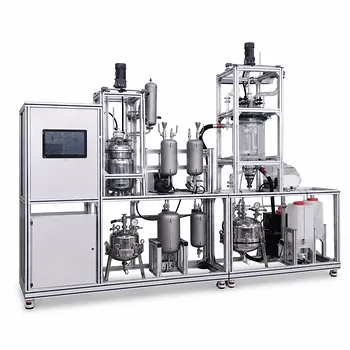
A chemical engineering pilot plant safely demonstrates the industrial chlor-alkali process in a university lab by integrating dedicated gas scrubbing, explosion-proofing, and real-time monitoring into a scaled-down, modular system. It encloses the (2\text{NaCl} + 2\text{H}_2\text{O} \rightarrow 2\text{NaOH} + \text{H}_2\uparrow + \text{Cl}_2\uparrow) reaction within engineered safeguards, allowing students to manipulate operating parameters, measure current efficiency, and study cell design under conditions that mirror industrial reality while eliminating the risks of toxic chlorine and flammable hydrogen.
The true challenge isn't just showing a chemical reaction—it’s creating a live, industrial-style environment that teaches process safety and control engineering. A pilot plant bridges this gap by transforming a hazardous electrolysis into a measurable, observable, and fully guarded learning system, making abstract electrochemical theory tangible.
The Core Reaction and Its Inherent Hazards
The chlor-alkali process splits saturated brine into three products: sodium hydroxide (NaOH), chlorine gas (Cl₂), and hydrogen gas (H₂). At the anode, chloride ions lose electrons to form toxic chlorine gas. At the cathode, hydrogen ions from water gain electrons to form highly flammable hydrogen gas, leaving behind hydroxide ions that create the caustic soda.
Why a Standard Bench-Top Setup Falls Short
Bench-scale experiments often use small beakers and simple electrodes. They cannot replicate the gas evolution rates, heat buildup, or mass transfer limitations of an industrial cell. Moreover, even a minor leak of chlorine or accumulation of hydrogen in a poorly ventilated fume hood can create an immediate safety incident.
The Pilot Plant’s Risk Reduction Philosophy
A pilot plant doesn't merely contain the reaction; it systematically eliminates the hazards through engineered layers of protection. It converts what would be a dangerous open process into a closed-loop, continuously monitored operation—turning a potential crisis into a predictable, teachable moment.
How a Pilot Plant Mitigates Risks
A chlor-alkali pilot plant integrates multiple, simultaneously active safety features. These are not add-ons; they form the structural backbone of the educational tool.
Closed-Loop Gas Handling and Scrubbing
The unit operates with gas-sealed piping and dedicated absorption systems. Chlorine gas is immediately routed through a scrubbing column, typically using a caustic or sulfite solution, where it is neutralized before any possibility of release. Hydrogen gas is managed through explosion-proof fittings, such as flame arrestors and forced ventilation, preventing any accumulation inside the equipment or the laboratory.
Redundant Sensing and Automated Shutdown
Industrial-grade gas detection sensors constantly monitor for any trace of chlorine or hydrogen above preset thresholds. If a deviation is detected or if flow rates or power supplies fail, the system triggers an automatic shutdown. This instantly isolates the cell and cuts the electrical load, teaching students the principles of process safety interlocks in real-time.
Engineered Cell Design and Material Selection
The cells themselves—often with transparent membrane or diaphragm modules—allow students to visually observe the separation of gases and the flow of electrolyte. They use materials resistant to caustic attack and chlorine corrosion, ensuring that the hardware itself remains stable under continuous operation. This demonstrates fundamental electrochemical cell design choices between membrane and diaphragm technologies.
Educational Value: Bridging Theory and Industrial Reality
The pilot plant’s true utility goes beyond safety. It turns textbook equations into measurable phenomena, letting students act as process engineers.
Direct Measurement of Current Efficiency and Mass Balance
With integrated online sensors for current density, cell voltage, pH, and temperature, the plant captures data streams that students analyze to calculate current efficiency—the fraction of electrons that actually produce the desired products. By comparing actual gas volumes measured via mass flow meters against the theoretical Faradaic yield, they confront real-world losses like side reactions and electrode passivation.
Observing pH Gradients and Separation Dynamics
In a working cell, the pH near the cathode rises sharply as NaOH forms. Monitoring this dynamic pH change connects the Nernst equation and ionic migration theory to a physical sensor readout. Students see why a diaphragm or membrane is essential to keep the anode’s acidic environment from neutralizing the cathode’s caustic product—illustrating product purity and separation in one direct observation.
Translating Thermodynamics into Operating Parameters
The pilot plant lets students vary temperature, flow rate, and current density and then trace how those changes alter cell voltage (thermodynamic) and product generation rate (kinetic). Performing energy balances becomes an experimental exercise, not just a paper calculation, cementing the bridge between abstract thermodynamics and practical industrial operation.
Trade-offs and Practical Considerations
Using a pilot plant is powerful, but it comes with costs and constraints that a university lab must plan for.
Initial Capital and Maintenance Overhead
A chlor-alkali pilot plant with gas scrubbing, sensors, and automation is a significant investment compared to simple beaker experiments. Consumables like scrubbing media and replacement membranes add recurring costs. The hardware requires regular calibration and inspection to keep its safety integrity—demanding a dedicated maintenance schedule and trained support staff.
Space and Infrastructure Requirements
The system needs specialized laboratory space with robust ventilation ducting, explosion-proof electrical zones, and possibly reinforced flooring. It cannot be placed in a typical open teaching lab without substantial retrofitting, so deployment often demands dedicated pilot-plant halls.
The Learning Curve for Operators
Students must be trained on process safety protocols, emergency shutdown procedures, and data acquisition systems before they can touch the equipment. This elevates the teaching burden but also mirrors the intensive training found in real chemical industries, turning the preparation itself into a valued educational asset.
Making the Right Choice for Your Curriculum
How you integrate the pilot plant should reflect your educational objectives. Choose the depth of engagement based on what you want students to take away.
- If your primary focus is process safety and hazard analysis: Use the pilot plant as a case study in layers of protection, alarm management, and automatic shutdown logic, having students audit the safety system design as part of their coursework.
- If your primary focus is core electrochemical principles: Configure the plant to run at varied current densities and temperatures, guiding students to calculate current efficiency, electrode kinetics, and mass balances from live sensor data and collected product volumes.
- If your primary focus is industrial process design and optimization: Run comparative trials between membrane and diaphragm cells, analyzing energy consumption per kg of product and demonstrating how cell design directly impacts operating cost and purity.
A well-implemented pilot plant doesn’t just show students how sodium hydroxide is made—it gives them a controlled space to fail safely, troubleshoot, and internalize the engineering discipline that keeps an entire industry running.
Summary Table:
| Key Aspect | How Pilot Plants Address It |
|---|---|
| Gas Safety | Closed-loop venting and dedicated scrubbing column to neutralize Cl2. |
| Risk Control | Real-time sensors trigger automated shutdown in case of leaks. |
| Core Education | Direct measurement of current efficiency, pH gradients, and mass balance. |
| Real-world Design | Compares membrane vs. diaphragm cells under industrial conditions. |
Elevate Process Safety and Practical Engineering with LABPARK
Bridge the gap between theoretical electrochemistry and industrial reality. LABPARK provides state-of-the-art Educational and Vocational Unit Operations Pilot Plants in chemical engineering, bioprocess & biotech, and environmental & water treatment tailored for universities, research institutes, and enterprises.
Equip your students with the tools to master process controls, analyze real-time data, and manage hazards safely.
Contact us today to request a quote or customize your pilot plant!
Related Products
- Alkaline Membrane Water Electrolysis Educational Pilot Plant Unit Operations Training System
- Electrolytic Hydrogen Production Educational Unit Operations Pilot Plant
- Electrolyte Distillation Purification and Formulation Educational Pilot Plant
- Water Electrolysis Hydrogen Production and Storage Educational Pilot Plant
- Methane Cracking Educational Unit Operations Pilot Plant
People Also Ask
- How do chemical engineering pilot plants demonstrate electrolysis? Bridge Theory & Industrial Scale
- How do composite membranes affect NaOH production? Key factors for high current efficiency.
- What are the core parameters of water electrolysis efficiency? Master them with pilot plants.
- Gap-Electrode vs. Zero-Gap Membrane: Key Design Choices for Water Electrolysis Pilot Plants
- How do alkaline and PEM electrolysis technologies differ in pilot plant operations?