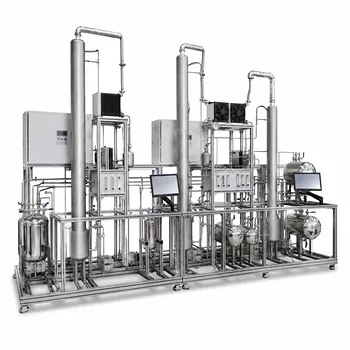
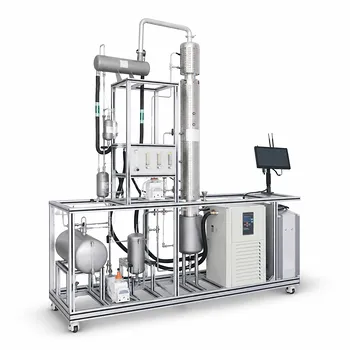
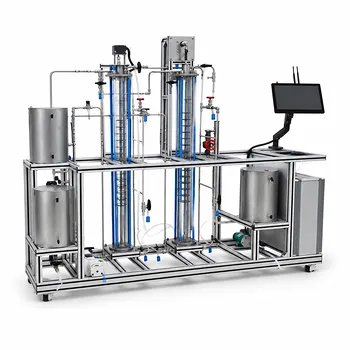
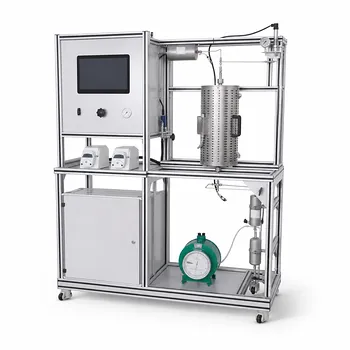
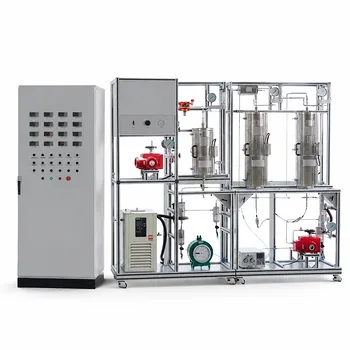
Azeotropic mixtures cannot be separated by simple distillation because the vapor and liquid compositions become identical. Chemical engineering unit operations pilot plants demonstrate this separation by physically applying advanced strategies—such as pressure-swing distillation, liquid-liquid extraction, or heterogeneous azeotropic distillation—and in the process, they validate critical vapor-liquid equilibrium (VLE) principles like non-ideality, activity coefficients, and the equality of chemical potentials at equilibrium.
The core takeaway: Pilot plants transform azeotropic separations from a theoretical puzzle into a hands-on investigation. By controlling pressure, introducing solvents, or exploiting liquid-liquid phase splits, you directly observe how the azeotrope can be broken, while simultaneously generating the real VLE data needed to calibrate and trust thermodynamic models.
Demonstrating Azeotrope Separation in a Pilot Plant
A pilot plant offers the perfect environment to move beyond textbook descriptions. You can physically manipulate process variables and watch the azeotrope shift or disappear.
Pressure-Swing Distillation: Breaking the Ethanol-Water Azeotrope
For the classic ethanol-water system, the azeotrope exists at a fixed composition under a given pressure.
In a pilot-scale distillation column, you can alter the operating pressure to shift that composition. As the primary reference confirms, lowering the pressure from 101.33 kPa to 13.33 kPa moves the azeotropic mole fraction of ethanol from 0.894 to 0.992.
By changing the pressure, you demonstrate that the relative volatility ((\alpha)) departs from 1, making further separation possible. Two columns operating at different pressures—one low, one high—can then be connected to purify ethanol beyond the atmospheric azeotrope, validating the feasibility of pressure-swing distillation without any chemical addition.
Liquid-Liquid Extraction: Circumventing the Azeotrope with a Solvent
When pressure adjustment isn’t enough, a liquid-liquid extraction (LLE) pilot plant shows another path.
Here, you mix a selective solvent with an azeotrope-forming feed. The solvent selectively extracts the target solute, creating two immiscible liquid phases. The extracted solute now resides in a mixture that exhibits a large boiling point difference and no longer forms an azeotrope.
This stream can then be distilled conventionally in a downstream column. The pilot plant teaches a fundamental industrial approach: integrating multiple unit operations to solve a problem that a single distillation column cannot.
Heterogeneous Azeotropic Distillation: Exploiting Phase Splits in a Ternary System
For complex ternary mixtures, such as ethyl acetate-ethanol-water, a pilot plant equipped with a decanter reveals the power of phase separation.
This system contains a ternary azeotrope boiling at 70.2°C, along with several binary azeotropes. The pilot plant integrates a distillation column with a decanter. After condensation, the overhead distillate separates into an organic-rich top phase and an aqueous bottom phase inside the transparent decanter.
You can visually inspect the phase split, then route the organic phase to a rectification column to yield 99.5% pure ethyl acetate, while recycling the aqueous phase to recover ethanol. This hands-on demonstration illustrates heterogeneous azeotropic distillation, where the liquid-liquid immiscibility eliminates the VLE constraint.
Validating Fundamental VLE Principles
Every successful separation in a pilot plant rests on VLE. Operating the pilot plant lets you quantify and verify the thermodynamic rules governing the process.
The Thermodynamic Definition of Phase Equilibrium
The most basic principle you validate is that equilibrium is reached when the chemical potential of each component is equal in both phases.
In a modern VLE or distillation pilot unit, you set a pressure, control the temperature, and allow the system to stabilize until macroscopic properties stop changing. By extracting simultaneous liquid and vapor samples, you confirm that the system has reached a true equilibrium state where no net driving force remains. This directly links the abstract thermodynamic condition to a measurable, steady-state pilot plant operation.
Non-Ideality and Activity Coefficients
Real mixtures like ethanol-water deviate sharply from Raoult's law. The pilot plant reveals this non-ideality.
As you sample vapor and liquid from ports along the column height, you measure compositions and calculate activity coefficients ((\gamma)) using the relationship (p_i = p_i^0 x_i \gamma_i). When the activity coefficients cause the vapor and liquid composition curves to touch or cross, you have identified the azeotrope—where (\alpha = 1). This exercise shows that the azeotrope isn’t a mysterious exception, but a direct consequence of strong molecular interactions reflected in (\gamma).
Vapor-Phase Non-Ideality: Dimerization and the Hayden-O'Connell Correction
Not all challenges arise in the liquid phase. For substances like acetic acid, molecules dimerize in the vapor phase, causing severe non-ideality.
In a pilot plant distillation column, using a standard equation of state without accounting for dimerization leads to incorrect stage calculations. The practical solution is to apply a sub-routine like the Hayden-O'Connell virial equation combined with the Nothnagel “chemical theory.” This correction correctly determines vapor fugacity coefficients and enthalpies. Validating this in a pilot plant shows you when and why standard simulation tools fail, and how to correct them using rigorous thermodynamic models.
The Bridge Between Theory and Reality: Generating Your Own VLE Data
Thermodynamic models such as Wilson, NRTL, or UNIQUAC rely on binary interaction parameters. A scarcity of reliable parameters often causes simulations to deviate from real plant behavior.
The pilot plant closes this gap. By directly measuring temperature, pressure, and phase compositions, you generate high-fidelity VLE data that can either confirm a model’s predictions or provide the regression set to improve it. This teaches a vital lesson: simulation alone is insufficient for accurate process design when complex azeotropes are involved.
Understanding the Trade-offs and Practical Pitfalls
Pilot plants are an essential teaching tool, but they demand a critical eye. Recognizing their limitations is part of the learning process.
When Pilot Data Doesn’t Match the Textbook
Even with careful operation, your experimental VLE data may not perfectly match a theoretical model.
This is often not an operator error, but a fundamental limitation of the available interaction parameters. A model might predict an azeotropic composition that differs by a few mole percent from what you measure. The pilot plant forces you to confront the uncertainty in thermodynamic predictions and to understand that process design must be grounded in verified experimental data, especially for safety-critical or high-purity separations.
Operational Challenges: Steady-State and Sampling Accuracy
Running a pilot distillation or extraction unit requires patience. The system must reach true steady state before any sample represents equilibrium conditions.
Rushing this step leads to misleading data. Additionally, sampling lines must be flushed properly, and temperature sensors need calibration. Small inaccuracies in composition analysis can distort the entire VLE curve. The experience of troubleshooting these mundane but critical details builds the practical competence that no simulation software can teach.
How to Apply This to Your Project
Your specific objective determines which pilot plant configuration offers the greatest learning value.
-
If your primary focus is validating thermodynamic models: Choose a VLE or distillation pilot plant with comprehensive sampling ports. Measure isobaric or isothermal VLE data for a non-ideal system and regress activity coefficient models to compare against literature.
-
If your primary focus is demonstrating pressure-swing feasibility: Set up a pilot plant with adjustable pressure control. Operate two columns at different pressures to purify an ethanol-water mixture beyond the atmospheric azeotrope, mapping the composition shift as a function of pressure.
-
If your primary focus is understanding integrated separation schemes: Configure a modular pilot plant with a decanter. Run a heterogeneous azeotropic distillation or a liquid-liquid extraction followed by distillation to show how combining unit operations solves a problem that a single column cannot.
Pilot plants transform azeotropic separation from an abstract VLE anomaly into a tangible, solvable engineering challenge. The key is to let the hands-on data and observed phase behavior drive your understanding, rather than relying solely on underlying theory.
Summary Table:
| Separation Strategy | Operational Approach | Key VLE Principle Validated |
|---|---|---|
| Pressure-Swing Distillation | Adjust column pressure to shift the azeotropic composition | Variation of relative volatility ($\alpha$) with pressure |
| Liquid-Liquid Extraction | Add a selective solvent to bypass the VLE constraint | Activity coefficients and phase equilibrium in ternary systems |
| Heterogeneous Distillation | Use a decanter to separate organic and aqueous phases | Liquid-liquid immiscibility and chemical potential equality |
| Direct VLE Measurement | Sample vapor and liquid compositions at steady state | Deviation from Raoult's Law and thermodynamic model validation |
Bring Complex Thermodynamics to Life in Your Lab
Are you looking to bridge the gap between theoretical thermodynamics and hands-on engineering? LABPARK provides premium Educational and Vocational Unit Operations Pilot Plants in chemical engineering, bioprocess & biotech, and environmental & water treatment.
Designed specifically for universities, research institutes, and enterprises, our pilot plants empower students and researchers to perform precise VLE measurements, run advanced separation schemes, and master industrial-scale processes.
Ready to upgrade your lab's capabilities? Contact LABPARK today to discuss your custom pilot plant needs!
Related Products
- Multi-Functional Special Distillation Educational Pilot Plant
- Continuous Batch Extractive Distillation Educational Pilot Plant
- Green Anhydrous Ethanol Purification Extractive Distillation Unit Operations Training Pilot Plant
- Ethyl Acetate Synthesis Unit Operations Pilot Plant for Practical Training
- Continuous Sieve-Plate Distillation Pilot Plant for Unit Operations Laboratory Education
People Also Ask
- Why does simple distillation yield higher efficiency than flash distillation? Key thermodynamic differences.
- How does double temperature difference control improve distillation pilot plants? Stabilize purity.
- How to Integrate Spectroscopy in Distillation Pilot Plants for Advanced Process Control
- How to Verify Distillation Boundary Lines & Composition Regions with Pilot Plants
- Why is the acentric factor important in pilot plants? Fluid property prediction.