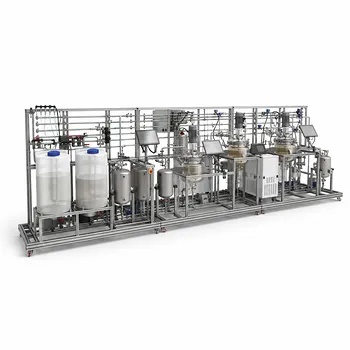
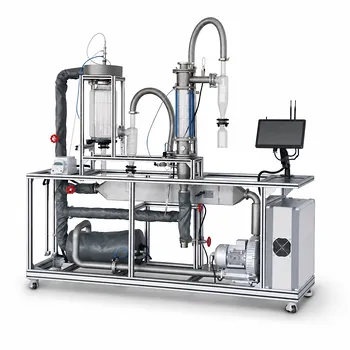
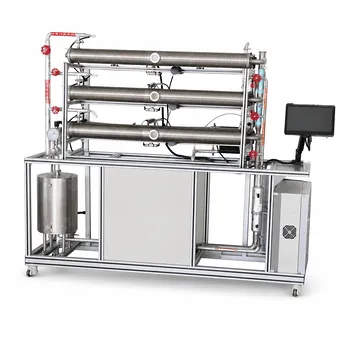
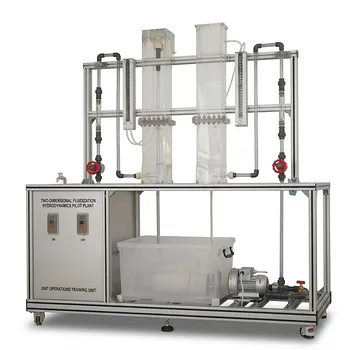
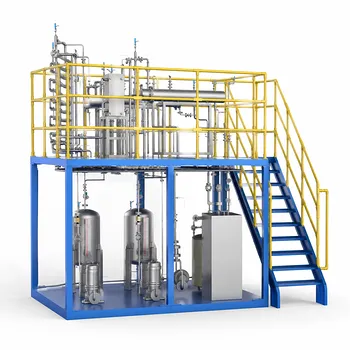
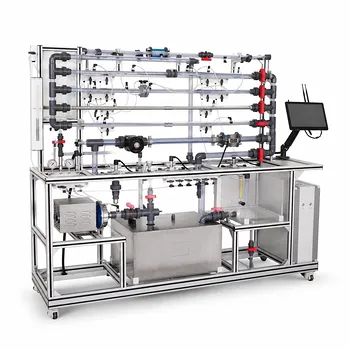
Yes, a unit operations pilot plant transforms the abstract concept of surface emissivity into a tangible, measurable phenomenon. By using a heated black body source as a perfect radiator reference, a thermopile radiometer to detect radiant energy, and interchangeable target plates of various materials, you can directly observe how a polished metal surface radiates far less heat than a darkened, oxidized one—even when both are at the exact same temperature. Students and researchers calculate emissivity values by applying the Stefan-Boltzmann law to the measured heat flux, building an intuitive link between surface finish and thermal radiation efficiency.
Demonstrating emissivity’s effect in a pilot plant hinges on isolating a single variable: the surface material. By comparing the radiant heat flux from a near-black body to that of a test surface kept at the identical temperature, the entire measured difference in emission is a direct consequence of the material’s emissivity. This turns an equation into an unmistakable, visible engineering principle.
The Anatomy of a Radiative Heat Transfer Pilot Plant
Core Components and Their Roles
A dedicated heat transfer pilot plant uses a few critical modules to make emissivity visible. The heated black body source serves as the absolute benchmark—a surface engineered to emit the maximum possible radiation at a given temperature.
A sensitive thermopile radiometer is positioned to capture the radiant energy leaving the source and test plates. This detector converts incoming thermal radiation into a measurable voltage, providing the raw data for heat flux calculations.
The key enabler is a set of interchangeable target plates made from different materials—from high-emissivity anodized aluminum to low-emissivity polished stainless steel. This modular design allows you to swap surfaces quickly without altering the rest of the experimental setup.
Why a Pilot Plant?
A pilot plant environment offers controlled, repeatable conditions that are impossible to achieve in a full-scale industrial setting. You can precisely regulate the temperature of the black body and the test plates, eliminating convective currents and conduction losses that would confound the radiant heat measurement.
This intermediate scale bridges the gap between theory and real-world application. It gives you the freedom to make deliberate changes to surface finish, measure the result, and immediately grasp why a space radiator is white or why a furnace interior is lined with dark refractory.
The Underlying Science: Emissivity and Stefan-Boltzmann
The Black Body as the Benchmark
A perfect black body is an idealized surface that absorbs and emits all incident radiation. Its emissive power is described by the Stefan-Boltzmann law: (E_b = \sigma T^4), where (\sigma) is the Stefan-Boltzmann constant and (T) is the absolute temperature in Kelvin.
In the pilot plant, the black body source is not truly perfect—it might have an emissivity of 0.95 or 0.98—but its performance is close enough to serve as a valid reference standard. By varying the source temperature and plotting the measured heat flux against (T^4), you can directly verify the Stefan-Boltzmann law; the plot should yield a straight line with a slope proportional to the source’s emissivity.
Defining Emissivity
Emissivity ((\epsilon)) is simply the ratio of the radiation emitted by a real surface to that of a black body at the same temperature. For any non-black body, the radiant heat flux per unit area becomes (q = \epsilon \sigma T^4).
A black body has an emissivity of 1.0. All practical engineering materials fall below this, meaning they radiate less heat for a given temperature. The pilot plant makes this math immediate—once you measure the emissive power of a test plate and compare it to the black body reference, the emissivity value drops out of the ratio (\epsilon = E / E_b).
The Role of Surface Characteristics
Emissivity is not just a material property; it is a surface characteristic. A smooth, polished aluminum sheet can have an emissivity as low as 0.03, while the same aluminum after heavy oxidation or a coat of matte black paint can exceed 0.8.
In the pilot plant, you can demonstrate this directly. Keeping the temperature constant and swapping a polished plate for a sandblasted or painted one causes an immediate, dramatic change in the radiometer reading. The only thing that changed is the surface finish, so the entire effect is due to emissivity.
Step-by-Step Demonstration Methodology
Verifying the Stefan-Boltzmann Law First
Begin by establishing the black body’s baseline. Set the black body source to a series of increasing, well-controlled temperatures. Record the steady-state radiometer voltage at each step. Because the radiometer output is proportional to heat flux, you can plot this against (T^4) (in K⁴). A strong linear correlation confirms the fourth-power temperature dependence and calibrates the system.
Isolating Emissivity Through Comparative Measurement
Now, heat a test plate to the exact same temperature as the black body source was kept during its calibration run. Measure its emissive power with the radiometer under identical geometric and environmental conditions.
Because the temperature is identical, the black body would emit (\sigma T^4)—but your test plate emits less. Dividing the test plate’s measured power by the black body’s power at that temperature gives its emissivity. Repeating this for copper, stainless steel, brass, and coated samples lets you build a material emissivity catalog right at the bench.
Common Pitfalls and Interpretation Trade-offs
Contending with Environmental Infrared Noise
No pilot plant is completely isolated from the laboratory’s own infrared radiation. Background reflections from walls or warm equipment can add a small offset to your measurements, which disproportionately affects low-emissivity surfaces.
The standard countermeasure is to subtract an ambient baseline reading taken with a cold, shielded reference or to use a radiation shield. Without this correction, you will overestimate the emissivity of highly reflective materials.
Achieving True Temperature Uniformity
A real plate has thermal gradients—its edges radiate more to the surroundings and cool faster than the center. If the radiometer’s field of view covers a non-isothermal area, you are measuring an average that does not correspond to a single emission temperature.
Good pilot plants embed the thermocouple just below the surface and use substantial thermal mass to minimize temperature gradients across the measurement zone. Insulating the rear and edges of the plate is also essential to ensure that the surface temperature truly matches the bulk reading.
The Grey Body Assumption
The calculation (q = \epsilon \sigma T^4) assumes a grey body—one whose emissivity is constant at all wavelengths. Many real materials, particularly metals, have emissivity that varies significantly with wavelength. The pilot plant’s radiometer typically measures total hemispherical emissivity, which is an integral over all wavelengths.
This value is accurate for many engineering heat transfer calculations, but it might not directly translate to applications dominated by a narrow spectral band (like infrared heaters). You must interpret the result in the context of the full spectrum measurement.
Applying Pilot Plant Insights to Real-World Engineering
The data you gather at the pilot scale directly informs how you think about thermal management in production. Here is how to tailor the learning to your specific goal:
- If your primary focus is education: Let students swap plates and watch the radiometer needle drop in real time. The sheer magnitude of the difference between a shiny and a black surface—at the same temperature—burns the concept of emissivity into memory far better than any textbook graph.
- If your primary focus is industrial process design: Use the measured emissivity values to improve the accuracy of your heat transfer models for furnaces, reactor jackets, or space vehicle radiators, replacing generic literature values with experimentally confirmed numbers for your specific materials and finishes.
- If your primary focus is research and material characterization: Treat the pilot plant as a standard reference measurement tool to benchmark novel coatings, oxide layers, or structured surfaces, producing repeatable emissivity data that can be published and correlated with surface roughness and chemistry.
By turning a black body source and a radiometer onto a simple test plate, the unit operations pilot plant gives you the power to see, measure, and trust the impact of surface emissivity—no approximation required.
Summary Table:
| Component | Function / Role | Scientific & Practical Value |
|---|---|---|
| Heated Black Body Source | Serves as a near-perfect radiator benchmark | Verifies Stefan-Boltzmann Law ($E_b = \sigma T^4$) |
| Thermopile Radiometer | Detects and measures incoming radiant energy | Converts thermal radiation into measurable voltage |
| Interchangeable Target Plates | Provides test surfaces of varying materials/finishes | Demonstrates emissivity differences at identical temperatures |
Upgrade Your Lab with LABPARK Pilot Plants
Bring complex thermodynamic concepts to life! LABPARK provides state-of-the-art Educational and Vocational Unit Operations Pilot Plants in chemical engineering, bioprocess & biotech, and environmental & water treatment for universities, research institutes, and enterprises. Our systems enable students and researchers to accurately measure surface emissivity and verify heat transfer laws in controlled, repeatable environments.
Ready to enhance your teaching and research capabilities? Contact LABPARK today to find the perfect pilot plant solution for your institution!
Related Products
- General Purpose Cosmetics Production Unit Operations Training Pilot Plant
- Multi Pump Fluid Transport Process Piping Unit Operations Training Pilot Plant
- Multi-Functional Drying Educational Unit Operations Pilot Plant
- Fixed-Bed Chemical Reaction and Gas Dust Tar Removal Unit Operations Pilot Plant
- 100L Continuous Loop Hydrogenation Educational Unit Operations Pilot Plant
People Also Ask
- Why is the chemical plant startup schedule crucial? De-risk scale-up with pilot plants.
- How do deviations in estimating latent heat impact pilot plant thermal systems? Avoid hardware mis-sizing.
- When to transition from PID to adaptive control in pilot plants? Key process indicators.
- Why Compare Predicted and Experimental Excess Enthalpy? Key to Accurate Pilot Plant Scale-up
- How to study gasification in pilot plants? Compare exit gas composition & efficiency