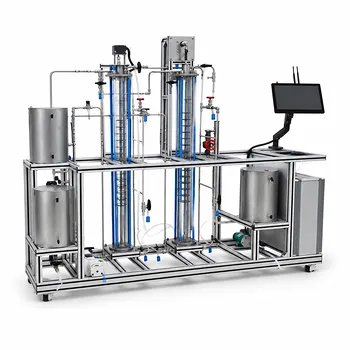
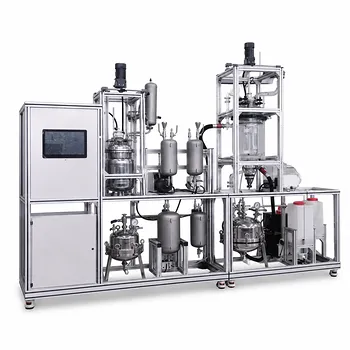
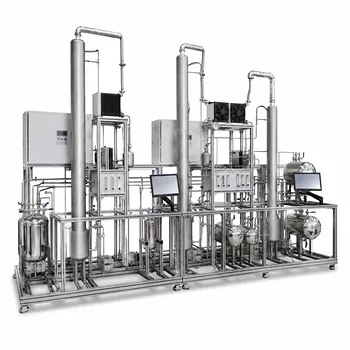
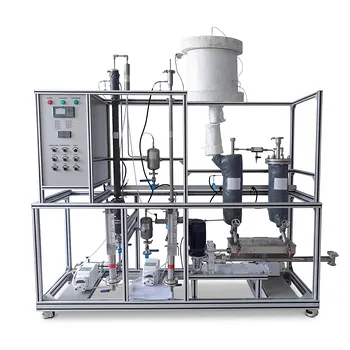
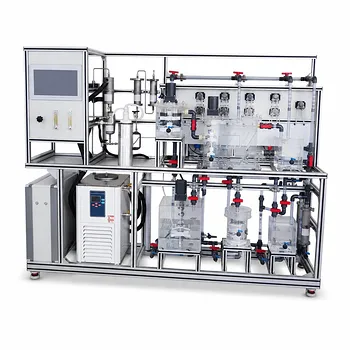
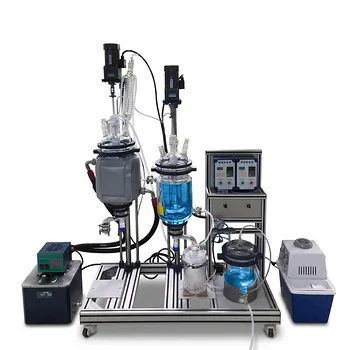
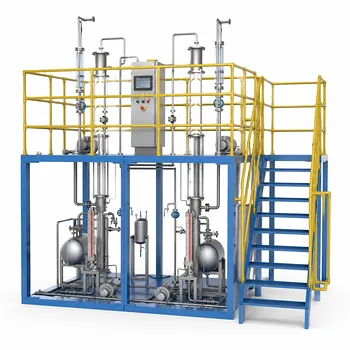
The ideal pilot plant configuration for demonstrating bromine extraction from seawater pairs a corrosive-resistant packed stripping column with a chemical absorption column in series. This setup replicates the industrial displacement reaction—using chlorine gas to liberate elemental bromine from bromide-rich brine—followed by air stripping and capture in a sodium carbonate solution. The design allows users to systematically manipulate acidification, liquid-to-gas ratios, and temperature, providing direct insight into mass transfer kinetics and the recovery of ultra-dilute solutes (bromine is present at just 67 ppm in seawater).
The core educational and research value lies in transforming a classic industrial process into a measurable, interactive system. By running the extraction in a modular, sensor-equipped pilot plant, you can quantify how chemical reactions and column hydraulics together enable the economic recovery of a trace component—making the invisible principles of unit operations visible.
The Industrial Chemistry Behind the Bromine Extraction Cycle
Displacement: Liberating Bromine with Chlorine
Seawater contains soluble bromide salts (primarily NaBr and MgBr₂) at roughly 67 mg/L. These are chemically stable and cannot be directly stripped.
Chlorine gas is injected into an acidified seawater stream to oxidize bromide ions to elemental bromine. The reaction is:
2Br⁻(aq) + Cl₂(g) → Br₂(aq) + 2Cl⁻(aq)
Acidification with sulfuric acid serves two purposes. It prevents hydrolysis of chlorine, and it suppresses the formation of unwanted hypobromite species, maximizing the yield of free bromine. The pilot plant must include a dosing point for acid and a static mixer or in-line reactor to ensure complete displacement before the stream enters the stripping column.
Stripping: Transferring Bromine from Water to Air
Elemental bromine has a low solubility in water and a relatively high vapor pressure. This makes it amenable to air stripping—a physical mass transfer operation.
The acidified, chlorinated seawater is fed to the top of a packed column while air flows counter-currently from the bottom. Intimate contact over the packing surface transfers bromine from the liquid phase to the gas phase. The stripping column’s efficiency is governed by the liquid-to-gas (L/G) ratio and the packing’s effective interfacial area.
Absorption: Capturing Bromine in a Reactive Solvent
The bromine-laden air leaving the stripper must be captured. In the industrial process, this is done by contacting the gas with a sodium carbonate (Na₂CO₃) solution in a second packed column.
The absorption is chemical, not merely physical. Bromine reacts with the alkaline solution to form a mixture of sodium bromide and sodium bromate:
3Br₂ + 3Na₂CO₃ → 5NaBr + NaBrO₃ + 3CO₂
Because the dissolved bromine is instantly consumed by this fast reaction, its equilibrium partial pressure at the gas-liquid interface is driven nearly to zero. This dramatically enhances the driving force for mass transfer, allowing complete capture even at low gas-phase concentrations.
Configuring the Pilot Plant System
Core Equipment and Materials of Construction
Corrosion resistance is non-negotiable. Wet bromine, chlorine, and acidic brines are extremely aggressive. The pilot plant must use materials such as borosilicate glass, PTFE-lined steel, or high-grade alloys like Hastelloy C-276 for all wetted parts.
The system consists of two packed columns operating in series. Each column should be transparent (e.g., glass) to allow visualization of flow patterns and flooding. A structured or random packing with a high surface-to-volume ratio—such as Raschig rings or structured mesh—is essential to maximize interfacial area.
The Stripping Column: Where Bromine Enters the Gas Phase
The liquid feed is pre-treated seawater. A metered dose of concentrated H₂SO₄ reduces pH to around 3–3.5, and then gaseous chlorine is bubbled into the line using a rotameter-controlled feed. A short residence time loop or in-line mixer ensures completion of the displacement reaction.
The treated liquid enters at the top of the column, distributed evenly over the packing. Air, supplied by a blower, enters at the bottom. Flow meters and control valves on both streams allow operators to explore a wide range of L/G ratios. Heated air or heated liquid feed can be used to study the effect of temperature on stripping efficiency.
The Absorption Column: Chemical Fixation of the Product
The bromine-containing air stream from the stripper flows directly into the bottom of a second absorption column. A sodium carbonate solution (typically 5–10% w/w) is pumped to the top and distributed over a similar high-surface-area packing.
This column can be configured with multiple sample ports along its height. This enables measurement of the concentration profile of the liquid phase (bromide/bromate) to calculate local mass transfer rates. Temperature probes embedded along the column can detect the exothermic heat of reaction, demonstrating the non-isothermal nature of chemical absorption compared to a purely physical process.
Instrumentation for Quantitative Analysis
A research-grade pilot plant should incorporate:
- In-line conductivity or pH probes to verify acidification and carbonate solution strength.
- UV-Vis spectrophotometers or ion-selective electrodes for bromide/bromate analysis in the liquid outlets.
- Gas detectors (e.g., electrochemical sensors) at the absorber gas outlet to monitor bromine breakthrough, confirming capture efficiency.
- Differential pressure transmitters across each column to track hydraulic loading and identify the onset of flooding.
- Thermocouples at multiple axial positions to map temperature profiles arising from reaction heat and evaporation.
This sensor suite transforms the plant from a qualitative demonstration into a tool for calculating mass transfer coefficients, HETP (height equivalent to a theoretical plate), and overall absorption rates.
Demonstrating Key Unit Operations Principles
Comparing Physical vs. Chemical Absorption
The bromine extraction process inherently contains a powerful comparative experiment. The stripping column represents physical desorption driven purely by concentration difference. The absorption column represents chemical absorption with an instantaneous reaction.
By running the system and recording the removal efficiency in each column, students can directly contrast the driving forces. They can also conduct a supplementary trial using pure water as the absorbent (physical absorption of bromine) and measure the dramatic drop in capture efficiency, quantifying the enhancement factor provided by the reactive solvent.
Quantifying Mass Transfer Coefficients and HETP
Using the measured inlet/outlet concentrations, flow rates, and known column dimensions, the overall volumetric mass transfer coefficient (KLa) can be calculated for both operations. Students can vary gas and liquid velocities to plot the dependence of KLa on hydrodynamic conditions, validating correlations from film theory.
For the absorption column, sampling at multiple bed heights allows determination of the HETP under various loads. This directly links pilot-scale data to the design of industrial-scale towers with multiple trays.
Extending the System for Process Optimization
A modular design adds immense educational value. By connecting two absorption columns in series—or using a single column with adjustable bed height—users can demonstrate the principle of staging. The second stage captures residual bromine, showing how increasing contact volume boosts overall recovery beyond a single equilibrium stage’s limitation.
This setup also illustrates the trade-off between capital cost (additional column height) and operating profit (increased product yield).
Understanding the Trade-offs and Safety Considerations
Corrosion and Material Integrity
While glass columns offer excellent visibility and corrosion resistance, they are fragile. Metal alloys are robust but expensive and opaque. A practical pilot plant often uses a glass column with a PTFE lining for the liquid handling components. Regular inspection is mandatory.
Handling Hazardous Chemicals
Bromine is toxic and a strong oxidizer. The pilot plant must be operated inside a fume hood or well-ventilated enclosure with bromine-specific scrubbers on the absorber vent. Chlorine gas requires leak-proof fittings and a gas monitor. Sodium carbonate solutions are mild but can cause eye irritation; standard PPE is required. All drains must lead to a safe neutralization tank.
Interpretability vs. Realism
At pilot scale, heat loss to the surroundings can be significant. The temperature rise in the absorption column may be smaller than in an industrial adiabatic tower. This must be noted when illustrating the exothermic nature of the reaction. The principle remains valid, but the magnitude is affected by scale.
Making the Right Choice for Your Goal
The exact configuration of the pilot plant depends on whether the primary objective is education, fundamental research, or process development.
- If your primary focus is undergraduate education: Prioritize visual demonstration and safety. Use glass columns, a simple two-column series, and focus on qualitative observations (color changes, pH shifts) alongside basic flow/driving force calculations.
- If your primary focus is kinetic research: Invest in a sensor-rich system with multiple sample ports and precise fluid control. The goal is to generate high-quality data to calculate KLa, HETP, and enhancement factors under systematically varied conditions.
- If your primary focus is process-scale economics: Configure the system with a modular absorption section (stages in series). Operate at higher temperatures and collect data on long-term material degradation and energy consumption to feed into techno-economic models.
A well-designed pilot plant does more than replicate an industrial recipe—it turns the recovery of a trace element from the ocean into a rigorous, measurable exploration of how chemical equilibrium, transport phenomena, and reaction kinetics intersect to make a process viable.
Summary Table:
| Process Stage | Key Equipment & Materials | Vital Parameters & Sensors |
|---|---|---|
| 1. Acidification & Displacement | Inline static mixer, acid/chlorine dosing pumps, PTFE/Glass wetted parts | pH level (target 3.0–3.5), chlorine gas flow rate (rotameter) |
| 2. Air Stripping (Desorption) | Glass packed column (Raschig rings/mesh), air blower | Liquid-to-gas (L/G) ratio, differential pressure (flooding detection) |
| 3. Chemical Absorption | Glass packed column, sodium carbonate (5-10% w/w) dosing pump | Exothermic temperature profiles, gas outlet bromine breakthrough sensors |
Bring Industrial Unit Operations to Life with LABPARK
Are you looking to enhance your laboratory training or scale up your mass transfer research? LABPARK provides state-of-the-art Educational and Vocational Unit Operations Pilot Plants in chemical engineering, bioprocess & biotech, and environmental & water treatment.
Designed specifically for universities, research institutes, and enterprises, our modular and corrosion-resistant systems (featuring borosilicate glass and PTFE) offer the perfect balance of visual process tracking and high-precision data acquisition.
Ready to configure a custom pilot plant for your facility? Contact LABPARK today to discuss your project requirements!
Related Products
- Natural Product Extraction Unit Operations Training Pilot Plant
- Continuous Batch Extractive Distillation Educational Pilot Plant
- Comprehensive Liquid-Liquid Extraction Pilot Plant for Engineering Education
- Gallium and Indium Selective Extraction Educational Pilot Plant
- Green Anhydrous Ethanol Purification Extractive Distillation Unit Operations Training Pilot Plant
People Also Ask
- How to Demo Solubility Sensitivity in SFE Pilot Plants? Practical Thermodynamics
- How do pilot plants differentiate physical vs chemical extraction? Enhance Chemical Engineering Training
- How are HTU and NTU applied to determine extraction column height? Guide to Pilot Plant Scaling
- Why use split-plot designs in pilot plants instead of CRD? Optimize process parameters effectively.
- Why use step disturbance in pilot plants? Master process control dynamic response.