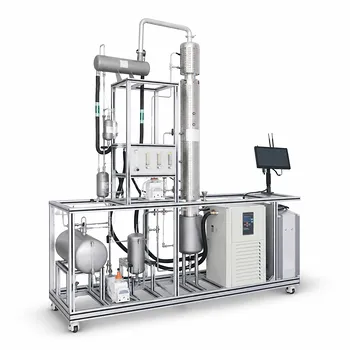
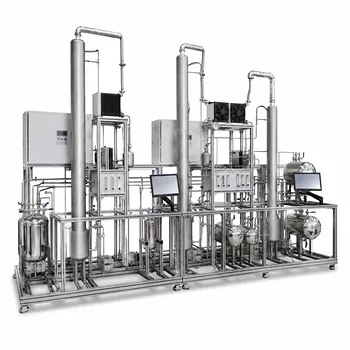
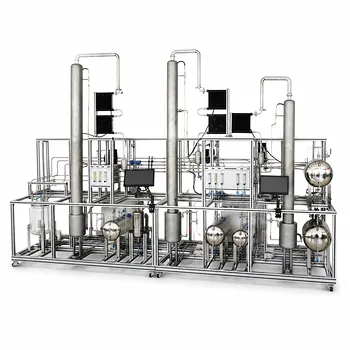
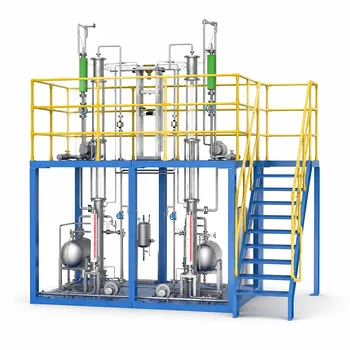
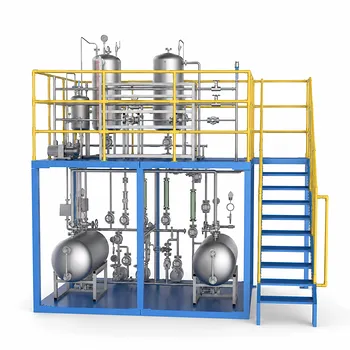
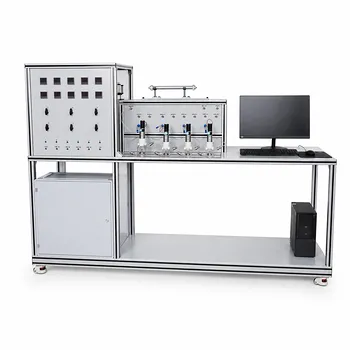
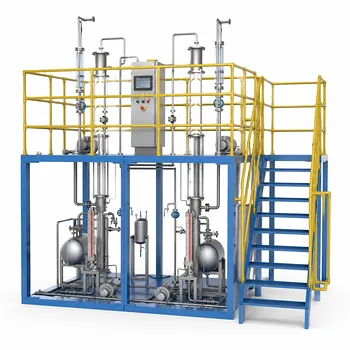
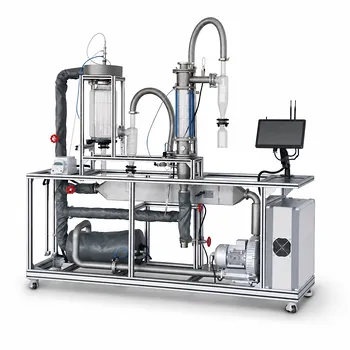
A distillation pilot plant is the bridge between textbook azeotrope theory and tangible, physical reality.
Chemical engineering students use these scaled-down columns to directly observe how azeotropes create a separation wall, sample liquid and vapor phases at different trays, measure the constant boiling temperature, and experimentally map distillation boundaries. By altering operating pressure, adding an entrainer, or integrating multiple columns with decanters, they validate the very techniques—pressure-swing distillation, azeotropic distillation, and extractive distillation—that industry uses to break these non-ideal mixtures and achieve purification.
Distillation pilot plants transform abstract vapor-liquid equilibrium charts into hands-on experiments. Students move from knowing that azeotropes prevent complete separation to seeing why, then actively testing how shifting pressure, composition, or solvent addition can reroute the distillation path and cross erstwhile impermeable boundaries.
Unveiling the Invisible Wall: Binary Azeotropes in Action
A binary mixture that forms an azeotrope is the perfect starting point to demonstrate the hard limit of conventional distillation. The pilot plant makes the invisible constraint visible through temperature profiles and composition sampling.
Observing the Constant-Boiling Phenomenon
When running a mixture like ethanol and water, students see the column temperature plateau at the minimum boiling point (351.1 K for the positive azeotrope) regardless of how the reboiler duty is adjusted.
They measure the vapor and liquid compositions from the top and bottom, confirming that both phases become identical—the relative volatility α=1. This is the direct, experimental proof that no further enrichment can occur. The column cannot produce anhydrous ethanol with simple rectification.
Shifting Composition to Study Limitation Boundaries
By changing the initial pot composition, students can trace the distillation limit. For a binary with a minimum-boiling azeotrope like n-heptane and ethanol (65 mol% ethanol), starting with a pot richer in ethanol beyond that azeotropic point forces the residue composition to drift toward pure ethanol, while the distillate remains locked at the azeotrope.
This hands-on manipulation teaches a critical principle: the azeotropic point acts as a thermodynamic fence. The pot composition can never cross it from one side to the other without changing the system’s physics.
Navigating the Liquid Phase Diagram: Ternary Systems and Distillation Boundaries
Ternary azeotropic systems take the learning further, introducing distillation boundaries that partition the phase diagram. The pilot plant becomes a tool to physically map those boundaries.
Generating Experimental Residue Curves Under Total Reflux
Operating the column at total reflux and allowing it to reach steady state lets students sample liquid-phase compositions from each tray. Plotting these compositions on a triangular diagram yields an experimental distillation curve.
When they overlay this curve with a theoretical residue curve map, they see how the azeotropic boundary forms an uncrossable ridge. For a feed located in one distillation region, the curve can never end in a pure component vertex that lies in a different region. This is the essence of why designing ternary separation sequences requires breaking the boundary, not simply pushing against it.
Visualizing the Butterfly Region and Feasible Product Compositions
A ternary mixture containing a saddle azeotrope—such as toluene, ethanol, and water (26 mol%, 47 mol%, 27 mol%)—creates a “butterfly” or constrained product region on the diagram.
Students can test different feed compositions and observe that the mass balance line connecting feed, distillate, and bottoms must stay within the same distillation region. The pilot plant makes the abstract concept of the “butterfly region” concrete: no matter how many stages are used, the top and bottom products will always fall inside the preset boundary unless a physical separation enhancer is introduced.
Breaking the Azeotrope: Hands-On with Advanced Separation Techniques
Once the limitation is felt viscerally, students can apply the methods that industrial practice relies on. The pilot plant becomes a sandbox for exploring pressure-swing, entrainer-based, and hybrid approaches.
Pressure-Swing Distillation: Shifting the Goalposts
Many pilot plants include adjustable pressure control, allowing students to demonstrate how the azeotropic composition is not a fixed constant but a function of pressure.
For the ethanol-water system, lowering the operating pressure from 101.33 kPa to 13.33 kPa shifts the azeotropic mole fraction of ethanol from 0.894 to 0.992. By running two columns at different pressures in sequence, students achieve practically pure ethanol without any additional chemical agent. This experiment anchors the concept of pressure-swing distillation in hard data they generated themselves.
Entrainer-Based Methods and Modular Column Configurations
When the pilot plant is equipped with multiple distillation columns and a liquid-liquid decanter, it mirrors an industrial azeotropic distillation setup. Students can:
- Introduce an entrainer (e.g., benzene or cyclohexane for ethanol-water) to form a heterogeneous ternary azeotrope that splits into two liquid phases upon condensation.
- Route the entrainer-rich phase back as reflux and send the water-rich phase to a second column for recovery.
This multi-column operation teaches the integration of distillation with phase separation, driving home the fact that breaking azeotropes often requires a system of units, not a single tower.
Special Distillation Techniques with a Third Component
Beyond entrainers, pilot plants can be configured for extractive distillation (using a high-boiling solvent to alter relative volatility), salt-effect distillation, or even reactive distillation.
Adding a solvent or a reactive entrainer physically changes the residue curve map, shifting or eliminating the distillation boundary. Students see on the glass column how the temperature profile changes and how the desired component emerges pure at the opposite end of the column—a direct demonstration of thermodynamic manipulation.
Bridging Theory and Practice: VLE and Tray Efficiency
The pilot plant doesn’t only teach what an azeotrope is; it deepens the understanding of why real columns deviate from ideal models.
Validating Vapor-Liquid Equilibrium Data
By measuring the temperature and analyzing the composition at multiple trays for a non-ideal binary like HCl and water—which forms a maximum-boiling azeotrope at 381.6 K, higher than both pure components—students confront a system with negative deviation from Raoult’s law.
The experimental boiling point at each stage serves as a validation point for thermodynamic models (NRTL, UNIQUAC). Mismatches between measured and predicted values stimulate discussions on activity coefficients and molecular interactions.
Calculating Murphree Efficiency for Non-Ideal Mixtures
Even in a perfectly designed column, real trays do not achieve equilibrium. By sampling vapor and liquid, students calculate the Murphree vapor efficiency and compare it to the ideal stage model from the McCabe-Thiele or Ponchon-Savarit method.
This reveals that for azeotropic mixtures, the efficiency can vary significantly along the column due to changing relative volatility. It’s a powerful lesson in why simulations based on ideal stages alone can be misleading for non-ideal systems.
Recognizing the Trade-offs and Educational Pitfalls
A pilot plant is an invaluable learning tool, but its limitations must be understood to avoid drawing wrong conclusions.
Scale and residence time mean that true steady-state operation can take hours. Students must manage their time carefully and avoid rushing to conclusions from transient samples.
Sampling and analytical accuracy are critical. Without reliable composition measurement (e.g., gas chromatography, density meter, or refractive index), the experimental residue curve may appear to cross boundaries incorrectly, leading to confusion.
Hydrodynamic complexities like weeping, entrainment, or vapor bypass reduce actual tray efficiency in ways not predicted by simple thermodynamics. This teaches the gap between idealized VLE and reality—a valuable lesson in itself—but can obscure the azeotropic boundary effect if not properly controlled.
Safety and cost also constrain the choice of mixtures. Toxic entrainers or corrosive components like HCl require robust materials, fume extraction, and extensive supervision, which limits the range of systems that can be studied safely in an educational setting.
How to Apply This to Your Learning Goals
How you approach the pilot plant depends on the depth of understanding you need.
- If your primary focus is mastering azeotropic fundamentals: Run a simple binary like ethanol-water at atmospheric pressure. Systematically sample across all trays at total reflux to confirm the azeotropic composition and practice VLE data reconciliation.
- If your primary focus is exploring advanced separation techniques: Use the plant’s pressure control to perform a pressure-swing experiment, or configure the multi-column setup with a decanter for entrainer-based distillation. Track composition trajectories and prove that you crossed a distillation boundary.
- If your primary focus is process design and scale-up: Collect tray-by-tray data to calculate Murphree efficiencies and compare them with simulation predictions. Pay attention to the impact of hydrodynamics on the separation of azeotropic mixtures.
- If your primary focus is bridging theory and simulation: Generate an experimental residue curve map for a ternary system, overlay it on an Aspen Plus simulation, and analyze the deviation. Use this to regress binary interaction parameters for a more accurate model.
The distillation pilot plant is not merely a piece of hardware—it is a physical interrogation tool that forces thermodynamics to reveal its secrets. When used systematically, it equips you with the empirical intuition to tackle any non-ideal mixture, no matter how stubborn the azeotrope.
Summary Table:
| Study Focus | Educational Objective | Key Experimental Action |
|---|---|---|
| Binary Azeotropes | Understand constant-boiling limits | Sample vapor/liquid compositions, track temperature plateaus |
| Ternary Systems | Map distillation boundaries | Plot tray compositions on triangular diagrams at total reflux |
| Advanced Separation | Learn to break azeotropes | Practice pressure-swing & entrainer-based multi-column distillation |
| Model Validation | Compare real vs. ideal systems | Calculate Murphree tray efficiency, validate NRTL/UNIQUAC models |
Elevate Chemical Engineering Education with LABPARK
Bring complex thermodynamic theories to life in your laboratory. LABPARK designs and manufactures high-performance Educational and Vocational Unit Operations Pilot Plants in chemical engineering, bioprocess & biotech, and environmental & water treatment.
Engineered specifically for universities, research institutes, and enterprises, our systems provide students with hands-on, practical experience in advanced separation techniques, VLE validation, and process control.
Ready to upgrade your lab's capabilities? Contact LABPARK today to discuss your custom pilot plant requirements!
Related Products
- Multi-Functional Special Distillation Educational Pilot Plant
- Continuous Sieve-Plate Distillation Pilot Plant for Unit Operations Laboratory Education
- Multi-Modal Distillation Unit Operations Training Pilot Plant
- Green Anhydrous Ethanol Purification Extractive Distillation Unit Operations Training Pilot Plant
- Ethyl Acetate Synthesis Unit Operations Pilot Plant for Practical Training
People Also Ask
- Why does simple distillation yield higher efficiency than flash distillation? Key thermodynamic differences.
- Why is the acentric factor important in pilot plants? Fluid property prediction.
- How does double temperature difference control improve distillation pilot plants? Stabilize purity.
- How to Verify Distillation Boundary Lines & Composition Regions with Pilot Plants
- How to Estimate Distillation Pilot Plant Tray Efficiency? O'Connell's Correlation Guide