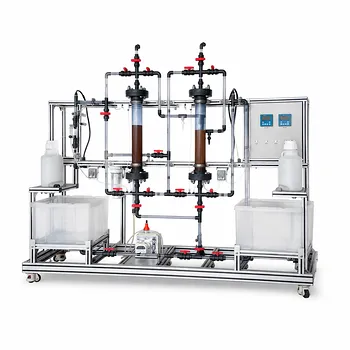
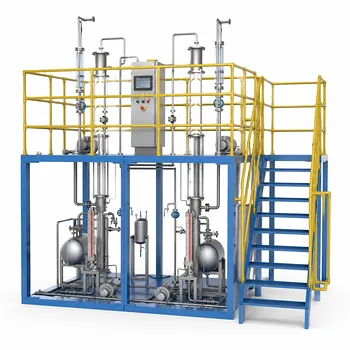
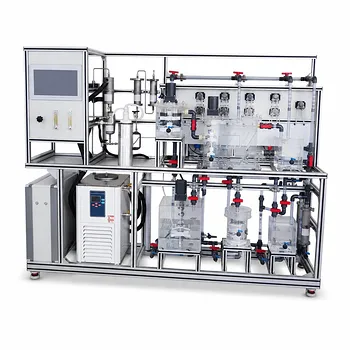
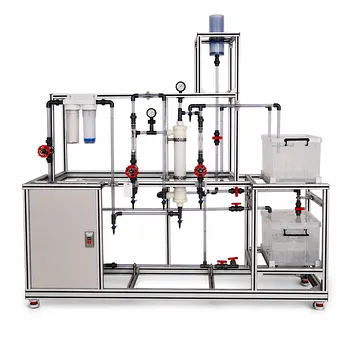
The only truly safe way for chemical engineering students to study the purification of a volatile metal like mercury is inside a specially designed, sealed unit operations pilot plant. Unlike standard benchtop glassware in a fume hood, these pilot systems use vacuum distillation under meticulously controlled, fully enclosed conditions. This transforms a highly hazardous procedure into a secure, hands-on learning experience, allowing students to safely visualize thermodynamic principles like vapor-liquid equilibrium in action.
The core problem is not just mercury’s toxicity but its volatility—the very property that makes distillation purification possible. The solution is a vacuum distillation pilot plant, which creates a sealed, sub-atmospheric environment that lowers the metal's boiling point, prevents hazardous vapor leaks, and allows students to study phase separation without direct exposure to the material.
The Fundamental Challenge of a Hazardous Volatile
To understand why the pilot plant is essential, you must first appreciate the unique danger of the material itself. Mercury’s volatility is both the key to its purification and the source of its risk to a student.
Why Volatility Defines the Danger
In a normal academic lab, the primary defense against toxic chemicals is the fume hood. This works for non-volatile liquids or solids that can be contained in open vessels. However, mercury continuously emits an invisible, odorless vapor at room temperature. Standard fume hood containment is no longer considered a sufficiently reliable control for hands-on training with a liquid that can spontaneously enter the breathing zone during a distillation.
The Limitations of Benchtop Chemistry
You might ask, “Can’t we just run a tiny distillation in a sealed, evacuated glass apparatus?” In theory, yes. In a teaching setting with multiple students, the risk is amplified. The fragility of glass, the potential for over-pressurization from a heat gun, and the lack of automated safety interlocks make benchtop distillation an unacceptable risk. You need a scaled-up, instrumented, and fundamentally safer system.
The Safe Solution: The Vacuum Distillation Pilot Plant
The primary reference correctly identifies the definitive answer: an educational unit operations pilot plant built around a vacuum distillation column. This is not just a bigger piece of glass; it is an engineered system for inherent safety and pedagogical clarity.
The Principle of Reduced-Pressure Separation
The plant operates on a simple thermodynamic principle. By pulling a vacuum, you reduce the pressure inside the distillation column. This significantly lowers the boiling point of mercury, allowing it to vaporize at a much lower temperature. This single design choice simultaneously reduces thermal hazards, saves energy, and allows the volatile metal to be the more volatile component in a separation from less volatile impurities, which remain in the reboiler.
Engineering a Sealed Learning Environment
The critical safety feature is not just the vacuum, but the hermetically sealed nature of the entire system. From the heated pot to the condensation system and the product collection vessel, students operate a closed loop. The vapors have no path to the room. They can only travel into the water-cooled or chilled condenser, where they reliquefy and drip into a sealed receiver. The learning is experiential and visual—you can observe the condensation rate through process sight glasses—without being physically present in the same container as the chemical.
Mastering Vapor-Liquid Equilibrium Hands-On
This setup provides a powerful teaching tool for a concept that often remains abstract. Students can directly manipulate the vacuum level and reboiler temperature and then observe the immediate effect on the distillation rate and overhead purity. They are not just crunching Antoine equation numbers; they are physically tuning the driving force for separation and witnessing the phase change as a controllable process variable.
The Critical Safety Architecture of an Educational Pilot Plant
The physical column and vacuum pump are just the start. A pilot plant suitable for teaching with mercury integrates multiple layers of critical safety architecture, transforming it from a simple unit operation into a safe learning platform.
Material Compatibility and Corrosion Resistance
The entire wetted path—column internals, reboiler, condenser, and piping—must be constructed from corrosion-resistant materials. Mercury, especially at elevated temperatures, can amalgamate with and corrode many common metals like aluminum. Educational pilot plants use specialized stainless steels or glass-lined components to ensure long-term integrity and prevent a catastrophic leak caused by material degradation.
Automated Control and Interlocks
This is where you move from mere containment to true operational safety. The plant integrates real-time sensor monitoring for temperature and absolute pressure, tied to automated safety interlocks. If the system detects a loss of vacuum (indicating a leak), an over-temperature condition, or a cooling water failure, the automated logic will immediately shut off heating and close isolation valves. This rapid response, impossible for a human operator to match, prevents the generation of pressurized toxic vapor.
Validating Safety with Cause-and-Effect Analysis
Before any student touches the equipment, the plant's design itself can be a teaching tool. Using Quality by Design (QbD) principles and a Cause-and-Effect (C&E) risk assessment, students can map the process. They learn to define the "Control" parameters (vacuum setpoint, cooling flow), identify "Noise" factors (ambient temperature), and most importantly, understand the pre-engineered "Effect"—the automated interlock that triggers if a process variable strays into a danger zone. This teaches safety as an integrated design feature, not as an afterthought.
Understanding the Trade-offs and Pitfalls
While this method sets the gold standard for safety and education, an objective advisor must be clear about its limitations and potential hidden dangers. A pilot plant is a proxy, not a perfect replica.
The Gap Between Pilot and Production Scale
The pilot plant will not teach all aspects of industrial operation. Heat loss profiles differ dramatically from large-scale operations, and trace impurity entrapment mechanisms can vary. You must frame the data as fundamentally valid for equilibrium stage calculations but require caution when extrapolating factors like specific energy consumption or absolute column capacity directly to a production design.
The Insidious Nature of Small Leaks
The plant’s safety depends on absolute integrity. The most dangerous failure mode is not a catastrophic break but a microscopic, slow vacuum leak from a fitting. This can allow odorless mercury vapor to continuously bleed into the room for an entire lab session. The critical, non-negotiable procedure is a robust pre-operation leak-test protocol. This involves pulling an ultimate vacuum on the cold system, isolating the pump, and demonstrating a pressure hold test that shows a decay rate below a safe threshold before any heating begins.
The Hidden Cost of Management
The run itself is the easy part. The trade-off comes at the end. You now have a hot, sealed system containing residual mercury and a hazardous liquid product that must be safely sampled, stored, and the entire apparatus must be chemically decontaminated. The educational plan must account for this "end-of-run" lifecycle. Without a pre-defined, safe standard operating procedure for product removal and system passivation, you create a legacy of contaminated capital equipment that becomes a future hazard.
How to Apply This to Your Curriculum
Your choice of experiments should align with your core pedagogical goal, moving from initial safety to deep thermodynamic mastery.
- If your primary focus is safety and hazard comprehension: Use the pilot plant’s C&E matrix and automated interlock system as a case study. Have students trace the safety circuit logic before ever turning on the heat.
- If your primary focus is fundamental thermodynamics: Design a simple experiment to verify the relationship between boiling point and absolute pressure. Have students plot their real-time pressure-temperature data against Clausius-Clapeyron predictions generated from the literature.
- If your primary focus is operability and process control: Task students with identifying the maximum stable distillation rate by systematically increasing heat input until they observe signs of column flooding or loss of separation, teaching them to feel the “operating window” boundaries.
- If your primary focus is purification efficiency: Challenge students to analyze the final product using trace metal analysis and then apply the McCabe-Thiele method using their logged reflux ratio and composition data to determine the effective number of theoretical stages in their pilot column.
The vacuum distillation pilot plant is not just a piece of equipment; it is a carefully engineered pedagogical platform that swaps an uncontrollable risk for a profound, visceral lesson in separation science.
Summary Table:
| Safety & Design Feature | Educational & Operational Benefit |
|---|---|
| Vacuum Distillation | Lowers boiling point to reduce thermal hazards and save energy. |
| Hermetically Sealed Loop | Prevents toxic vapor leaks, keeping the laboratory environment safe. |
| Automated Interlocks | Instantly shuts down heating if vacuum loss or over-temperature is detected. |
| Corrosion-Resistant Materials | Prevents structural degradation and leaks from chemical reactions. |
| Leak-Test Protocols | Teaches students the importance of system integrity before operation. |
Bring hands-on safety and advanced process control to your lab. LABPARK provides premium Educational and Vocational Unit Operations Pilot Plants in chemical engineering, bioprocess & biotech, and environmental & water treatment for universities, research institutes, and enterprises. Contact us today to discover how we can customize the perfect pilot plant for your training and research needs!
Related Products
- Multi-Functional Special Distillation Educational Pilot Plant
- Continuous Sieve-Plate Distillation Pilot Plant for Unit Operations Laboratory Education
- Continuous Batch Extractive Distillation Educational Pilot Plant
- Multi-Modal Distillation Unit Operations Training Pilot Plant
- Green Anhydrous Ethanol Purification Extractive Distillation Unit Operations Training Pilot Plant
People Also Ask
- Why does simple distillation yield higher efficiency than flash distillation? Key thermodynamic differences.
- How to Verify Distillation Boundary Lines & Composition Regions with Pilot Plants
- How to Integrate Spectroscopy in Distillation Pilot Plants for Advanced Process Control
- How does double temperature difference control improve distillation pilot plants? Stabilize purity.
- Why is the acentric factor important in pilot plants? Fluid property prediction.