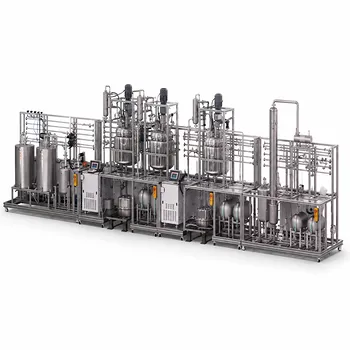
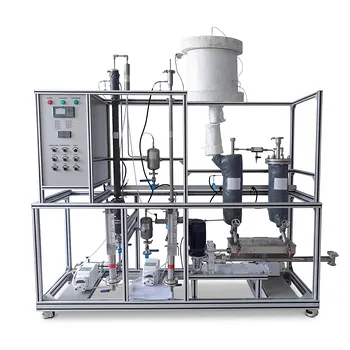
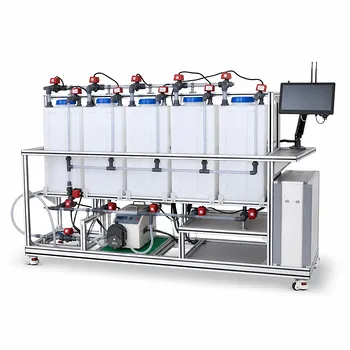
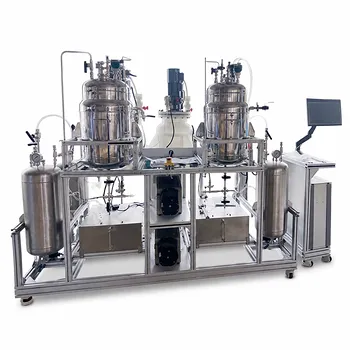
A pilot plant transforms the abstract concept of enthalpy from a textbook calculation into a measurable, physical reality. It allows students to experimentally determine the heat of reaction by constructing a precise, real-time energy balance on a jacketed or calorimetric reactor. By measuring the temperature change of the process side, the flow rate and temperature change of the heat exchange fluid, and accounting for heat losses and accumulation in the vessel, students can directly calculate the total heat released or absorbed, verifying theoretical values from Hess's Law.
The core educational value isn't just getting a number; it's confronting the gap between theory and practice. A pilot plant reveals that real-world enthalpy measurement is less about a single formula and more about a systems-thinking approach to energy accounting, where managing non-ideal heat losses and systemic heat capacity is the true challenge.
The Core Principle: The Energy Balance Model
The pilot plant’s utility hinges on its role as a practical tool for performing a dynamic energy balance. This is the foundational equation that governs the entire experiment.
From Theory to Practice
In a textbook, the energy balance is a simple formula: Energy Accumulated = Energy In - Energy Out. A pilot plant makes this equation tangible. Instead of numbers on a page, each term corresponds to a physical stream or a measured change in the reactor itself, allowing students to physically trace the path of energy.
Decoding the Terms of the Equation
For an exothermic batch reaction, the "Energy Out" term becomes the critical focus. It's the sum of heat that is deliberately removed. This removal primarily happens through the reactor's cooling jacket, and the heat is directly calculated by multiplying the coolant's measured mass flow rate, its specific heat capacity, and its temperature difference (outlet minus inlet).
The "Energy Accumulated" term bridges theory and reality. It accounts for the thermal mass of the reactor vessel, the agitator, and internal components. Without this term, a significant amount of initial heat would remain unaccounted for. Students learn this is not an error but a physical property of the system that must be measured and incorporated.
The Practical Method: Data Collection in a Pilot Plant
Pilot plants are designed to feed the energy balance equation with high-quality, real-time data, which is a critical upgrade over simple lab equipment.
The Critical Role of Instrumentation
The accuracy of your final ΔH value is determined entirely by the quality of your instrumentation. A pilot plant’s automated sensors directly address the large errors common in manual lab calorimetry.
- Minimizing Heat Loss: Pilot systems use vacuum-insulated reaction vessels, not a simple beaker with foam. This drastically reduces uncontrolled heat loss to the air, which is the largest source of unaccounted error and an unmeasurable "Energy Out" term in a simple cup calorimeter. By minimizing it, you can trust your other measurements more.
- Ensuring Uniform Conditions: Automated, variable-speed agitators ensure uniform thermal distribution inside the reactor. This prevents localized hot spots from forming, ensuring the temperature sensor provides data that is truly representative of the bulk reaction mixture's state.
- Achieving High Precision: High-precision sensors, such as PT100 probes for temperature and Coriolis mass flowmeters for the jacket fluid, provide the data resolution needed. A small error in measuring a 2°C temperature differential can lead to a 50% error in the calculated enthalpy, making precise instrumentation non-negotiable.
The Step-by-Step Experimental Process
The experimental verification is a structured process. First, a system characterization is performed without any chemical reaction, typically by supplying a known amount of electrical heat to the vessel, to experimentally calculate the reactor's specific heat capacity and quantify baseline heat loss to the environment.
Next comes the reaction step. The reaction is initiated carefully, with a controlled feed rate for a reactant to manage the heat release. The data acquisition system continuously logs the reactor temperature, the jacket inlet and outlet temperatures, and the jacket’s mass flow rate, providing a complete thermal profile of the event.
Finally, the data analysis integrates the collected data over the entire reaction period. Students apply the full energy balance equation, accounting for the heat removed by the cooling system, the heat absorbed by the reactor vessel itself, and any environmental loss, to definitively solve for the heat generated by the reaction.
Understanding the Trade-offs of the Approach
This hands-on method is powerful, but it introduces complexities that a textbook calculation avoids. Recognizing these trade-offs is essential for true mastery.
- Managing Non-Ideal Heat Loss: Even a well-insulated pilot plant experiences some heat loss. This forces students to quantify it, teaching them the critical engineering skill of designing experiments to minimize and then mathematically account for systematic losses rather than ignoring them.
- Systemic Heat Capacity: The reaction heat doesn't just warm the liquid; it warms the steel vessel, the internal cooling coils, and the glass of a sight glass. The thermal mass of this entire wetted assembly absorbs a substantial portion of the initial energy, especially in small pilot batches, creating a "heat sink" that must be carefully calculated.
- The Dynamic Nature of Real Reactions: In an industrial context, enthalpy isn't always a single number given upfront. Students can use the real-time temperature data from a continuous stirred-tank reactor (CSTR) and concentration data from inline sensors (like conductivity meters) to observe how the overall heat release rate changes as reactant concentrations change over time. This connects the static concept of
ΔHwith the dynamic reality of reaction kinetics.
Making the Right Choice for Your Learning Goal
The way you use a pilot plant should be tailored to your specific educational objective.
- If your primary focus is verifying fundamental thermodynamics: Concentrate on a simple, high-enthalpy reaction like a neutralization. Meticulously account for all heat loss and heat capacity terms, and perform multiple trials to rigorously compare your directly measured
ΔHwith the value calculated from Hess's Law and standard heats of formation. - If your primary focus is understanding real-world process engineering: Focus on the dynamic energy balance itself. Compare how the rate of heat generation changes over the course of the reaction, analyze the efficiency of the cooling system, and determine the practical limitations of heat transfer, which are all key to reactor design and safety protocol.
- If your primary focus is bridging classroom theory and industrial practice: Perform an end-to-end experiment where you calculate a theoretical
ΔH, run the reaction on the pilot plant, perform the energy balance, and then conduct a detailed variance analysis. Document every assumption made in the theory and every uncontrollable variable in the experiment to explain the inevitable discrepancy.
Ultimately, the pilot plant is your most powerful tool for turning the abstract sign and magnitude of a ΔH value into an intuition for the unyielding physical reality of energy conservation in process engineering.
Summary Table:
| Parameter | Textbook Theory | Pilot Plant Reality |
|---|---|---|
| Energy Balance | Simple static formula | Dynamic tracking of physical streams |
| Heat Loss | Assumed to be zero (ideal) | Quantified via insulation & system characterization |
| Thermal Mass | Often neglected | Vessel & components act as measured heat sinks |
| Data Source | Static provided values | Real-time sensors (PT100, Coriolis flowmeters) |
Bring Thermodynamics to Life with LABPARK
Bridging the gap between textbook theory and physical reality requires the right hands-on tools. LABPARK provides high-quality Educational and Vocational Unit Operations Pilot Plants in chemical engineering, bioprocess & biotech, and environmental & water treatment. Designed specifically for universities, research institutes, and enterprises, our pilot plants empower students and researchers to master real-world thermodynamics, dynamic energy balances, and process scale-up with industry-grade instrumentation.
Ready to upgrade your laboratory capabilities and enhance student learning outcomes? Contact us today to discuss your customized pilot plant solution!
Related Products
- Multi-Reactor Educational Pilot Plant for Reaction Engineering Unit Operations
- Multi-Functional Special Distillation Educational Pilot Plant
- Fixed Bed Gas Solid Catalytic Reaction Educational Pilot Plant
- Carbon Dioxide Hydrogen Methanol Synthesis Educational Unit Operations Pilot Plant
- Fixed-Bed Chemical Reaction and Gas Dust Tar Removal Unit Operations Pilot Plant
People Also Ask
- How do educational unit operations pilot plants address safety and waste management when scaling up?
- How do educational unit operations pilot plants bridge theory and design? Bridge the Engineering Gap
- Why Compare Predicted and Experimental Excess Enthalpy? Key to Accurate Pilot Plant Scale-up
- How to study gasification in pilot plants? Compare exit gas composition & efficiency
- Why Use PTFE & Hastelloy in Chemical Pilot Plants? Prevent Corrosion & Ensure Safety