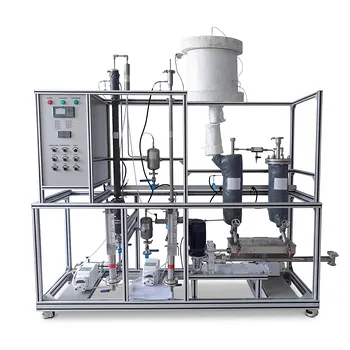
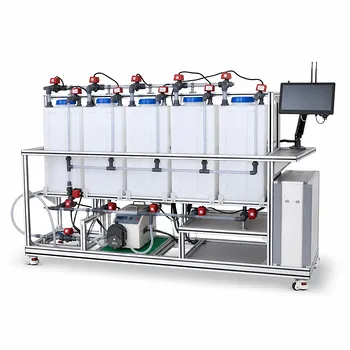
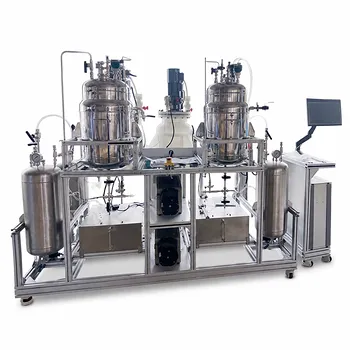
The hands-on laboratory environment of a chemical engineering pilot plant provides the definitive bridge between textbook equations and industrial reality. With these scaled-down systems, students, engineers, and researchers can physically manipulate recycle loops, vary bypass fractions, measure real-time stream compositions, and directly calculate critical performance metrics such as single-pass and overall conversion. This immediate feedback transforms abstract material balances into tangible, cause-and-effect learning experiences that demonstrate precisely how recycling unreacted materials conserves resources and how bypassing modulates final product properties.
Recycling and bypassing are not just flow-sheet symbols; they are dynamic control strategies that dictate process economics, yield, and safety. Educational pilot plants allow users to isolate these strategies, run purposeful experiments, and validate theoretical models against physical measurements, turning qualitative understanding into quantitative mastery.
Building the Bridge from Lecture Hall to Plant Floor
Textbooks present recycling and bypassing as algebraic exercises—a set of equations tied to a neat block diagram. The deep need of any learner or researcher is to feel the operational consequences of these choices. Educational pilot plants fill that gap by making the process physical.
A Living Flow Sheet Under Your Control
These units are fully instrumented, modular systems that replicate industrial unit operations at a safe, manageable scale. Instead of solving a homework problem on paper, you actually open a valve to send a portion of the reactor effluent back to the feed.
This lets you observe how the entire system re-stabilizes. Real-time temperature, pressure, flow, and composition sensors capture the transient behavior that static calculations predict but never truly convey. The experience ingrains the “why” behind each process decision.
From Single Components to Integrated Processes
The primary reference emphasizes that pilot plants are used to study the reasons for recycling, including catalyst recovery, dilution of a process stream, control of process variables, and circulation of working fluids. Supplementary references add real-world complexity: they speak of recovering unreacted raw materials, solvents, or catalysts from a separation stage and redirecting them to the reactor.
In a single coordinated setup, you can demonstrate a full benzene hydrogenation loop—measuring feed rates and recycle flow rates, calculating the recycle ratio, and watching how that ratio shifts conversion and product purity. This integration shows that recycling is never an isolated tactic; it’s a lever that influences every downstream vessel.
Demonstrating the Power of Recycling
The core practical benefit of recycling is maximizing raw material utilization while avoiding waste. Educational pilot plants make this benefit visible and measurable.
Turning Incomplete Reactions into Near-Complete Recovery
Chemical reactions rarely proceed to 100% completion in a single pass. The primary reference clearly states that unreacted reactants must be separated from the product and returned to the reactor to minimize raw material waste. In a pilot plant, you physically separate that unreacted stream using a small distillation column or membrane unit and pipe it back.
You then sample the feed, the reactor inlet, and the final product stream. The numbers you collect allow you to compute two critical conversion measures that quantify exactly how effective recycling is.
Key Calculations: Single-Pass vs. Overall Conversion
These two formulas are the mathematical heart of any recycle analysis. Pilot plants let you collect the exact data required to plug into them, turning them from textbook abstractions into living performance indicators.
- Overall conversion = (Reactant input to the process – Reactant output from the process) / Reactant input to the process.
- Single-pass conversion = (Reactant input to the reactor – Reactant output from the reactor) / Reactant input to the reactor.
Because the pilot plant has sampling ports at the fresh feed inlet, the combined reactor feed (fresh + recycle), the reactor outlet, and the final product, you can compute both numbers simultaneously. Seeing that overall conversion can approach 95% while single-pass conversion sits at 30% immediately justifies the capital and energy costs of the recycle loop.
Closing the Solvent and Catalyst Loop
Recycling is not limited to reactants. Many pilot plants incorporate solvent recovery loops. You can demonstrate how reusing a carrier fluid saves money and reduces environmental footprint.
In catalyst studies, the pilot system can include a solids separation step to return active catalyst particles to the reactor. Observing the sustained reaction rate compared to a once-through run proves the value of catalyst recovery directly—a concept far more persuasive than any spreadsheet.
The Bypass Valve: A Direct Control Tool
While recycling recycles material backward, bypassing selectively sends a portion of the inlet stream around a process unit and re-mixes it downstream. The primary reference highlights that students can manipulate bypass streams to observe how they affect overall system variables and output concentrations.
Modulating Final Specifications Without Over-Processing
Picture a heat exchanger designed to cool a product stream to a precise temperature. Instead of trying to fine-tune the exchanger itself, you can bypass a fraction of the hot feed around it and blend it with the cooled output. This instantly gives you temperature control with a simple hand valve.
In a pilot plant, you can log inlet temperature, bypass fraction, exchanger outlet temperature, and final blend temperature. The resulting data set demonstrates the elegance of bypassing as a fast, low-cost control strategy—perfect for applications like maintaining a specific concentration or preventing freeze-up in a chiller.
A Concrete Introduction to Process Intensification Concepts
The supplementary materials mention process intensification with microreactors and compact heat exchangers. Bypassing also finds a subtle, yet powerful role here. By demonstrating how a bypass stream helps shell-and-tube exchangers avoid pressure-drop penalties or how it can protect a sensitive monolithic reactor from feed surges, you connect a simple valve operation to advanced design philosophy.
Addressing the Hidden Challenge: Inert Build-up and Purging
A recycle loop can become its own worst enemy if inert components accumulate. The supplementary reference on continuous reactor pilot plants describes this vividly: integrating a recycle loop with a variable purge valve allows students to see the real-time build-up of inerts and learn the economic trade-off.
The Invisible Thief of Reaction Kinetics
In a process that uses air as a reactant or contains a minor feed impurity, nitrogen or other inerts enter the system. Without an exit, they concentrate in the loop, diluting reactants and degrading kinetics. You won’t see this effect clearly in a single-pass theoretical example.
On the pilot unit, you can close the purge valve and watch—in real time—as inert concentration rises on the gas analyzer while conversion steadily drops. Re-opening it incrementally restores performance, visually teaching the concept of a purge-to-recycle ratio.
The Tearing Method Comes to Life
Physically measuring a recycle stream allows students to tackle the inherent complexity of recycle-loop mass balances. The supplementary references recommend the tearing (iteration) method and simultaneous equations. After taking physical samples, students can perform the calculations on paper or in a simulator and compare their results with the actual measurements.
When the first guessed recycle composition doesn’t match the measured value, they iterate. The physical plant validates their final solution far more convincingly than any stated answer key. It embeds the practical reality that a recycle stream’s composition is not an input but a dependent variable of the entire process.
Understanding the Trade-offs
Educational pilot plants are not perfect mirrors of full-scale economics, and it’s crucial to teach the limitations.
Capital vs. Operating Cost Blurring
At pilot scale, the incremental cost of adding a recycle line or an extra separation step is negligible compared to an industrial plant. The calculated “savings” from recycling can seem disproportionately large.
A responsible learning module must pair the technical demonstration with a scaling discussion: utility consumption, pump energy, and column size must be estimated for a production facility. The supplementary reference on by-product recovery economic evaluation reinforces this—determining whether net revenue covers extra processing costs is a separate, essential exercise.
Instrumentation Gaps and Measurement Errors
Inline sensors provide excellent real-time data, but students must also learn to account for sensor drift, dead volume, and calibration errors. A small flow meter deviation can cascade into a significant mass balance closure error.
Using redundant measurements (e.g., weight loss from a feed tank to verify total feed) and performing a component material balance closure as an experiment in itself builds a deep appreciation for data quality.
The Oversimplified Bypass
While bypassing is elegant, its educational demonstration can inadvertently suggest it is a panacea. It is vital to show that bypassing a reactor completely, for instance, sends unreacted material to product, potentially creating a safety or specification failure. The pilot plant should be used to demonstrate both the control opportunity and the associated risk.
Making the Right Choice for Your Learning or Research Goal
The versatility of a pilot plant means you can tailor experiments precisely to your educational objective. Here’s how to focus your approach.
- If your primary focus is teaching core reaction engineering: Structure the lab around measuring single-pass and overall conversion under varying recycle ratios. Make students hand-plot conversion versus recycle ratio and explain the asymptotic benefit, reinforcing why practical loops are designed around an optimum, not an infinite return.
- If your primary focus is demonstrating sustainable design and economic feasibility: Add an energy integration layer. Combine the recycle study with heat exchanger measurements to show how hot recycle streams pre-heat the feed, then use utility meters to quantify avoided external heating. Extend the lesson by estimating the annual savings for a scaled-up plant.
- If you want to bridge simulation models with real-world data: Task students with modeling the pilot plant in a process simulator first, then running the physical experiment. They must reconcile their simulated predictions (using ideal thermodynamic models) with the live data, discussing deviations caused by non-idealities and validating their simulation’s value as a design tool.
- If your aim is to address inert management and safety: Design an experiment with a nitrogen-rich feed to force inert accumulation. Have students measure the falling reaction rate, calculate the required purge flow from a mass balance on the inert component, implement it, and verify the system’s return to stable operation. This directly demonstrates the balance between material conservation and kinetic performance.
By deliberately choosing a single, clear learning objective for each session, you unlock the pilot plant’s full potential as an unmatched tool for turning abstract conservation laws into an engineer’s intuitive judgment.
Summary Table:
| Concept | Practical Benefit | Key Calculations & Measurements |
|---|---|---|
| Recycling | Maximizes raw material use; recovers catalysts/solvents | Overall & single-pass conversion; recycle ratio |
| Bypassing | Provides rapid, low-cost control of product specs | Blend temperature/concentration; bypass fraction |
| Purging | Prevents inert build-up; maintains reaction kinetics | Purge-to-recycle ratio; inert concentration trends |
Bring Textbook Equations to Life with LABPARK
Are you looking to bridge the gap between process theory and industrial reality for your students or researchers?
LABPARK provides state-of-the-art Educational and Vocational Unit Operations Pilot Plants in chemical engineering, bioprocess & biotech, and environmental & water treatment. Designed specifically for universities, research institutes, and enterprises, our pilot plants empower users to:
- Physically manipulate recycle loops and bypass fractions to see real-time system responses.
- Accurately measure stream compositions and calculate single-pass vs. overall conversion.
- Train the next generation of engineers on sustainable design, inert purging, and process control.
Ready to upgrade your laboratory? Contact LABPARK today to request a customized quote or consult with our technical experts!
Related Products
- Multi-Reactor Educational Pilot Plant for Reaction Engineering Unit Operations
- Multi-Functional Special Distillation Educational Pilot Plant
- Fixed Bed Gas Solid Catalytic Reaction Educational Pilot Plant
- Carbon Dioxide Hydrogen Methanol Synthesis Educational Unit Operations Pilot Plant
- Fixed-Bed Chemical Reaction and Gas Dust Tar Removal Unit Operations Pilot Plant
People Also Ask
- How do educational unit operations pilot plants address safety and waste management when scaling up?
- How do educational unit operations pilot plants bridge theory and design? Bridge the Engineering Gap
- Why Compare Predicted and Experimental Excess Enthalpy? Key to Accurate Pilot Plant Scale-up
- Why Use PTFE & Hastelloy in Chemical Pilot Plants? Prevent Corrosion & Ensure Safety
- How to study gasification in pilot plants? Compare exit gas composition & efficiency