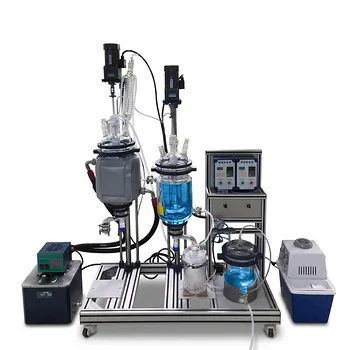
Defining the safe operating window for industrial crystallization begins in a pilot plant, where the Metastable Zone Width (MSZW) is experimentally mapped. Researchers utilize pilot-scale crystallizers to determine this critical boundary by precisely controlling cooling rates or holding solutions at controlled supersaturations, then detecting the exact moment nucleation begins—most often with turbidity probes, concentration sensors, or laser scattering. The resulting MSZW data directly answers the central design question: how far can you push supersaturation to drive growth without crashing into uncontrolled, crystal-showering primary nucleation?
While many view MSZW only as a laboratory curiosity, its practical power lies in defining the process’s safe supersaturation ceiling. By pinpointing the metastable limit experimentally, engineers gain a quantitative map to maximize crystal growth rates and yield while safeguarding product purity and size distribution against the chaos of spontaneous nucleation.
How Pilot Plants Measure the Metastable Zone Width
Pilot-scale crystallizers provide the controlled environment—precision temperature manipulation, real-time particle detection, and representative mixing dynamics—needed to capture the delicate boundary between a steady supersaturated solution and the labile zone where rampant nucleation erupts. Two core experimental methods dominate, each suited to different crystallization modes and process objectives.
The Cooling Rate Method: Mapping Temperature Against Kinetics
This method directly mimics a cooling crystallization cycle. A saturated solution is cooled at multiple constant rates (e.g., 0.1, 0.25, 0.5, 0.75, and 1 °C/min) while a turbidity sensor or conductivity probe monitors for the first sign of particle formation.
At each cooling rate, the temperature at which crystals appear is recorded. Faster cooling consistently forces nucleation to occur at a lower temperature—the system overshoots the true equilibrium limit. By plotting these crystallization temperatures against the corresponding linear cooling rates and extrapolating the trend to a zero cooling rate (infinite slow cooling), the actual metastable limit temperature is revealed. The vertical distance between the solubility curve and this extrapolated curve defines the MSZW for that system and recipe.
The Nucleation Induction Time Method: Probing Time at Fixed Supersaturation
Unlike the cooling rate approach, this method works with any crystallization mode—cooling, antisolvent addition, reactive, or evaporative. A saturated solution is rapidly brought to a specific target supersaturation (e.g., by a quick temperature drop or solvent shift) and then held isothermally while the time to first crystal detection, the induction time, is measured.
Repeating the experiment at several supersaturation levels produces a plot of induction time against supersaturation. The curve typically shows a steep asymptote at a particular supersaturation: beyond this threshold, induction times become impractically short. That asymptote marks the metastable limit, pinpointing the maximum supersaturation the solution can tolerate before primary nucleation becomes instantaneous and uncontrollable.
Laser Scattering for Instantaneous Nucleation Detection
Accurate MSZW determination hinges on detecting nuclei the moment they form, and direct laser scattering offers a highly sensitive, unambiguous approach. A Helium-Neon laser beam passes through the crystallizing solution; as soon as nanoscopic crystal nuclei appear, they scatter and diffract the light, causing a sharp drop in transmitted laser power.
Correlating this signal plunge with in-situ temperature or time yields a precise, observer‑independent measurement of the supersaturation limit. This optical method reduces the lag and subjectivity often associated with turbidity probes, making it a powerful complementary tool for both cooling rate and induction time experiments.
Why MSZW Is a Non-Negotiable Process Design Parameter
Knowing the metastable zone width transforms crystallization from an empirical art into a predictable, scalable unit operation. Its importance extends far beyond a single number—it defines the fundamental operating philosophy of the entire process.
Safeguarding Crystal Growth Against Uncontrolled Primary Nucleation
Primary nucleation in the labile zone is indiscriminate: it spawns a massive population of minuscule crystals almost instantly, a phenomenon known as crystal showering. This floods the downstream system with fine particles that filter poorly, occlude impurities, and ruin size distribution.
By deliberately operating inside the metastable zone—where the solution is supersaturated but primary nucleation is kinetically inhibited—you force crystal mass deposition onto existing seeds or secondary nuclei through controlled growth. The result is larger, more uniform crystals with inherently higher purity.
Defining the Maximum Allowable Supersaturation for Yield and Throughput
The MSZW essentially sets the process’s speed limit. A narrow metastable zone limits how much supersaturation you can generate in a single cooling step or antisolvent addition, which in turn caps the yield per cycle and dictates the number of stages or equipment size.
Conversely, a wider MSZW grants greater freedom to push supersaturation higher, accelerating growth kinetics and boosting throughput without risking nucleation events. By quantifying this width early in development, engineers can optimize the balance between cycle time, equipment cost, and product quality.
Enabling Robust Scale-up and Process Control
Pilot-plant MSZW data serves as the foundation for industrial control strategies. The measured metastable limit is translated into a supersaturation setpoint trajectory, often expressed as a constant supersaturation profile, that a plant-age control system follows in real time using feedback from concentration or crystal size monitors.
Without this experimentally validated window, scaling a crystallization step from grams to tons becomes a gamble. The margin for error in mixing intensity, heat transfer, and impurity profiles at large scale can easily breach the labile boundary unwittingly, leading to batch-to-batch variability and frequent quality failures.
Understanding the Trade-offs and Limitations
No single MSZW measurement captures the full reality of a real-world crystallizer. Recognizing the method’s limitations is essential for using the data intelligently.
Detection Sensitivity Defines the Apparent MSZW
The measured MSZW is not an absolute thermodynamic property—it is inherently dependent on the detection method’s sensitivity and response time. A turbidity probe that can sense 1-micron particles will report a wider MSZW than a technique that sees nanometer-scale nuclei earlier. Always cross-reference sensor specifications and, where possible, use orthogonal detection (e.g., laser scattering plus imaging) to confirm the onset point.
Impurities and Mixing Can Dramatically Shift the Boundary
Pilot-plant MSZW results are often acquired with high-purity reagents and ideal mixing conditions. In an industrial feed stream, trace impurities, side-products, or dissolved gases can narrow the metastable zone by catalyzing heterogeneous nucleation. Similarly, poor macro-mixing or dead zones at scale create localized high-supersaturation pockets that prematurely trigger nucleation, effectively eroding the safe window. Pilot studies designed to include realistic impurity levels and mixing variability are critical before finalizing a control strategy.
Scale Dependence of the Induction Time
Induction times measured in a small pilot vessel do not scale linearly. The probability of nucleation is volume-dependent; a larger crystallizer offers more potential nucleation sites, shortening the apparent induction time. The consequence: the metastable limit determined in a 1-liter reactor may not hold in a 10,000-liter vessel unless a rigorous scale-up methodology accounts for nucleation kinetics and mixing energy dissipation. Always validate the MSZW at a representative scale, or incorporate safety factors based on nucleation order.
Making the Right Choice for Your Goal
Effective use of pilot-plant MSZW data depends on what you are trying to achieve. Tailor your experimental approach and interpretation accordingly.
- If your primary focus is screening new molecules or solvent systems: Speed and material efficiency matter most. Use the cooling rate method with a sensitive laser scattering detector to rapidly map the approximate metastable zone across multiple conditions with minimal material consumption, then dive deeper into the most promising leads.
- If your primary focus is designing a robust industrial cooling crystallization: Prioritize the induction time method at several fixed supersaturations, and include realistic impurity spikes and seeding strategies. This data directly feeds into a control trajectory that keeps the process firmly within the growth-only window, even under scale-up variability.
- If your primary focus is troubleshooting an existing plant with fines or purity issues: Return to the pilot plant and recapture the MSZW using the plant’s actual feed solution and representative mixing conditions. The diagnostic value often lies not in the width itself but in whether real-world impurities or dead zones are dramatically narrowing it, pointing toward process cleaning or agitation upgrades rather than recipe changes.
The metastable zone is far more than a textbook concept—it's the tangible bridge between fundamental nucleation science and repeatable, profitable crystal manufacturing.
Summary Table:
| Method | Key Mechanism | Best Suited For |
|---|---|---|
| Cooling Rate Method | Monitors particle onset at varying constant cooling rates to extrapolate true solubility limits. | Cooling crystallization cycles & rapid solvent screening. |
| Nucleation Induction Time | Measures the time elapsed before crystallization occurs at a fixed supersaturation level. | Cooling, antisolvent, reactive, and evaporative crystallization. |
| Laser Scattering Detection | Detects light diffraction from nanoscopic nuclei instantly, reducing human error. | High-sensitivity, real-time detection in both cooling and induction tests. |
Optimize Your Crystallization Process Scale-Up with LABPARK
Ready to master crystallization kinetics and bridge the gap between laboratory research and industrial-scale production? LABPARK offers advanced Educational and Vocational Unit Operations Pilot Plants in chemical engineering, bioprocess & biotech, and environmental & water treatment.
Tailored for universities, research institutes, and enterprises, our pilot plants empower you to accurately determine MSZW, optimize crystallization parameters, and train the next generation of process engineers.
Contact LABPARK today to discover how our pilot plant solutions can elevate your research, teaching, and process development capabilities!
Related Products
- Multi Functional Membrane Crystallization Educational Unit Operations Pilot Plant
- Potassium Salt Thermal Dissolution and Crystallization Separation Educational Unit Operations Pilot Plant
- Multi-Functional Special Distillation Educational Pilot Plant
- Ethyl Acetate Synthesis Unit Operations Pilot Plant for Practical Training
- Multi-Modal Distillation Unit Operations Training Pilot Plant
People Also Ask
- Control Crystallization Pilot Plant Secondary Nucleation: 4 Key Adjustments
- Why is precise temperature control critical in crystallization pilot plants? Key to Scale-Up Success
- What key factors should be considered when configuring a crystallization unit operations pilot plant?
- What are the benefits of integrating online PAT tools like ATR-FTIR into crystallization unit operations pilot plants?
- How to use crystallization pilot plant agitation speed to identify diffusion vs reaction growth?