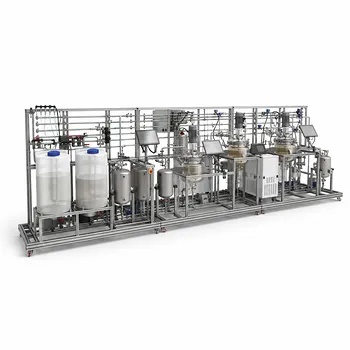
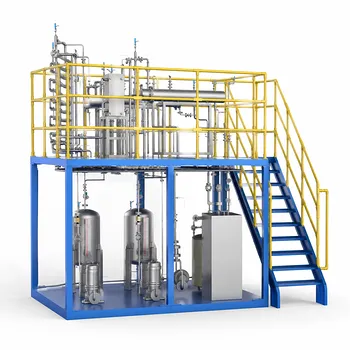
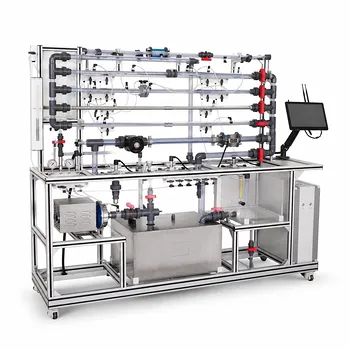
Waste isn't a byproduct of bad luck; it's a symptom of bad design. Chemical engineering and environmental unit operations pilot plants serve as the ultimate educational sandbox for teaching industrial waste minimization. They allow students and researchers to physically manipulate variables—temperature, pressure, catalyst selection, and recycle ratios—and directly observe the resulting reduction in effluent toxicity, volume, and energy consumption, moving the concept of waste prevention from an abstract moral imperative to a measurable engineering metric.
The core pedagogical value of a pilot plant lies in its ability to make waste visible and quantifiable. It transforms the abstract principle of "source reduction" into a hands-on challenge, where students learn that every unreacted molecule that exits a reactor or every joule of heat lost to the surroundings is not just an environmental liability but a direct financial loss and an engineering failure that can be corrected through fundamental unit operations.
From Theoretical Calculations to Physical Reality
Traditional coursework excels at teaching the thermodynamics and kinetics of a process but often fails to convey the integrated, messy reality of an industrial flow sheet. A pilot plant bridges this critical gap.
Why a P&ID on Paper Isn’t Enough
Paper-based designs often hide the routine inefficiencies that generate most waste. In a simulation, opening a valve is a frictionless event; in a pilot plant, a student feels the resistant pressure drop that indicates fouling or improper sizing.
These physical interactions force an immediate connection between engineering decisions and real-world consequences. A poorly placed temperature sensor can lead to a hot spot, which triggers a side reaction, which generates a kilogram of organic waste that a spreadsheet might never have predicted.
Quantifying the Invisible With E-Factors
Pilot plants enable the practical application of green chemistry metrics, most notably the E-factor. The E-factor, calculated as the ratio of total waste mass to desired product mass, becomes a visceral scorecard for a student’s operational choices.
By running a traditional Lewis-acid-catalyzed reaction, a student will physically collect kilograms of aqueous salt waste from a neutralization step. Switching the same process to a solid zeolite catalyst in the pilot reactor and re-running the mass balance allows them to isolate and weigh a reduction in aqueous waste from kilograms down to mere grams per kilogram of product—a powerful, practical lesson in catalysis and wastewater minimization.
The Three Pillars of Pilot Plant Pedagogy
A well-designed educational pilot plant teaches waste minimization through three distinct but interconnected strategies: modifying the inputs, controlling the reaction environment, and redesigning the downstream logic.
Source Reduction: Preventing Waste Before It Begins
The most elegant solvent recovery system is the one you never have to build. Source reduction focuses on eliminating waste at the origin, and pilot plants provide the safe, low-risk environment needed to test radical upstream changes.
Students can experiment by modifying inputs that are often locked in at full scale. They can introduce feed purification units—such as a simple guard bed or a small distillation column upstream of the reactor—to strip out impurities that cause side reactions. By comparing the reactor’s selectivity with and without purified feed, they directly measure how upstream purity dictates downstream sludge.
Process Optimization: Tuning the Core Reaction
Waste minimization isn't stationary; it’s a dynamic response to operational discipline. In a pilot plant, a reactor is not a black box but a transparent system of glass and stainless steel where students can manipulate dependent processing steps.
They learn to use advanced process control to hunt for the "sweet spot" of temperature and residence time where byproduct formation is minimized. Testing alternative feedstocks or novel catalysts becomes a safe, data-driven exercise. A student can observe how a slight drop in hot-spot temperature eliminates the thermal degradation of a solvent, a change that directly prevents the creation of a hazardous tar-like waste that would otherwise require expensive incineration.
Recycling and Segregation: Redefining the "End" of the Pipe
The traditional concept of "end-of-pipe treatment" is re-engineered into "in-process recovery." Pilot plant units like distillation columns and liquid-liquid extraction columns are not treatment devices; they are separation profit centers placed directly in the process loop.
A critical lesson here is the "purity vs. energy" trade-off. Students can set up a continuous distillation unit to recover spent solvent and then manipulate the reflux ratio. They visually see that pushing for 99.99% purity generates a logarithmic increase in energy consumption and greenhouse gas emissions. This teaches the design principle of "good enough" separation for direct reuse, and it demonstrates how minimizing the diversity of solvents in a process radically simplifies the entire recovery loop.
Understanding the Trade-offs and Pitfalls
While pilot plants are transformative educational tools, their value is lost if the curriculum ignores the inherent tensions and practical problems of scale-up. This objectivity is essential for building real expertise.
The Energy Blind Spot
The most common student mistake is optimizing for mass waste reduction while ignoring the energy debt. A perfectly separated solvent loop that eliminates liquid waste but requires triple the energy input for reboiling has arguably worsened the environmental impact. Pilot plants equipped with heat exchangers and evaporators make this visible; a student can use pinch analysis on the physical unit, measuring how a clever heat integration strategy—using hot bottoms to preheat the cold feed—can decouple purity goals from energy addiction.
Catalyst Deactivation and Immobilized Waste
Even catalytic routes create waste, just in a more concentrated form. While solid zeolites eliminate the aqueous salt crisis, they eventually deactivate. A pilot plant setup with adsorbent guards upstream of the catalyst bed allows students to study how protecting catalysts from poisons extends their life, directly minimizing the solid waste footprint of the spent catalyst material itself.
The Scale-Up Disconnect
A perfectly optimized pilot plant does not guarantee a stoppage-free industrial plant. The fluid dynamics in a 1-inch diameter tube are fundamentally different from those in a large-scale facility. Educators must use pilot plant data to teach the existence of dimensionless numbers and scaling laws, ensuring that students understand why a perfect recycle loop on the bench might fail catastrophically in a plant due to the accumulation of trace impurities that don't show up in a short, lab-scale test run.
Making the Right Choice for Your Educational Goal
The design of your pilot plant experiment must align with the specific engineering instinct you want to build. A single pilot plant can be configured to emphasize different facets of the waste hierarchy.
- If your primary focus is green chemistry and molecular design: Prioritize reactor setups where you can swap between homogeneous and heterogeneous catalysts. Have students physically collect and weigh the precipitated salts versus the clean separated product to make the E-factor tangible.
- If your primary focus is industrial process engineering and energy management: Use an interconnected network of a reactor, a distillation column, and a heat exchanger. The core exercise should be a heat integration experiment where students measure the energy lost in the condenser and redirect it to preheat the reactor feed.
- If your primary focus is environmental compliance and wastewater treatment: Focus on separation unit operations like extraction or stripping. The objective is to show how moving a separation unit from the very end of the pipe to a point preceding the biological treatment plant concentrates the toxic load into a small, recoverable stream rather than diluting it into a large, unmanageable one.
A chemical engineering pilot plant turns waste from an unfortunate statistic into a tangible design flaw. This direct, physical feedback system doesn't just teach engineers how to minimize waste; it hardwires the instinct that a liter of solvent never purchased is superior to a million liters perfectly recycled.
Summary Table:
| Strategy | Focus Area | Key Educational Lesson |
|---|---|---|
| Source Reduction | Upstream feed & inputs | Preventing waste at the origin through purification and catalyst selection |
| Process Optimization | Core reaction control | Balancing temperature, pressure, and residence time to minimize byproducts |
| Recycling & Segregation | Downstream loops | Managing the critical trade-offs between solvent purity and energy consumption |
Equip Your Lab for Hands-On Environmental & Process Training
LABPARK provides premium Educational and Vocational Unit Operations Pilot Plants in chemical engineering, bioprocess & biotech, and environmental & water treatment. Designed specifically for universities, research institutes, and enterprises, our systems make complex concepts like waste minimization, E-factors, and energy integration tangible.
Help your students and researchers master real-world process optimization. Contact the LABPARK team today to discuss your custom laboratory and pilot plant requirements!
Related Products
- General Purpose Cosmetics Production Unit Operations Training Pilot Plant
- Multi Pump Fluid Transport Process Piping Unit Operations Training Pilot Plant
- Multi-Functional Drying Educational Unit Operations Pilot Plant
- Fixed-Bed Chemical Reaction and Gas Dust Tar Removal Unit Operations Pilot Plant
- 100L Continuous Loop Hydrogenation Educational Unit Operations Pilot Plant
People Also Ask
- How do deviations in estimating latent heat impact pilot plant thermal systems? Avoid hardware mis-sizing.
- Why is the chemical plant startup schedule crucial? De-risk scale-up with pilot plants.
- When to transition from PID to adaptive control in pilot plants? Key process indicators.
- Why Compare Predicted and Experimental Excess Enthalpy? Key to Accurate Pilot Plant Scale-up
- How to study gasification in pilot plants? Compare exit gas composition & efficiency