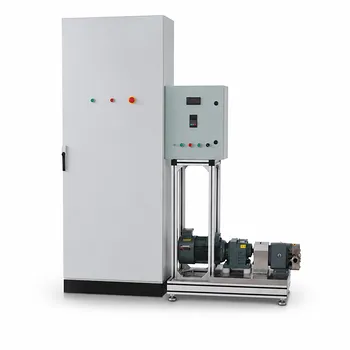
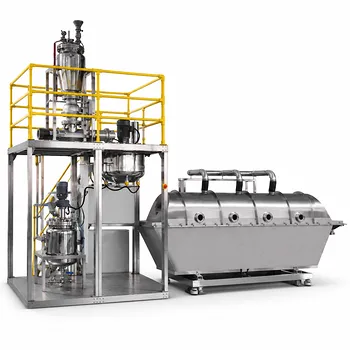
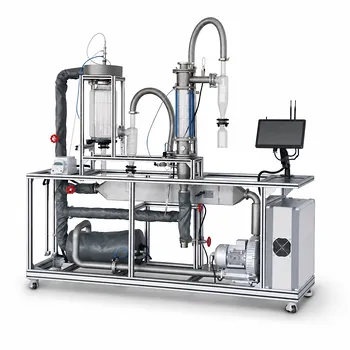
A well-designed educational bioprocess pilot plant for multi-stage extraction and purification must integrate a sequence of modular, visually accessible unit operations. The configuration typically starts with a fermentation vessel, followed by cell harvesting, a multi-stage liquid-liquid extraction cascade to transfer the product into a solvent, a vacuum evaporator for concentration and solvent recovery, and finally a glass chromatography column for polishing. By connecting these steps, students can observe and control each separation mechanism firsthand, moving beyond theory to practical, measurable operation.
To teach effective multi-stage extraction and purification, the pilot plant must do more than just provide hardware—it must let students visualize interphase contact, quantify mass transfer, and troubleshoot real separation challenges. The key is designing a flexible, instrumented train that mirrors industrial logic while remaining safe, transparent, and instructively decomposable.
Core Modules for a Fermentation-Derived Product Separation Train
The Bioreactor and Harvesting: Setting the Foundation
Start with a stirred-tank bioreactor that demonstrates aerobic fermentation under controlled pH, temperature, and dissolved oxygen.
This vessel not only produces the target compound but also serves as a platform to explore microbial kinetics—an invaluable bonus for integrated curricula.
After fermentation, the broth must be clarified. A small disk-stack centrifuge or a tangential-flow filtration unit shows real-world cell removal, teaching the impact of cell debris on subsequent extraction efficiency.
Multi-Stage Liquid-Liquid Extraction: The Heart of the Process
The core teaching opportunity lies in configuring a countercurrent extraction cascade.
A simple yet powerful educational setup uses three to five glass mixer-settler stages connected in series, with the heavy and light phases fed from opposite ends.
Each stage contains a mixing chamber and a gravity-settling zone, making interphase mass transfer visible. Students can sample both outlet phases, measure concentrations, and calculate stage efficiency and theoretical stage requirements using the McCabe–Thiele or Kremser method.
For intracellular products, a solid-liquid extraction vessel—equipped with a stirrer and filtration mesh—replaces the mixer-settler, demonstrating leaching and diffusional mass transfer after cell disruption.
Solvent Evaporation and Concentration: Bridging to Purification
After extraction, the product-rich solvent stream needs concentration.
A rotary evaporator or a wiped-film evaporator operated under vacuum permits students to observe the effect of reduced pressure on boiling point and to collect the recovered solvent for reuse.
This step reinforces vapor-liquid equilibrium principles and energy efficiency, while sampling the concentrate lets students quantify enrichment before final polishing.
Polishing via Adsorption Chromatography: The Final Touch
A glass column packed with silica gel or alumina provides a visually engaging purification finale.
Students load the concentrated extract and watch the separation of colored bands under gravity or low-pressure flow.
By collecting fractions and analyzing them (e.g., with UV spectroscopy or thin-layer chromatography), they witness the resolution of closely related impurities and link adsorption isotherms to practical plate-height concepts.
Understanding the Trade-offs in an Educational Setup
Batch vs. Continuous Operation
A fully continuous train mirrors industry but dramatically increases complexity and cost.
For most teaching labs, operating each module in batch or semi-batch mode, with holding tanks between steps, is more practical. Students can debug and characterize each unit independently before confronting integration challenges, deepening their understanding.
Glass vs. Stainless Steel Construction
Glass components offer unmatched visualization—critical for teaching phase behavior, emulsion formation, and bed compaction.
Industrial stainless steel is robust but opaque. A design using glass columns, mixer-settlers, and carefully shielded tubing strikes the best balance between visible learning and operational safety.
Solvent Selection and Safety Hazards
Multi-stage extraction often uses organic solvents (ethyl acetate, methyl isobutyl ketone, etc.), which introduce flammability and health risks.
The plant must include explosion-proof ventilation, secondary containment, and rigorous protocols. Using a benign model system (e.g., separating aqueous acetone from toluene) can mitigate risks while still demonstrating key principles.
Instrumentation and Process Control Overhead
Equipping each unit with temperature, pressure, flow, and level sensors significantly enhances educational value—enabling data logging and closed-loop control experiments.
However, this added complexity demands maintenance and can overwhelm novices. A staged approach, starting with manual operation and gradually layering on instrumentation, works best for diverse student levels.
Making the Right Choice for Your Educational Goals
- If your primary focus is teaching equilibrium-stage calculations: Build a dedicated liquid-liquid extraction train with at least three glass mixer-settlers and integrated sampling ports. Use a simple, safe solute-solvent pair to emphasize data analysis.
- If your primary focus is providing an end-to-end bioprocess experience: Include all modules—bioreactor, centrifuge, extraction cascade, evaporator, and chromatography column—and run a complete fermentation-to-purification sequence over multiple lab sessions.
- If your primary focus is preparing students for industrial automation: Instrument the extraction and evaporation units with digital sensors and connect them to a process control system, enabling experiments with PID loops and real-time trend monitoring.
- If your primary focus is safety and scalability: Invest in a plant that combines glass columns with pressure-rated stainless steel vessels, and add a solvent distillation loop to demonstrate closed-cycle solvent recovery.
By thoughtfully configuring the pilot plant around your teaching objectives, you transform a collection of hardware into a powerful discovery platform where separation phenomena become visible, measurable, and undeniably real.
Summary Table:
| Module | Core Function | Educational & Practical Value |
|---|---|---|
| Bioreactor & Harvesting | Cell cultivation & clarification | Teaches fermentation kinetics and centrifugal/filtration separation. |
| Mixer-Settler Cascade | Countercurrent liquid-liquid extraction | Visualizes mass transfer; enables stage efficiency calculations. |
| Evaporator (Vacuum) | Solvent concentration & recovery | Demonstrates vapor-liquid equilibrium (VLE) and energy recycling. |
| Chromatography Column | Final product polishing | Explains adsorption isotherms and resolution of close impurities. |
Bring Industrial-Scale Learning to Your Laboratory
Ready to equip your students and researchers with hands-on, practical engineering skills?
LABPARK designs and manufactures high-quality Educational and Vocational Unit Operations Pilot Plants in chemical engineering, bioprocess & biotech, and environmental & water treatment. Tailored specifically for universities, research institutes, and enterprises, our modular systems offer the perfect balance of safety, visibility, and industrial accuracy.
Take your bioprocess curriculum to the next level—contact LABPARK today to request a customized configuration design!
Related Products
- Multi-Reactor Educational Pilot Plant for Reaction Engineering Unit Operations
- Educational Unit Operations Pilot Plant for Intraparticle Diffusion Effective Factor Measurement
- Bio-fermentation Ethanol Production Practical Training Unit Operations Pilot Plant
- Multi-Functional Membrane Separation Educational Pilot Plant for Unit Operations Lab
- Quantitative Dosing and Liquid Flow Control Educational Unit Operations Pilot Plant
People Also Ask
- How do educational unit operations pilot plants address safety and waste management when scaling up?
- How do educational unit operations pilot plants bridge theory and design? Bridge the Engineering Gap
- Why Compare Predicted and Experimental Excess Enthalpy? Key to Accurate Pilot Plant Scale-up
- How to study gasification in pilot plants? Compare exit gas composition & efficiency
- Why Use PTFE & Hastelloy in Chemical Pilot Plants? Prevent Corrosion & Ensure Safety